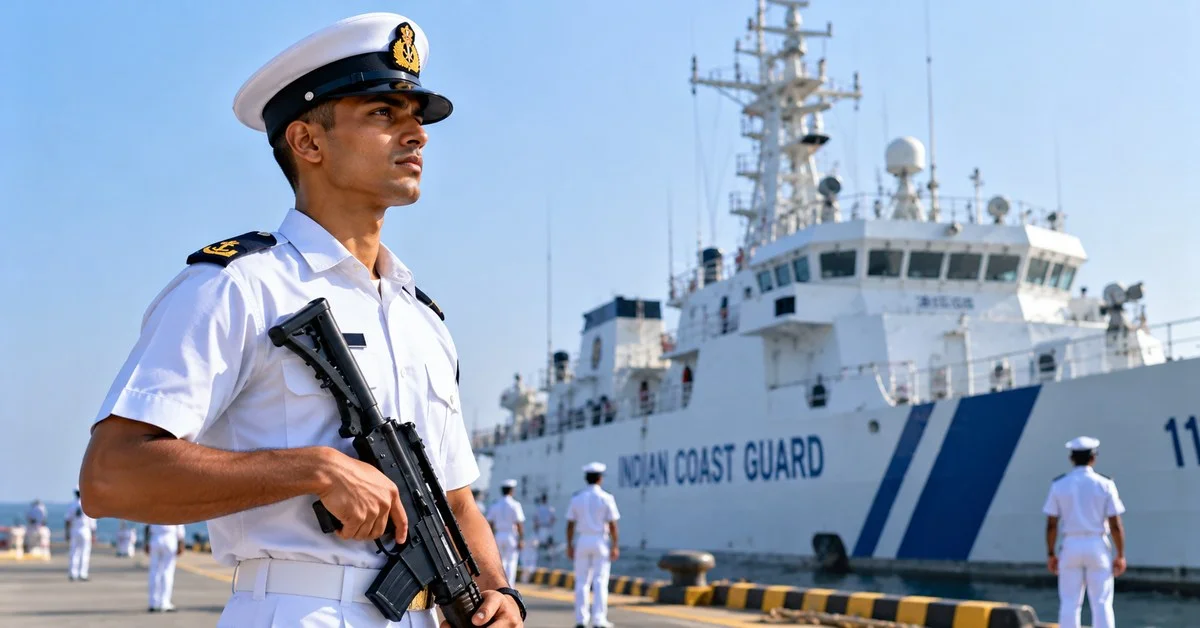
Coast Guard Navik GD Physical Test 2026-27: Running, Push-ups, Squats and Sit-ups
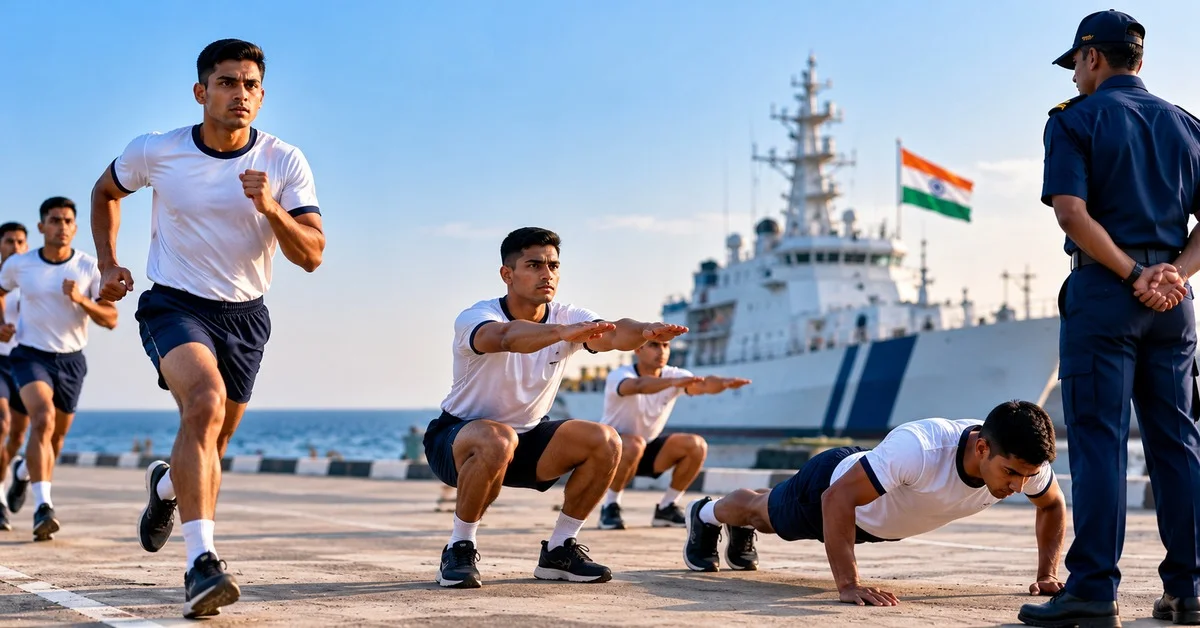
The Coast Guard Navik GD PFT has four events done back to back without a break: a 1.6 km run, squats, push-ups and bent-knee sit-ups. This guide gives the official standards for men and women, how Stage II works, and an 8-week training plan.
Many candidates who clear the written exam are stopped at the physical test, not because they areunfit, but because they trained for the wrong standard. The Coast Guard Navik GD physical test has four events done back to back, and any break in between means failing. This guide gives the official standards from the CGEPT 01/2027 and 02/2027 notice, explains where the PFT fits in the selection process, and shares an 8-week training plan.
Applications for CGEPT 01/2027 and 02/2027 ran from 6 to 21 October 2026 on ssc.gov.in. Stage I is tentatively in early or mid November 2026, and Stage II at the end of February 2027. If you are preparing for a future batch, expect the standards to be similar, but confirm them in that notice.
What Is the Coast Guard Navik GD PFT?
The Physical Fitness Test (PFT) is part of Stage II, which is held at Indian Coast Guard recruitment centres for candidates shortlisted after the Stage I computer-based exam. Stage II lasts one to two days and its tests are qualifying in nature: you pass or you are out. In order, Stage II covers:
- Identity and biometric verification
- Physical Fitness Test (PFT)
- Assessment and Adaptability Test
- Document verification
- Recruitment medical examination
The PFT is at your own risk, and you should carry sports gear such as shoes, a T-shirt and trousers.
Official PFT Standards
| Gender | 1.6 km run | Squats (uthak-baithak) | Push-ups | Bent-knee sit-ups |
|---|---|---|---|---|
| Male | 6 min 30 sec | 20 | 15 | 15 |
| Female | 8 min | 15 | 10 | 10 |
The most important rule is this: all four tests are carried out in continuity without any break, and any break leads to failure in the PFT. That means you can't rest between the run and the exercises, so train them as one block.
You may see websites quoting 7 minutes for the run, or 20 push-ups for everyone. Those figures don't match the official advertisement.
How Hard Is the Run?
A 6 minute 30 second 1.6 km works out to about 4 minutes 4 seconds per kilometre for men. Women's 8 minutes means about 5 minutes per kilometre. That is faster than casual jogging, and the real challenge is that the run is only the first event. You then have to do squats, push-ups and sit-ups with tired legs and a high heart rate.
The standards are different from other recruitments. For example, Army Agniveer runs are graded in time groups, so don't copy another force's standard. Train to the Coast Guard notice.
Squats, Push-ups and Sit-ups
After the run you move straight into the exercises. The notice lists them in this order: squats (uthak-baithak), push-ups, then bent-knee sit-ups. The counts are 20, 15 and 15 for men, and 15, 10 and 10 for women.
The notice doesn't describe the form rules in detail, but assessors will count only correct repetitions, so practise clean form:
- Squats: go down fully and stand up straight each time.
- Push-ups: keep the body straight, lower the chest properly and fully straighten your arms at the top.
- Bent-knee sit-ups: keep your knees bent, and come all the way up and down on each rep.
What Happens After the PFT?
Candidates who pass the PFT take an Assessment and Adaptability Test, which is online or OMR-based and only qualifying. Its marks are not part of the final merit list and are used only to break ties. Then come document verification and the recruitment medical. Merit is based on your Stage I marks, provided you qualify in every part of Stage II.
For the GD branch, the main medical standards include a minimum height of 157 cm for men and 152 cm for women, with relaxation for certain regions, and candidates who use glasses are not eligible. Check the notice for the full list.
8-Week Training Plan
This is a suggested plan, not an official one. Adjust it to your starting level and see a doctor if you have any health concerns.
- Weeks 1 and 2 (base): Run or brisk-walk 3 to 4 days a week, and build up to 1.6 km without stopping. Practise squats, push-ups and sit-ups in 3 sets, with perfect form.
- Weeks 3 and 4 (pace): Run 1.6 km twice a week, aiming for 7:30 to 8:00 for men. Add one interval day, such as 6 x 200 m fast with short rests.
- Weeks 5 and 6 (continuity): Start doing the full sequence once a week: run 1.6 km, then straight into squats, push-ups and sit-ups without a break. Aim to finish the run under 7 minutes.
- Weeks 7 and 8 (test mode): Do the full sequence twice a week at test pace, targeting about 6 minutes for the run so that 6:30 feels comfortable. Keep one easy day and one complete rest day every week.
Sleep 7 to 8 hours, eat enough protein and carbohydrates, and avoid trying something new on test day.
Common Mistakes
- Starting the run too fast and slowing down badly in the last 400 metres.
- Training the run and exercises separately, then struggling to do them without a break.
- Skipping sit-ups, since many aspirants forget this fourth event.
- Following outdated standards, such as 7 minutes or 20 push-ups.
- Poor form, which can cost you valid repetitions.
FAQs
What are the PFT standards for Coast Guard Navik GD?
For male candidates, the standards are a 1.6 km run in 6 minutes 30 seconds, 20 squats (uthak-baithak), 15 push-ups and 15 bent-knee sit-ups. For female candidates, they are a 1.6 km run in 8 minutes, 15 squats, 10 push-ups and 10 bent-knee sit-ups.
Are the four PFT events done together?
Yes. The official notice says all four tests are carried out in continuity without any break, and any break in these tests leads to failure in the PFT. Train the four events back to back.
How fast do I need to run 1.6 km for the Navik GD PFT?
Male candidates must complete 1.6 km in 6 minutes 30 seconds, which is a pace of about 4 minutes 4 seconds per kilometre. Female candidates have 8 minutes, a pace of 5 minutes per kilometre.
What happens if I fail the PFT?
Stage II tests are qualifying in nature, so failing the PFT ends your candidature for that batch. Selection is valid only for the batch you applied for, so you must apply afresh in a future recruitment if you are still eligible.
What comes after the PFT in Stage II?
Candidates who qualify in the PFT take an online or OMR-based Assessment and Adaptability Test, which is qualifying only, followed by document verification and the recruitment medical. The assessment marks are used only to break ties in the merit list.
When is Stage II for CGEPT 01/2027?
The tentative schedule is Stage I in early or mid November 2026, Stage II at the end of February 2027, and Stage III in early May 2027. Date and centre for Stage II are allotted on a first-come, first-served basis after shortlisting, so check your login for updates.