Indian Army Training After Selection: Life Inside IMA Dehradun and OTA Chennai
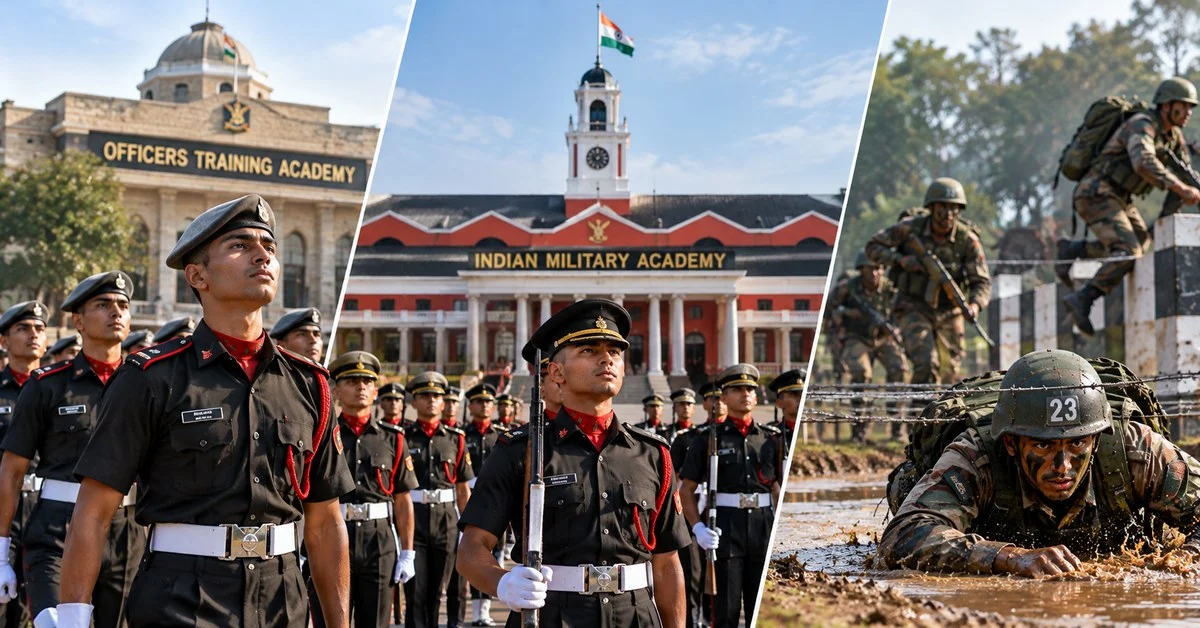
What happens after SSB? This guide covers IMA Dehradun training and OTA Chennai pre-commission training, including duration, entry routes, Permanent vs Short Service Commission, the daily cadet routine, curriculum and how to prepare physically.
Clearing the SSB interview is a significant milestone, but the real transformation begins the moment you walk through the gates of an academy. IMA Dehradun training and the pre-commission course at OTA Chennai are both designed to turn selected civilians into commissioned officers, yet the two institutions differ considerably in pace, duration, and the type of commission they award. If you want a realistic picture of what awaits you, this guide covers both academies with the specificity that official portals rarely provide, including what daily life as an IMA Dehradun cadet actually looks like.
Whether you entered through the NDA entry route, cracked the CDS exam, or cleared a technical entry, your academy experience will define the next several decades of your military career. Here is exactly what to expect.
IMA Dehradun vs OTA Chennai: Key Differences at a Glance
The most common confusion among aspirants is treating IMA and OTA as interchangeable. They are not. Each academy serves a different intake profile and produces officers under distinct service conditions, and that distinction matters when thinking about the daily routine of an IMA cadet or planning for pre-commission training in India.
According to the Indian Military Academy's official portal, IMA Dehradun grants a Permanent Commission to its graduates. Officers commissioned from IMA serve until the mandatory retirement age applicable to their rank. OTA Chennai, by contrast, awards a Short Service Commission, which runs for an initial period of 10 years, extendable to 14 years, with a structured option to convert to Permanent Commission based on vacancies and performance.
The IMA vs OTA difference in duration is substantial. An IMA cadet spends up to 18 months in training, while an OTA cadet completes the full course in approximately 49 weeks. Both academies maintain rigorous physical and academic standards, but the longer IMA tenure allows deeper immersion in military science and leadership theory, something that directly shapes the quality of pre-commission training India produces.
For aspirants still deciding between entry routes, the article on Indian Army vs Navy career paths after 12th on Defence Study provides additional context on how commission type affects long-term career trajectories.
Daily Routine of an IMA Cadet: From Reveille to Lights Out
The daily routine of an IMA cadet begins before most of the country is awake. Reveille sounds at 05:30 hours, and cadets are expected to be on the PT ground within minutes. There is no grace period and no negotiation. The academy's philosophy is straightforward: every minute of a cadet's day is structured with purpose, including the leadership exercises the academy builds into the afternoon schedule.
A typical weekday at IMA Dehradun follows this sequence:
-
05:30 - Reveille, personal hygiene, and room preparation
-
06:00 to 07:30 - Physical training, which rotates between cross-country runs, obstacle courses, and squad PT
-
07:30 to 08:30 - Bath, breakfast, and barrack inspection
-
08:30 to 13:00 - Academic instruction covering military history, map reading, weapons theory, and leadership studies
-
13:00 to 14:00 - Lunch and mandatory rest period
-
14:00 to 17:30 - Drill instruction, field craft, sports, or outdoor training
-
17:30 to 19:00 - Games period and personal time
-
19:00 to 21:00 - Dinner, followed by mandatory self-study hours
-
22:00 - Lights out
As documented in the detailed cadet life overview at Sids Defence, the structure leaves almost no unscheduled time during the first term. Senior terms earn minor privileges, but the core reveille military routine remains fixed throughout training.
The life at IMA Dehradun cadet experiences is built around controlled stress. Instructors deliberately overload schedules to test time management under fatigue, mirroring the operational demands officers will face in the field.
OTA Chennai Training: Schedule, Physical Demands and Academic Load
OTA Chennai pre-commission training runs for 49 weeks and is designed to produce combat-ready officers in a compressed timeline. The course is demanding precisely because it must achieve the same commissioning standard in significantly less time than IMA.
The physical fitness benchmarks at OTA are non-negotiable. Male cadets must complete a 5-kilometre run within a stipulated time, perform a minimum number of push-ups and pull-ups in each assessment, and clear the obstacle course to a defined standard. Female cadets follow a parallel assessment framework calibrated to the same principle of functional combat fitness.
OTA Chennai is also notable for being the first Indian Army academy to integrate male and female officer cadets within the same training environment. This shapes both the course design and the leadership dynamics within cadet companies.
The academic load at OTA mirrors IMA in subject coverage but condenses the timeline. Cadets study:
-
Military law and administration
-
Tactical and leadership theory
-
Map reading and terrain analysis
-
Weapons systems and handling procedures
-
Physical conditioning theory and first aid
Weekends at OTA are not rest days in the conventional sense. Saturday mornings typically involve drill parades or field exercises. Sundays offer limited personal time, but cadets are expected to use those hours for self-study and equipment maintenance. Candidates who arrive without a solid fitness base often struggle during the initial phase, and the pace does not ease up to accommodate them.
What the Curriculum Actually Covers: Drills, Weapons and Leadership
Indian Army officer cadet training across both academies is built on four interconnected pillars: physical conditioning, military skills, academic study, and character development. Knowing what each pillar contains helps aspirants prepare with precision rather than guesswork.
Drill instruction refers to the formal process of teaching cadets precise military movements, parade formations, and weapon handling in both ceremonial and tactical contexts. It is not ceremonial vanity. Drill builds the habit of executing instructions correctly under pressure, a habit that transfers directly to command situations in the field.
Weapons handling training covers the INSAS rifle, light machine guns, and grenade use. Cadets progress from classroom theory to dry firing to live range practice. Safety protocols are tested at every stage before live ammunition is introduced. Map reading military exercises are conducted both in the classroom and outdoors, where cadets navigate unfamiliar terrain using topographical maps and compasses without GPS assistance.
The combat tactics module introduces section-level attacks, ambush drills, and defensive position setting. Cadets learn to plan and execute small-unit operations under simulated enemy contact, with exercises escalating in complexity across terms. The final outdoor training camp serves as the capstone field assessment before commissioning.
Leadership exercises at the academy involve cadets rotating through command roles within their platoons. One cadet leads while others follow, then roles reverse. Assessors observe how each cadet performs under both authority and subordination, since effective officers must be competent in both positions.
The curriculum also includes military history, defence studies, and a module on the ethics of command. These academic components are examined formally, and cadets who score below the pass threshold are placed on academic review before being permitted to continue to the next term.
How to Prepare Before You Join: Physical and Mental Benchmarks
Preparation for pre-commission training in India should begin at least six months before the reporting date. The cadets who thrive in the first term are not necessarily the most talented. They are the most prepared.
The physical fitness benchmarks army academies apply are publicly documented. Use these as your training targets:
-
5 km run: Complete in under 24 minutes consistently before joining
-
Push-ups: Minimum 40 in two minutes, targeting 60 for a comfort margin
-
Pull-ups: Minimum 8 to 10 without rest
-
Obstacle course: Practise basic climbing, crawling, and balance drills
-
Swimming: Basic water confidence is assessed at both academies
Mental preparation follows its own structure. The academy environment involves sleep deprivation during field exercises, public evaluation in front of peers, and rapid task-switching under time pressure. Practising these conditions before joining, through camping, trekking, or competitive group sports, builds the resilience that helps cadets perform when the pressure is sustained rather than momentary.
Cadets who have already completed an SSB interview have been assessed on Officer Like Qualities. The academy does not reassess those qualities from scratch, but it does test whether they hold under prolonged physical and psychological load. A single day of high performance is not the standard. Forty-nine weeks or 18 months of consistent performance is what the training demands, and that gap between interview conditions and academy conditions is what separates candidates who prepared from those who assumed they were ready.
Read the comprehensive comparison of Indian Army careers on Defence Study to understand how your commission type will shape your long-term posting patterns and promotion timelines.
FAQs
What is the daily routine of a cadet at IMA Dehradun from wake-up to lights out?
Reveille sounds at 05:30. PT runs from 06:00 to 07:30, followed by breakfast and barrack inspection. Academic classes run from 08:30 to 13:00. The afternoon covers drill, field craft, and sports until 17:30. Self-study occupies 19:00 to 21:00, and lights out is at 22:00. Every hour is scheduled, with minimal discretionary time in junior terms.
What is the difference between IMA and OTA in terms of training duration and commission type?
IMA Dehradun training lasts 18 months for direct-entry cadets and grants a Permanent Commission. OTA Chennai runs for 49 weeks and awards a Short Service Commission, initially valid for 10 years with an option to extend. The IMA vs OTA difference in commission type significantly affects retirement age, promotion timelines, and long-term service conditions.
How tough is pre-commission training at OTA Chennai?
OTA Chennai pre-commission training is physically and academically demanding within a compressed 49-week window. Physical assessments are conducted regularly, and cadets who fall below benchmarks on running, strength, or obstacle courses face remedial training. The academic load runs concurrently, not sequentially, meaning field exercises and classroom examinations often occur in the same week.
What does the Indian Army officer cadet training curriculum include?
The curriculum covers drill instruction, weapons handling training, map reading military exercises, the combat tactics module, leadership exercises, outdoor training camps, military law, and defence studies. Physical conditioning runs in parallel throughout. Cadets are assessed formally on both written examinations and field performance before progressing between terms.
How do I physically prepare before joining IMA or OTA?
Start at least six months out. Build your 5-kilometre run time to under 24 minutes, reach 40 or more push-ups in two minutes, and work up to 8 to 10 pull-ups comfortably. Add obstacle course elements, swimming, and multi-day physical activities like trekking to develop stamina beyond single-session effort. The physical fitness benchmarks army academies use are consistent, so training against them directly is the most efficient approach.