India Nuclear Triad Explained: How Land, Air and Sea Forces Give India an Assured Second Strike
India can deliver nuclear weapons from land, air and sea. Here is how the India nuclear triad works, from Agni-V missiles to SSBNs like INS Arihant and the new INS Aridhaman, and why second-strike capability matters.
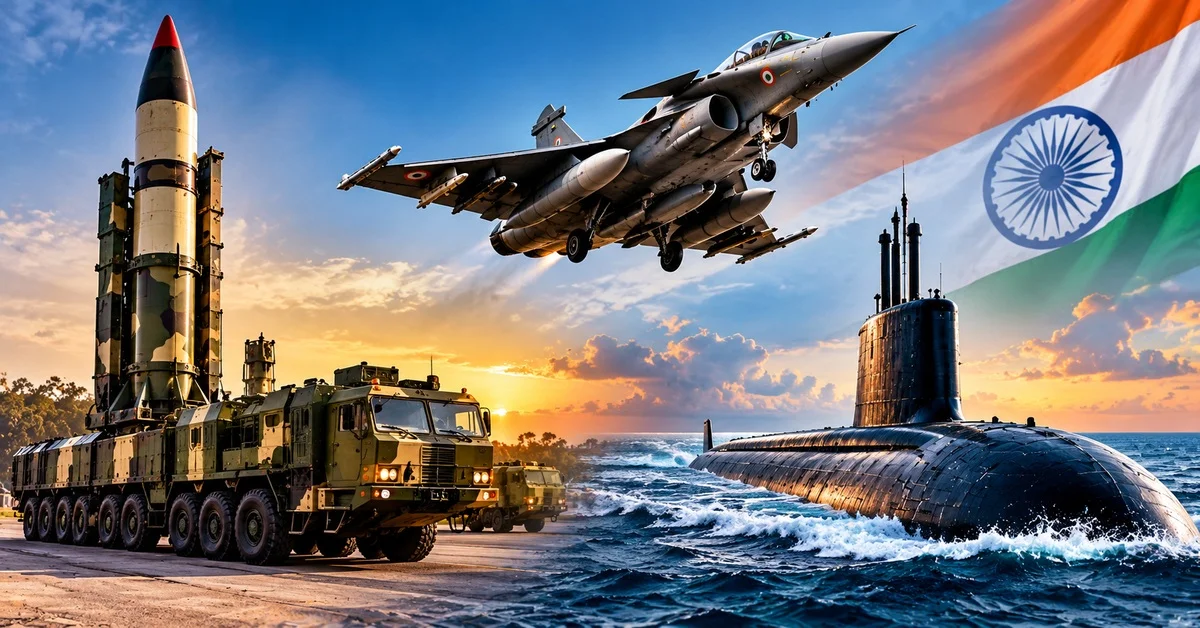
India is one of only a handful of countries that can deliver nuclear weapons from land, from the air and from under the sea. This three-part capability, known as a nuclear triad, has grown steadily stronger over the past decade. The commissioning of a third nuclear-powered ballistic missile submarine in 2026 added fresh weight to the sea leg.
The India nuclear triad is built for one purpose: to make sure that no adversary can destroy the country’s ability to strike back in a single attack.
What is a nuclear triad?
A nuclear triad means a country has three separate ways of delivering nuclear weapons:
-
Land: Ballistic missiles fired from fixed sites or mobile launchers.
-
Air: Fighter aircraft or bombers that can carry nuclear weapons.
-
Sea: Missiles fired from submarines hidden under the ocean.
Having all three makes a deterrent much harder to knock out. Land bases and airfields can be located and targeted, but a submarine on patrol deep under water is very difficult to find.
The land leg
The land leg is the oldest and most developed part of India’s deterrent. It is based on the Agni family of ballistic missiles, developed by the Defence Research and Development Organisation (DRDO). The longest-range of these, Agni-V, can strike targets more than 5,000 km away. In March 2024, under Mission Divyastra, India tested the missile with Multiple Independently Targetable Re-entry Vehicle (MIRV) technology, which lets one missile carry several warheads aimed at different targets.
Newer missiles are also being stored in sealed canisters, which makes them quicker to launch and easier to move.
The air leg
The Indian Air Force forms the air leg. Fighter aircraft such as the Mirage 2000 and Jaguar are widely reported to have a nuclear delivery role. Aircraft give planners flexibility, because unlike a missile, they can be recalled or redirected after take-off.
The sea leg
The sea leg is the newest leg and the most important for survival. It is built around India’s nuclear-powered ballistic missile submarines (SSBNs), developed under the secret Advanced Technology Vessel programme.
-
INS Arihant: India’s first indigenous SSBN, commissioned quietly in 2016. In November 2018, it completed its first deterrence patrol, and Prime Minister Narendra Modi announced that the triad was complete.
-
INS Arighaat: The second boat, commissioned in August 2024 at Visakhapatnam.
-
INS Aridhaman: The third boat, commissioned in April 2026. It is reported to be larger and more capable than the first two. A fourth submarine of the same class is in sea trials.
These submarines carry the K-series missiles, including the K-4, which has a range of around 3,500 km.
Why second strike matters
The real value of the triad lies in second-strike capability. This means India can retaliate even after suffering a nuclear attack. If land bases and airfields are hit, a submarine at sea can still respond. This assurance is what makes the deterrent credible.
India’s nuclear doctrine
India’s approach is defensive and is set out in its nuclear doctrine, made public in 2003. Its key points are:
-
No First Use: India will not be the first to use nuclear weapons, and will not use them against countries that do not have them.
-
Credible minimum deterrence: India keeps only as many weapons as it needs to deter an attack.
-
Massive retaliation: Any nuclear attack on India will be met with a response designed to cause unacceptable damage.
-
Civilian control: Only the political leadership can authorise a nuclear strike, through the Nuclear Command Authority headed by the Prime Minister.
The Strategic Forces Command, set up in 2003, manages and operates India’s nuclear forces.
How big is India’s arsenal?
India does not officially disclose the size of its arsenal. According to the Stockholm International Peace Research Institute (SIPRI), India had an estimated 190 warheads in January 2026, up from about 180 a year earlier. SIPRI also assessed that a small number may now be deployed on launchers, which it described as a firs