India’s Fifth-Generation Fighter Race: Can the IAF Close the Stealth Gap with China and Pakistan?
Quick summary
China’s J-20 and J-35 stealth fleets are growing while the IAF’s squadron strength shrinks. A look at the debate over the Su-57E, AMCA, Tejas and Rafale as India weighs its fifth-generation fighter options.
India’s push to field a fifth-generation fighter is reaching a turning point. Defence spending is rising and the government continues to back domestic manufacturing, yet the Indian Air Force (IAF) still faces a shrinking fighter squadron strength while China and Pakistan move ahead with stealth aircraft. A recent commentary published by Russian state broadcaster RT argues that New Delhi’s current choices are expensive and do little to narrow that gap, and makes the case for buying Russia’s Su-57E.
The Stealth Threat on Two Fronts
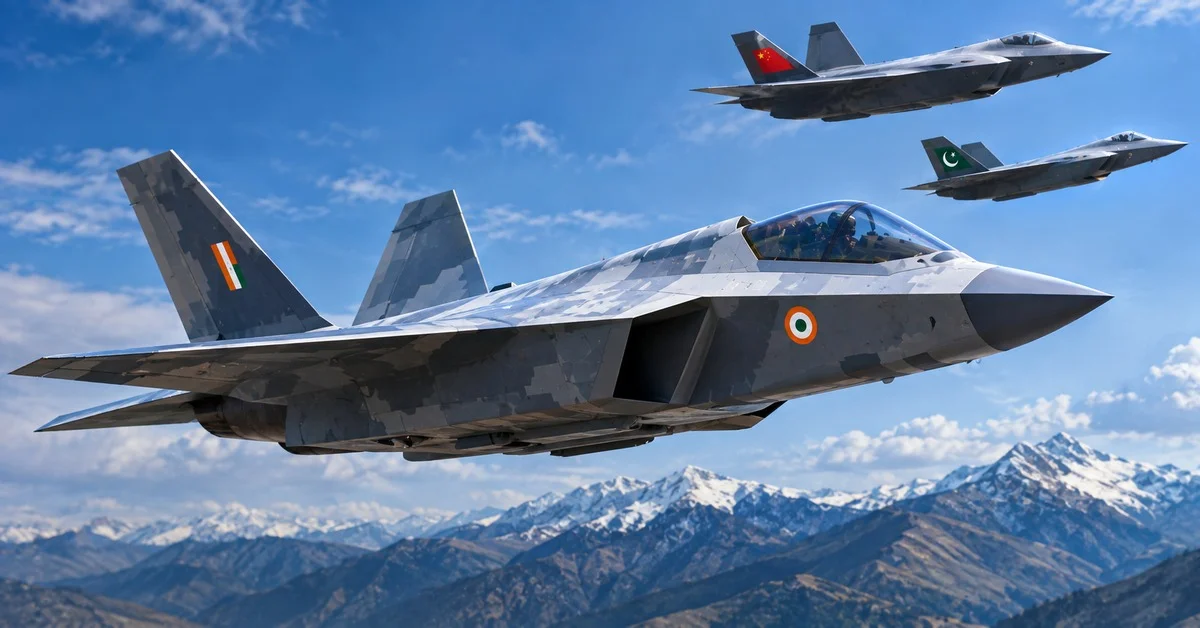
China is steadily expanding its fleets of J-20 and J-35 stealth fighters, and Pakistan is expected to receive up to 40 J-35 jets from Beijing. If these deliveries go ahead, India’s two main rivals could together hold a clear fifth-generation advantage over the next decade.
The concern is about more than numbers. A stealth fighter armed with advanced sensors and long-range missiles may be able to detect and strike older aircraft before it is seen. In that situation, having more fourth-generation jets may not make up for the technology gap.
Rafale, Tejas and Su-30MKI Under the Lens
Most of India’s current fighter spending goes to 4th and 4.5-generation aircraft such as the Rafale and the Tejas. The RT piece questions the value of importing Rafale jets, which it puts at roughly $160 million each, when more Su-30MKI aircraft could be built by Hindustan Aeronautics Limited (HAL) at lower cost using existing bases, training and spares. The Su-30MKI remains the backbone of the IAF and offers strong range, payload and manoeuvrability.
Supporters of a faster fifth-generation buy argue that no quantity of Rafale or Tejas fighters can match a J-20 or J-35 in combat.
The Su-57E Proposal
The commentary presents the Su-57E as a quick fix. It highlights the jet’s stealth shaping, N-036 Byelka radar and long-range RVV-BD missiles. One widely discussed proposal involves buying 50 aircraft off the shelf, followed by licensed production of up to 450 more in India, possibly including a two-seat Su-57D version. Backers point to more than seven decades of India-Russia defence ties as a reason the deal could also boost India’s own aerospace industry.
Delays in Indigenous Programmes
The piece points to the track record of home-grown projects. The Tejas programme began in the 1980s to replace the MiG-21, but by the time it reached squadrons, most MiG-21s had already been retired. The naval Tejas was tested on INS Vikramaditya and INS Vikrant but was found unsuitable for carrier use due to its limited thrust-to-weight ratio. That led to the Twin Engine Deck Based Fighter (TEDBF), which is not expected to fly until the next decade.
The Tejas MK-1A and MK-2 are progressing, and the IAF has placed large orders. The Advanced Medium Combat Aircraft (AMCA), India’s own stealth fighter, is targeting a first flight before 2030 and induction in the mid-2030s. Critics question whether that timeline keeps pace with China, which has commissioned the carrier Fujian and is reportedly exploring sixth-generation designs.
Dependence on Foreign Engines and Radars
Self-reliance remains a challenge. After the indigenous Kaveri engine fell short, the Tejas came to rely on American General Electric engines, and technology transfer talks with Washington have reportedly been difficult. Israeli radars, first adopted as a stop-gap, have also become a long-term fixture.
The Other Side of the Debate
The Su-57E case is far from settled. India withdrew from the joint FGFA programme with Russia in 2018 over concerns about cost, technology sharing and the aircraft’s stealth and engine performance. The Su-57 has been built only in limited numbers, and its next-generation engine is still being fielded. Western sanctions on Russia also raise questions about spares support and payment channels. Many analysts argue that funding a foreign stealth jet could take money and attention away from AMCA, which is designed to give India full control over its fifth-generation technology.
What Lies Ahead
Indian planners must balance two goals that pull in different directions: building a domestic aerospace base and meeting urgent operational needs. Whether India chooses an interim stealth import, more Su-30MKI and Rafale jets, or a faster AMCA programme, the decision will shape the Indian Air Force’s ability to hold its ground in the skies for decades.
Tags
- India fifth-generation fighter
- fifth-generation fighter
- Indian Air Force
- IAF
- fighter squadron strength
- stealth fighter
- Su-57E
- Su-57D
- AMCA