CRPF SI Syllabus 2026: Subject-wise Guide for Sub-Inspector GD Exam
Becoming a Sub-Inspector (SI) in the Central Reserve Police Force (CRPF) is a dream for thousands of defence and police aspirants across India. The position offers an excellent combination of responsibility, career growth, job security, and the opportunity to serve the nation in one of India's largest Central Armed Police Forces. However, clearing the recruitment process requires much more than determination—it demands a thorough understanding of the syllabus and a well-planned preparation strategy.
One of the biggest mistakes candidates make is preparing without first understanding the syllabus. Many spend weeks studying topics that are either less important or not included in the examination, while neglecting sections that carry significant weightage. A clear understanding of the syllabus allows candidates to prepare systematically, manage time effectively, and focus on high-scoring areas.
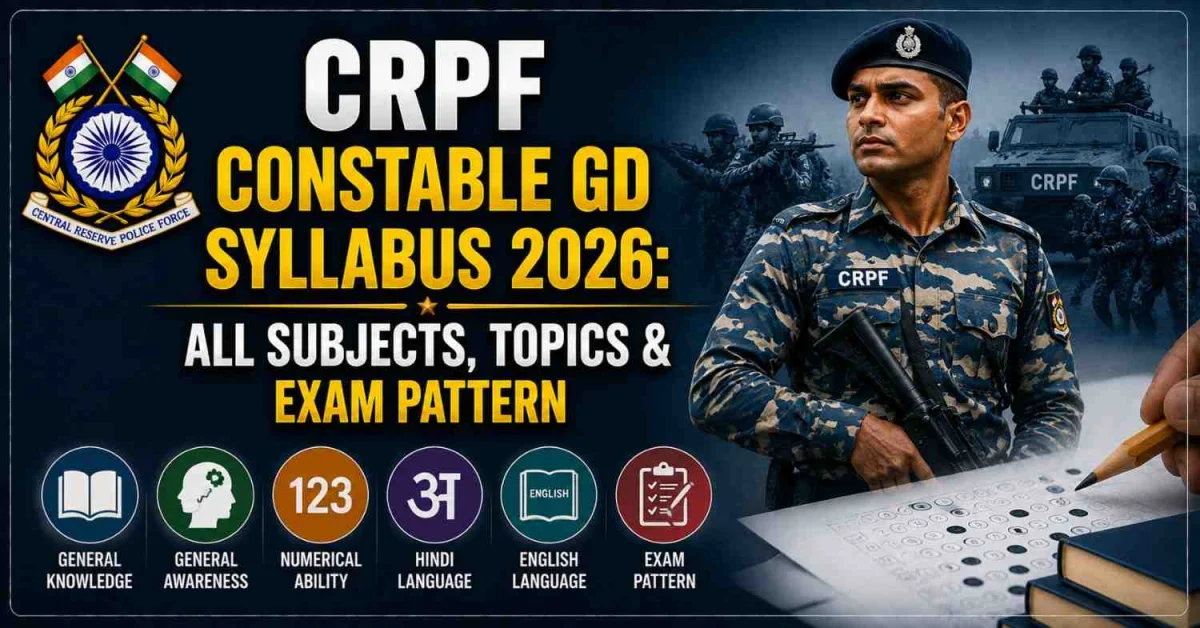
Although the detailed syllabus is released with the recruitment notification, the written examination generally evaluates candidates in four key areas: General Intelligence & Reasoning, General Knowledge & General Awareness, Elementary Mathematics, and English/Hindi Language. These subjects are designed to assess analytical ability, academic fundamentals, language proficiency, and awareness of national and international events.
This guide explains the complete CRPF SI Syllabus 2026, subject by subject, along with preparation tips, recommended resources, and a practical study approach.
Why Understanding the CRPF SI Syllabus is Important
Many candidates begin solving mock tests immediately after the notification is released. While practice is important, it becomes effective only when you know what the exam actually covers.
A clear understanding of the syllabus helps you:
-
Prioritize important topics
-
Avoid unnecessary study material
-
Create a balanced timetable
-
Allocate time according to subject difficulty
-
Improve revision efficiency
Rather than studying everything equally, candidates should focus on the topics that appear consistently in the examination.
CRPF SI Selection Process 2026
Before discussing the syllabus, it's useful to understand the overall recruitment process.
The CRPF Sub-Inspector recruitment generally includes multiple stages to assess both academic knowledge and physical fitness.
The selection process usually consists of:
-
Written Examination
-
Physical Standard Test (PST)
-
Physical Efficiency Test (PET)
-
Medical Examination
-
Document Verification
-
Final Merit List
The written examination is the first major hurdle and plays a crucial role in determining who progresses to the physical stages.
CRPF SI Exam Pattern 2026
Before diving into the syllabus, candidates should understand the likely structure of the written examination.
Although the exact pattern is notified during recruitment, the written test generally includes four major sections.
The paper is objective in nature and requires both speed and accuracy. Candidates should refer to the official recruitment notification once released for the final exam pattern and marking scheme.
CRPF SI Syllabus 2026: Subject-Wise Topics
Understanding every subject separately makes preparation much easier. Let's look at each section in detail.
General Intelligence & Reasoning Syllabus
The reasoning section evaluates a candidate's logical thinking, observation skills, and problem-solving ability.
Unlike General Knowledge, this section does not require memorization. Instead, it rewards regular practice and pattern recognition.
Important Topics
-
Analogy
-
Classification
-
Coding-Decoding
-
Blood Relations
-
Direction Sense
-
Number Series
-
Alphabet Series
-
Seating Arrangement
-
Statement and Conclusion
-
Syllogism
-
Mirror Images
-
Embedded Figures
-
Cubes and Dice
-
Non-Verbal Reasoning
-
Logical Sequence
Candidates should solve reasoning questions daily because consistent practice significantly improves speed and accuracy.
General Knowledge & General Awareness Syllabus
This section tests a candidate's awareness of both static and current events.
Unlike reasoning, General Knowledge requires regular reading and revision over a long period.
Static General Knowledge
Candidates should prepare topics such as:
-
Indian History
-
Geography
-
Indian Constitution
-
Polity
-
Economy
-
Science
-
Environment
-
Art and Culture
-
Important Days
-
Awards and Honours
-
Sports
-
Books and Authors
Current Affairs
Current events are equally important.
Candidates should regularly follow:
-
National News
-
International Events
-
Defence Exercises
-
Government Schemes
-
Budget Highlights
-
Appointments
-
Science & Technology
-
Space Missions
Reading a newspaper and revising monthly current affairs magazines can greatly improve performance in this section.
Elementary Mathematics Syllabus
Many candidates find Mathematics challenging, but the syllabus is generally based on Class 10-level concepts.
The key is conceptual clarity and regular practice.
Major Topics
-
Number System
-
Simplification
-
Percentage
-
Ratio and Proportion
-
Profit and Loss
-
Simple Interest
-
Compound Interest
-
Average
-
Time and Work
-
Time, Speed and Distance
-
Partnership
-
Algebra
-
Geometry
-
Mensuration
-
Trigonometry (Basic)
-
Data Interpretation
Candidates should first master formulas before attempting speed-based practice.
Daily revision is essential because mathematical concepts are easily forgotten without practice.
English / Hindi Language Syllabus
The language section evaluates grammar, vocabulary, comprehension, and basic communication skills.
Candidates generally choose either English or Hindi depending on the recruitment rules.
English Topics
-
Grammar
-
Vocabulary
-
Synonyms
-
Antonyms
-
Error Detection
-
Sentence Improvement
-
Fill in the Blanks
-
Reading Comprehension
-
Idioms & Phrases
-
One Word Substitution
-
Active & Passive Voice
-
Direct & Indirect Speech
Hindi Topics
Candidates opting for Hindi should prepare:
-
व्याकरण
-
पर्यायवाची
-
विलोम शब्द
-
मुहावरे एवं लोकोक्तियाँ
-
संधि
-
समास
-
वाक्य सुधार
-
गद्यांश
-
शब्द ज्ञान
Regular reading and grammar practice help improve accuracy in this section.
Subject-Wise Preparation Strategy
Preparing every subject using the same approach rarely works.
Each section demands a slightly different study method.
Reasoning
Instead of reading theory repeatedly:
-
Solve practice sets daily.
-
Learn shortcuts.
-
Improve speed through timed quizzes.
Reasoning improves only through practice.
General Knowledge
For GK:
-
Read newspapers every day.
-
Revise monthly current affairs.
-
Study static GK separately.
-
Prepare short notes.
Revision is more important than reading multiple books.
Mathematics
A practical approach is:
-
Learn formulas first.
-
Solve basic questions.
-
Gradually increase difficulty.
-
Practice mixed question papers.
Consistency matters more than studying Mathematics for long hours once a week.
English/Hindi
Language preparation should include:
-
Reading editorials or articles
-
Learning new vocabulary
-
Grammar exercises
-
Comprehension practice
Improvement happens gradually, so daily practice is recommended.
Best Books for CRPF SI Preparation
Choosing the right books saves time and prevents unnecessary confusion.
Reasoning
-
R.S. Aggarwal – Verbal & Non-Verbal Reasoning
Mathematics
-
R.S. Aggarwal – Quantitative Aptitude
-
NCERT Mathematics (Class 8–10)
General Knowledge
-
Lucent's General Knowledge
-
NCERT History, Geography, and Polity
English
-
S.P. Bakshi – Objective General English
Hindi
-
Lucent Samanya Hindi
-
Arihant General Hindi
Avoid collecting too many books. One standard resource per subject is usually sufficient when combined with regular revision.
How to Complete the Syllabus in 90 Days
Candidates often ask how long they should take to finish the syllabus.
A practical approach is to divide preparation into three phases.
First 30 Days
Focus on:
-
Understanding concepts
-
Completing Mathematics basics
-
Starting Reasoning
-
Reading Current Affairs daily
Next 30 Days
Shift your attention to:
-
Practice questions
-
Previous year papers
-
Topic-wise mock tests
-
Formula revision
This phase strengthens concepts through application.
Final 30 Days
The last month should be dedicated to:
-
Full-length mock tests
-
Revision
-
Current Affairs
-
Weak topic improvement
-
Time management
Avoid starting entirely new topics during the final week before the examination.
Common Mistakes Candidates Should Avoid
Many aspirants lose marks because of avoidable mistakes.
Some common errors include:
Ignoring Current Affairs
Static GK alone is not sufficient.
Studying Without a Timetable
Random preparation often results in incomplete syllabus coverage.
Neglecting Revision
Reading once is never enough.
Regular revision improves long-term retention.
Avoiding Mock Tests
Mock tests help improve:
-
Speed
-
Accuracy
-
Confidence
-
Time Management
Candidates who attempt regular mocks usually perform better in the actual examination.
Last-Minute Preparation Tips
As the examination approaches, candidates should focus on revision rather than learning entirely new concepts.
A few practical tips include:
-
Revise formulas daily.
-
Read current affairs notes.
-
Solve one mock test every two or three days.
-
Analyse mistakes after every test.
-
Maintain a healthy sleep schedule.
Remember, confidence comes from preparation—not last-minute cramming.
Final Verdict
The CRPF SI Syllabus 2026 covers four major areas—Reasoning, General Knowledge, Mathematics, and English/Hindi. Although the syllabus is broad, it is manageable with a structured preparation plan and regular revision.
Rather than trying to study everything at once, candidates should complete the syllabus subject by subject, solve previous year's questions, and practice mock tests consistently. Building strong fundamentals in Mathematics and Reasoning, staying updated with current affairs, and improving language skills will significantly increase your chances of scoring well in the written examination.
Success in the CRPF SI recruitment process is not about studying harder than everyone else—it is about studying smarter, remaining disciplined, and preparing according to the syllabus.
FAQs
What subjects are included in the CRPF SI syllabus?
The written examination generally includes General Intelligence & Reasoning, General Knowledge & General Awareness, Elementary Mathematics, and English/Hindi Language.
Is the CRPF SI syllabus difficult?
The difficulty level is generally moderate. Candidates with a clear understanding of Class 10–12 concepts and consistent practice can prepare effectively.
How should I prepare for General Knowledge?
Focus on both static GK and current affairs. Reading newspapers, revising monthly current affairs, and studying standard GK books is recommended.
Are previous year papers useful?
Yes. Previous year papers help candidates understand question patterns, important topics, and the expected difficulty level.
How much time is required to complete the CRPF SI syllabus?
Most candidates can complete the syllabus in around 90 days with a disciplined study plan, followed by regular revision and mock tests.