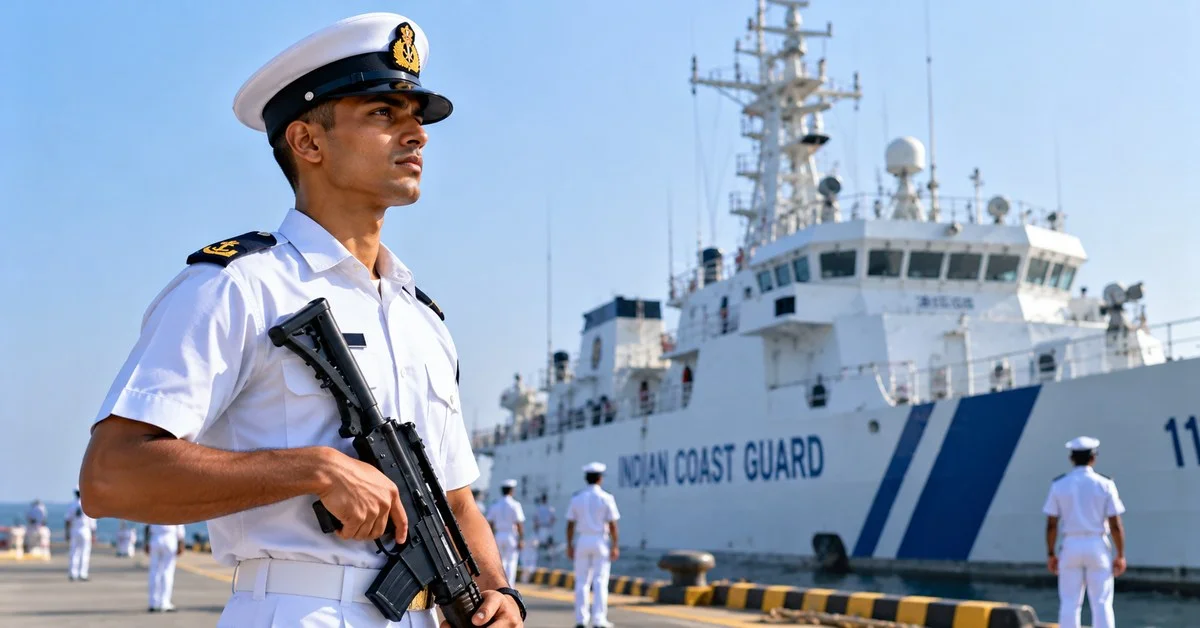
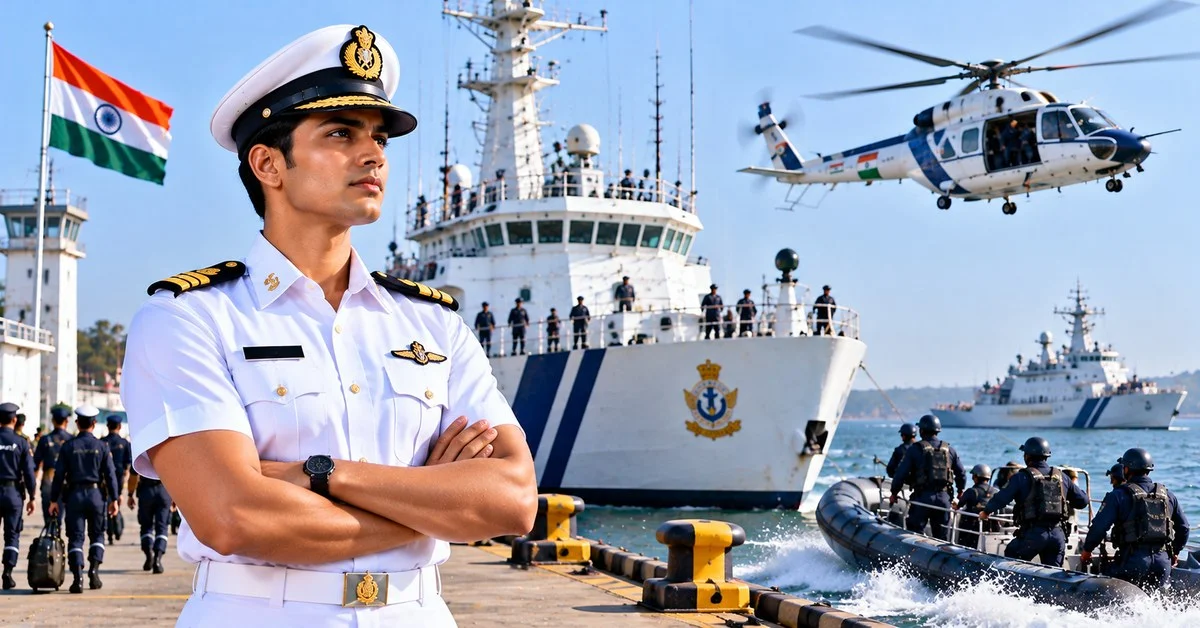
Coast Guard vs Navy : Salary, Eligibility and Which Career to Choose
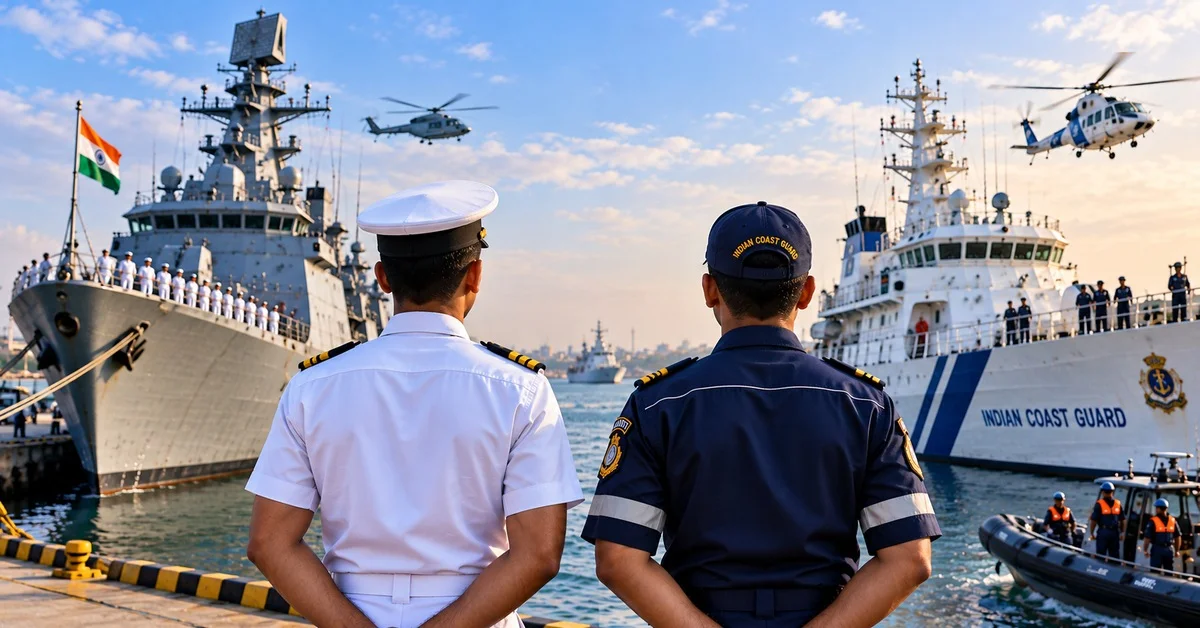
Compare the Indian Coast Guard and Indian Navy by job role, salary, eligibility, service duration and career growth. Learn about Navik GD, Agniveer SSR and the latest 2027 recruitment updates.
Choosing between the Indian Coast Guard and the Indian Navy is an important decision for defence aspirants after Class 12. Both services operate at sea and contribute to India's maritime security, but their responsibilities, recruitment routes, service conditions and career opportunities differ.
If you are comparing Navik GD with Agniveer Navy SSR, look beyond the starting salary. Consider whether you want a regular service career or a four-year engagement, what kind of maritime work interests you, and which entry you qualify for. This guide compares the two services using available 2026 recruitment information and explains what candidates should know about the 2027 recruitment cycle.
Coast Guard vs Navy: What Is the Difference?
The Indian Coast Guard and Indian Navy are separate maritime services with different primary responsibilities. The Coast Guard is an Armed Force of the Union constituted under the Coast Guard Act, 1978. The Navy operates under the Navy Act, 1957, and is responsible for India's naval defence and military operations at sea.
The Coast Guard focuses on maritime law enforcement, coastal security, protection of offshore assets, marine pollution response and assistance to people in distress. The Navy focuses on maritime defence, combat readiness, deterrence and military operations, including deployments beyond India's immediate coastal waters.
The key difference is their operational role, not simply the uniform or location of service. Both require discipline, physical fitness, technical skills and the ability to work in demanding maritime conditions.
Indian Coast Guard vs Indian Navy: Comparison Table
Pay figures are not directly equivalent: Coast Guard Navik GD figures refer to basic pay, while Agniveer SSR figures refer to a consolidated monthly package. Allowances and deductions differ. Refer to the official Indian Coast Guard recruitment portal and Join Indian Navy website for current conditions.
Roles and Responsibilities: What Will You Do?
Indian Coast Guard
The Coast Guard protects India's maritime interests and supports maritime law enforcement. Its work includes patrolling coastal waters, protecting fishermen, responding to marine pollution incidents and safeguarding offshore installations.
Its Search and Rescue SAR operations help coordinate assistance for people, vessels and aircraft in distress within the Indian Search and Rescue Region. The Coast Guard also helps enforce laws relating to activities at sea and protects India's maritime resources.
Indian Navy
The Navy is responsible for maritime defence and military operations. Personnel may work on warships, submarines, aircraft, technical systems or shore establishments, depending on their branch and training.
Naval work includes operational deployments, fleet exercises, maritime surveillance and maintaining combat readiness. Some roles involve extended periods away from shore, including deployments in the Indian Ocean Region and beyond.
How to Join Indian Coast Guard After 12th
Candidates exploring how to join Indian Coast Guard after 12th can consider the Navik General Duty entry if they meet the educational, age, medical and other conditions in the relevant notification.
For Navik GD, the usual educational requirement is Class 12 with Mathematics and Physics from a recognised board. The exact eligibility criteria, date-of-birth range, vacancies and selection stages must be checked in the recruitment notification for the relevant batch.
The selection process generally includes a computer-based examination, physical fitness assessment, medical examination and document verification, as specified in the notification.
Applications for enrolled personnel are submitted through the recruitment route stated in the official notice. For the 2027 batches, the Coast Guard announced CGEPT recruitment through the Staff Selection Commission.
Navik GD Batch 01/2027: Latest Recruitment Update
The Navik GD Batch 01/2027 recruitment was part of the Coast Guard Enrolled Personnel Test (CGEPT) notification covering batches 01/2027 and 02/2027.
According to the published recruitment schedule, applications opened on 6 October 2026 and closed on 21 October 2026. Therefore, the application window for this notification has closed as of 27 October 2026. Candidates should monitor official websites for examination updates, admit cards and future recruitment notices rather than rely on unofficial reopening claims.
The notification listed 130 Navik GD vacancies for batch 01/2027, including 117 male and 13 female vacancies. Vacancies and selection arrangements should always be confirmed against the official notice.
Check the Staff Selection Commission and the Indian Coast Guard recruitment page for official updates.
Agniveer Navy SSR 2026: Eligibility and Service Duration
Agniveer Navy SSR is an entry for eligible candidates joining the Indian Navy under the Agnipath scheme. The 2026 recruitment notice covered the 01/2026 and 02/2026 batches alongside the preceding recruitment cycle.
The usual educational route for SSR requires Class 12 with Mathematics and Physics and the prescribed minimum aggregate marks. Eligible engineering diploma holders and candidates with specified vocational qualifications may also qualify under the notification's conditions. Age limits are batch-specific, so candidates must use the date-of-birth range stated in the applicable notice.
Agniveer SSR is a four-year engagement. At the end of this period, up to 25% of each batch may be selected for regular enrolment in the Navy, based on organisational requirements and the applicable selection criteria. Retention is not guaranteed.
The current application window for the 2026 batches has passed. Candidates planning for a future cycle should check the official Join Indian Navy recruitment website for the next notification.
Navik GD vs Agniveer Navy SSR: Salary Comparison
Salary is a major factor when comparing these entries, but it is important to compare like with like.
Indian Coast Guard Navik GD salary
Navik GD has a basic pay of ₹21,700 per month under Pay Level 3. Dearness Allowance and other eligible allowances may be added according to the applicable rules, nature of duty and place of posting.
The actual amount credited to a Navik GD's account can differ from the basic pay because allowances, deductions and individual service conditions affect the final figure. Do not treat a single estimated in-hand salary from an unofficial website as a guaranteed amount.
Agniveer Navy SSR salary
The Agniveer SSR monthly package follows a fixed yearly progression:
Under the scheme, 30% of the monthly package is contributed to the Agniveer Corpus Fund, with a matching government contribution. Additional allowances may apply under the scheme's rules.
The table shows the notified package and 70% in-hand component, not a guarantee of the exact amount received in every month.
Seva Nidhi Corpus Fund: What Does an Agniveer Receive?
The Seva Nidhi corpus fund is a one-time package payable at the end of the four-year engagement, subject to the scheme's rules. It combines the Agniveer's own contributions with the government's matching contribution and applicable interest.
For the published SSR pay structure, the total corpus contributions from the individual and government amount to approximately ₹10.04 lakh before applicable interest. This is separate from the monthly in-hand salary.
Agniveers do not receive the standard pension and gratuity benefits for the four-year engagement. Candidates should read the current scheme conditions carefully and not confuse the Seva Nidhi payout with a monthly pension.
Sea Duty Allowance and Other Benefits
Both services may provide allowances and benefits according to the applicable service rules, posting and nature of duty. A sea duty allowance may apply where the relevant conditions are met, but it should not be assumed that every person receives the same amount every month.
For Coast Guard Navik GD, the basic pay is supplemented by Dearness Allowance and other eligible allowances under the prevailing regulations. For Navy Agniveers, the published scheme provides for applicable risk and hardship, dress and travel allowances.
Accommodation, ration, medical support and other entitlements depend on the relevant service conditions and rules. Avoid comparing a full estimated Coast Guard package with the Navy's base Agniveer package without accounting for how each figure is calculated.
Exclusive Economic Zone India: Why the Coast Guard Matters
India's Exclusive Economic Zone is the maritime area in which the country has specific sovereign rights over natural resources and certain economic activities under the law of the sea. The Coast Guard helps protect India's maritime interests through surveillance, law enforcement, protection of fishermen and offshore asset security.
The Navy also operates in support of India's maritime security, but its central purpose is national defence and military readiness. This difference helps explain why the two services can operate in the same broad maritime region while carrying out different tasks.
Lifestyle, Posting and Career Growth
Coast Guard personnel may work at coastal stations, onboard ships or in specialised operational and technical units. Duties can involve patrols, rescue missions, law enforcement and emergency response. Although many responsibilities relate to India's maritime zones, Coast Guard service can still involve sea deployments, transfers and demanding schedules.
Navy personnel may serve on ships, submarines, aircraft, technical establishments and shore bases. Some operational roles require extended deployments and periods away from home. The exact lifestyle depends on the branch, ship, appointment and service requirements.
Neither service guarantees a fixed posting pattern or a specific promotion speed. Career progression depends on service rules, performance, vacancies, training and eligibility for advancement.
Assistant Commandant Entry: Is It Part of CGEPT?
The phrase Assistant Commandant CGEPT can cause confusion because these are not the same recruitment route. CGEPT is used for enrolled-person recruitment such as Navik and Yantrik, while Assistant Commandant recruitment is a separate officer-entry process with its own notification and selection requirements.
Graduates interested in becoming Coast Guard officers should monitor the official Coast Guard recruitment website for Assistant Commandant notifications. The age, educational qualification, branch availability, selection stages and application dates must be checked in the relevant notice.
For the Navy, candidates can explore officer entries such as NDA after Class 12 and other graduate or technical routes, subject to eligibility. Do not assume that one service's officer examination is interchangeable with the other's.
Coast Guard or Navy Which Is Better?
The answer depends on your career goals and the entry route for which you qualify.
The Coast Guard may appeal to candidates interested in maritime law enforcement, coastal security, rescue work and protecting India's maritime resources. Navik GD offers a regular service entry under the applicable service rules.
The Navy may suit candidates whose interests lie in naval defence, fleet operations, combat readiness, submarines, aviation or other specialised maritime roles. Agniveer SSR provides a four-year engagement, with an opportunity for up to 25% of a batch to be selected for regular enrolment under the scheme's rules.
Before deciding, compare the actual service conditions rather than relying on general claims about prestige, salary or promotion speed. Consider your eligibility, preferred duties, tolerance for extended deployments and long-term career plans.
Common Mistakes to Avoid
-
Comparing Coast Guard basic pay directly with the full Navy Agniveer package.
-
Assuming sea duty allowance or other allowances are paid to everyone at the same rate.
-
Treating Agniveer retention as guaranteed after four years.
-
Relying on an old age limit or date-of-birth range for a new recruitment batch.
-
Assuming the Coast Guard and Navy use the same recruitment examination.
-
Believing that a closed application window will reopen without an official announcement.
FAQs
Is the Indian Coast Guard part of the Indian Navy?
No. The Indian Coast Guard and Indian Navy are separate services with different legal frameworks and primary responsibilities. The Coast Guard is an Armed Force of the Union under the Coast Guard Act, 1978.
Which is better after Class 12: Navik GD or Agniveer Navy SSR?
Both have different roles and service arrangements. Navik GD is a regular enrolled entry, while Agniveer Navy SSR is a four-year engagement with a possible regular-enrolment opportunity for up to 25% of a batch. Compare eligibility, work, service conditions and long-term goals before choosing.
What is the basic pay for Coast Guard Navik GD?
The notified basic pay is ₹21,700 per month under Pay Level 3, with applicable Dearness Allowance and other eligible allowances under the prevailing rules.
What is the starting package for Agniveer Navy SSR?
The published starting monthly package is ₹30,000 in the first year. The package increases in subsequent years, with 30% contributed to the corpus fund and a matching government contribution.
Can an Agniveer join the Indian Coast Guard after four years?
Candidates should check the specific Coast Guard recruitment notification for any provisions, age relaxation or eligibility rules applicable to former Agniveers. Do not assume that completing Navy Agniveer service guarantees Coast Guard recruitment or automatic entry.
Is Navik GD Batch 01/2027 recruitment still open?
No. The application window for the CGEPT 01/2027 and 02/2027 notification closed on 21 October 2026. Follow official portals for the next stages and future recruitment announcements.
What is the difference between CGEPT and Assistant Commandant recruitment?
CGEPT is the recruitment test for enrolled personnel such as Navik and Yantrik. Assistant Commandant is a separate officer-entry route with its own recruitment notification and eligibility conditions.