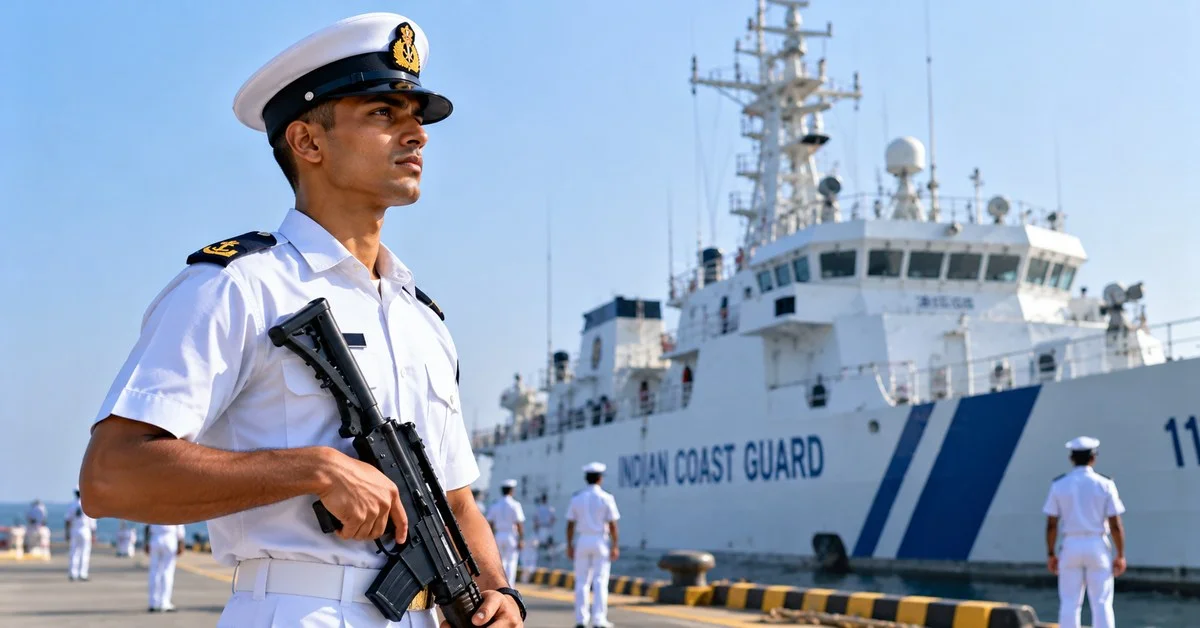
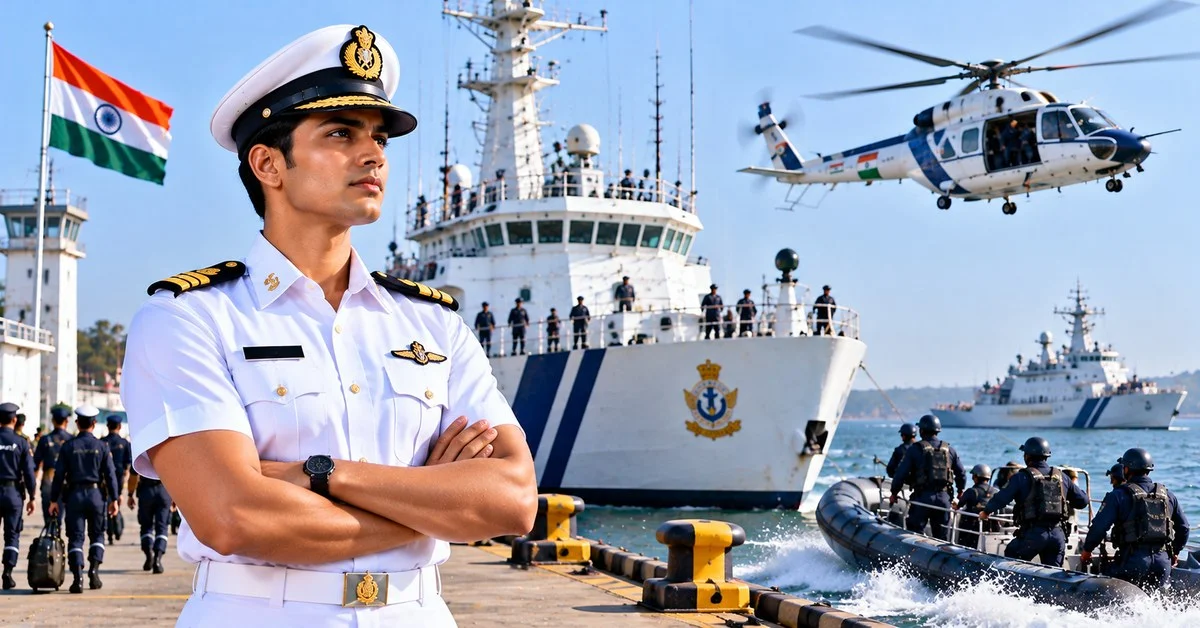
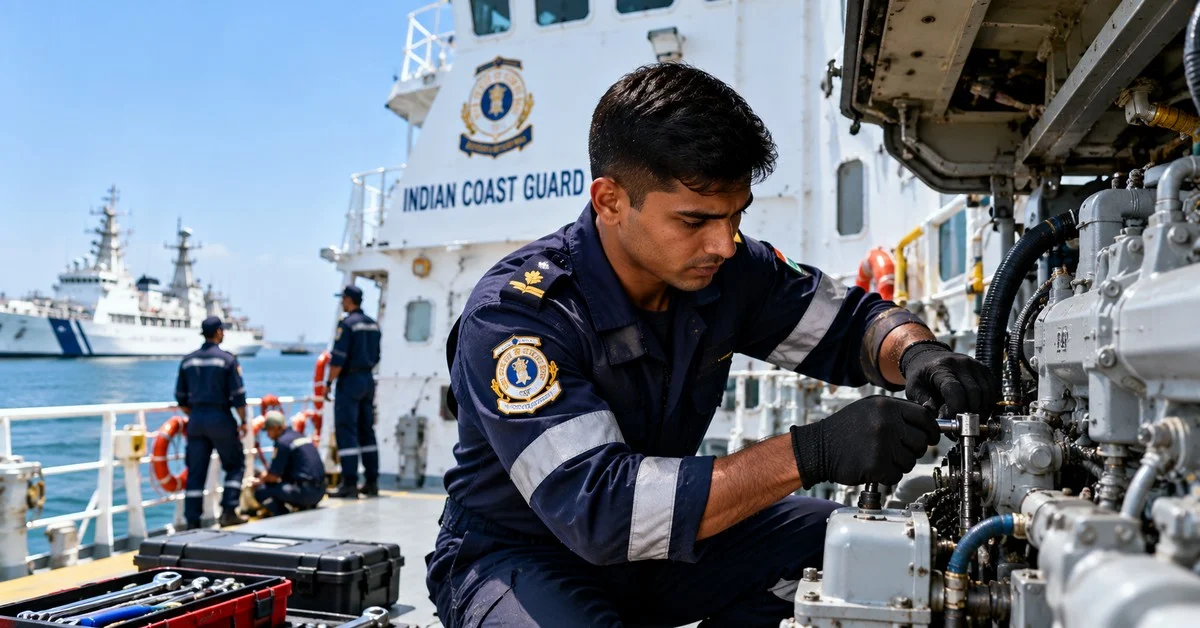
Indian Coast Guard Navik GD: Eligibility, Syllabus and Selection
Quick summary
Check the Indian Coast Guard Navik GD eligibility, 10+2 qualification, age limit, syllabus, exam pattern, physical fitness test, medical standards and CGEPT selection process for 2027.
Navik GD is a sailor-level Indian Coast Guard post for aspirants aged 18 to 22 who passed 12th with Maths and Physics. Selection starts with a computer-based examination of 100 questions for 100 marks, followed by a Physical Fitness Test, Assessment & Adaptability Test, document verification and medical examination. Stage-I for CGEPT 01/2027 and 02/2027 is scheduled for 17 and 18 November 2026. Confirm current-cycle details on the official recruitment portal.
Your 12th marksheet shows Physics and Maths. A friend has forwarded a Coast Guard notice on WhatsApp, and three websites quote three different run times. Which one is right? And could flat feet or a minor eye problem end your chances at the medical?
This guide covers Coast Guard Navik GD eligibility, the syllabus and every selection stage. It also explains, in detail, the medical disqualifiers that aspirants keep asking about on forums. Stage-I for CGEPT 01/2027 and 02/2027 is scheduled for 17 and 18 November 2026. If you're aiming for the next cycle, start preparing now.
What Is the Navik GD Role and the CGEPT Cycle?
Navik GD is the general duty sailor entry of the Indian Coast Guard. Recruitment runs through the Coast Guard Enrolled Persons Test, or CGEPT. One notification covers several posts, so read it closely before you apply.
Posts in one cycle: Navik (GD), Navik (DB), Yantrik and Hygienist-I.
Batch codes: the notice released on 6 October 2026 covered two batches, 01/2027 and 02/2027.
Vacancies: 365 across all posts in that notice.
The year in a batch code runs ahead of the notice. The 2027 batches were announced in 2026. Watch the Indian Coast Guard recruitment website, then check the Coast Guard Navik GD eligibility criteria below against the current notice.
Eligibility Criteria
To apply for Coast Guard Navik GD, you need 10+2 with Maths and Physics from a COBSE-recognised board and must fall inside the notified birth-date window. Everything else is a filter on top of those two rules. The table below covers the latest cycle.
| Criterion | Requirement (CGEPT 01/2027 and 02/2027) |
|---|---|
| Age band | Born between 1 November 2005 and 1 May 2009 |
| Education | 10+2 with Maths and Physics, COBSE-recognised board |
| Nationality | Indian citizen |
| Marital status | Check the applicable conditions in the official notification |
Age Limit
For the current cycle, you must be born between 1 November 2005 and 1 May 2009. Miss that window by a single day and the portal won't accept you.
Reserved categories get extra years. OBC candidates receive 3 years of relaxation and SC/ST candidates receive 5 years. The current notification specifies these relaxations. The window shifts with every batch, so check the exact dates on the official recruitment website before you fill anything in.
Educational Qualification
You need Class 12 passed with Maths and Physics from a board recognised by COBSE. Biology in place of Maths won't qualify you for GD. Don't confuse it with Navik DB, which only asks for Class 10.
The current recruitment notification does not specify a minimum percentage requirement for Navik GD. Some preparation guides mention 60% aggregate in Class 12 and 50% in Class 10 Maths, but don't treat these figures as official requirements without confirmation from the applicable notification.
Your Class 12 Maths and Physics are also important parts of the Navik GD syllabus, so give both subjects enough preparation time.
Other Conditions
The notification requires candidates to be Indian citizens. Read the official notification carefully for all applicable conditions before applying. A wrong assumption here can get a form rejected at document verification, months after you've cleared the written test.
Language matters too. The current computer-based examination is bilingual, in English and Hindi. Even so, English is tested as part of the preparation syllabus, so working-level reading skills aren't optional. For a deeper walkthrough of each rule.
Navik GD Exam Syllabus and Pattern
The Navik GD written exam is a computer-based examination carrying 100 marks. It has 100 objective questions, with one mark for each correct answer. The examination lasts one hour and is conducted in Hindi and English. There is no negative marking for incorrect answers.
| Particular | Details |
|---|---|
| Examination mode | Computer-based examination |
| Total questions | 100 |
| Total marks | 100 |
| Marks per question | 1 |
| Duration | 60 minutes |
| Question type | Objective MCQs |
| Language | Hindi and English |
| Negative marking | No |
| Qualifying marks (UR/EWS/OBC) | 40 |
| Qualifying marks (SC/ST) | 35 |
The current notification directs candidates to the examination portal for the detailed post-wise syllabus. Do not rely on the previous cycle's sectional question distribution as the confirmed pattern for CGEPT 01/2027 and 02/2027.
Mathematics
Maths is an important subject for Navik GD. Expect standard school-level units such as algebra, trigonometry, geometry, mensuration and statistics, along with the Maths topics prescribed for the current examination.
Here's the good news. If you've studied for NDA or Agniveer, most of this is familiar ground. Trigonometric identities, quadratic equations and basic statistics show up across all these exams. So one solid Maths routine serves several CGEPT cycles and other defence entries at once. Practise with a timer from day one, because you have only 60 minutes for the complete examination.
Physics
Physics is another important subject because Navik GD requires Class 12 Physics along with Maths.
Focus your Class 11 and 12 revision on mechanics (motion, laws of motion, work and energy), heat, optics and current electricity. Mechanics deserves enough preparation time. It feeds into numericals across the subject and rewards formula recall. Keep a one-page formula sheet for each unit and revise it daily. Also check the detailed syllabus on the examination portal before deciding which chapters need the most attention.
English
English is an important part of the examination preparation. It is also where many aspirants from Hindi or regional-medium schools need extra practice.
Expect grammar (tenses, articles, prepositions, subject-verb agreement), sentence correction, fill in the blanks, synonyms, antonyms and a short comprehension passage. Fixing it doesn't need fancy material. Try these:
Read one newspaper editorial a day and underline 5 unfamiliar words.
Learn one grammar rule daily and solve 10 questions on it.
Solve English sets from Previous Year Papers every weekend.
Read comprehension questions first, then the passage, to save time.
General Knowledge and Current Affairs
GK is part of your written exam preparation. Don't let it swallow Maths and Physics time.
The preparation areas include geography (soil, rivers, mountains, ports and harbours), the freedom movement and heritage, history, defence, wars and neighbouring countries, plus awards, authors, discoveries, diseases and nutrition. Add basic polity and science in the news. For current affairs, rely on a daily national newspaper, monthly current affairs compilations and official government press releases. Defence news deserves extra attention: Coast Guard exercises, ship commissionings and maritime security updates are natural question material for this entry.
Reasoning and Quantitative Aptitude
Reasoning is another useful area to prepare. Practising common question patterns can help you solve them more quickly.
Common types include number and letter series, coding-decoding, analogies, direction sense, blood relations, odd one out and simple data interpretation from tables or charts. The approach is the same as the one we explained in our AFCAT Military Aptitude Test guide: learn to spot the pattern type within seconds, then apply a fixed method. Solve 20 mixed reasoning questions a day for the first month. If a question doesn't click within 40 seconds, move on and return later.
Subject-Wise Preparation Sequence
Start with Maths, then Physics, then English, followed by Reasoning and GK. That order gives you enough time for the two main subjects required for Navik GD while keeping the other preparation areas active.
A practical daily split for about 5 hours of study:
| Subject | Daily time |
|---|---|
| Mathematics | 2 hours |
| Physics | 1 hour 30 minutes |
| English | 45 minutes |
| Reasoning | 30 minutes |
| GK and current affairs | 15 minutes |
From the second month, replace one study session a week with a full timed mock of the 100-question examination. Keep your running practice going alongside, because the next stage of the CGEPT selection process includes physical tests.
Selection Process: Stage by Stage
The CGEPT selection process for Navik GD runs in four stages, and you must clear each one before moving to the next. The written examination comes first, followed by physical fitness and other assessments. Here's the full order:
Stage I: Computer-Based Examination (CBE)
Stage II: Physical Fitness Test (PFT), Assessment & Adaptability Test, Document Verification and Recruitment Medical Examination
Stage III: Document Verification and Pre-Enrolment Medical Examination at INS Chilka
Stage IV: Verification and authentication of original documents
The gap between stages can be long. For the current batches, Stage-II is tentatively scheduled for the end of February 2027. That gives you roughly three months after the CBT to sharpen your running. Use them.
Stage 1: Online Written Exam (CBT)
Stage I is a computer-based examination with 100 objective questions carrying 100 marks in total. You get one hour to complete the paper. The minimum qualifying marks are 40 for UR/EWS/OBC candidates and 35 for SC/ST candidates.
There is no negative marking for wrong answers according to the current recruitment notification. Attempting questions carefully and managing your time are important.
Stage 2: Physical Fitness Test (PFT)
The PFT has four events, done back to back with no break. Any pause counts as a failure. Fail one event and the whole test is failed. Here are the official Navik GD physical fitness test standards from the notification:
| Event | Male | Female |
|---|---|---|
| 1.6 km run | 6 min 30 sec | 8 min |
| Squats (uthak-baithak) | 20 | 15 |
| Push-ups | 15 | 10 |
| Bent-knee sit-ups | 15 | 10 |
Ignore the "7 minutes" run time quoted elsewhere. Train according to the notification figures. For men, the run target works out to about 4 minutes 4 seconds per kilometre. That's a real pace, not a jog.
The trap is continuity. Most aspirants practise the run and the push-ups on separate days, then arrive gasping at the squats. Before you apply, run this self-check once a week:
Can you finish the run inside your gender's time without walking?
Can you go straight into squats with no rest?
Do your push-ups still meet the count after the squats?
Can you finish the sit-ups without stopping between reps?
If any answer is no, that's your training gap. Our week-by-week Navik GD PFT training plan builds you from base runs to full test-mode sequences.
After the PFT, qualified candidates also have to clear the Assessment & Adaptability Test. It is qualifying in nature, and its marks are not included in the final merit list. Document verification and the recruitment medical examination are also conducted during Stage II.
Stage 3: Document Verification and Pre-Enrolment Medicals
Candidates who qualify Stage I and Stage II and stand in the merit list according to available vacancies are shortlisted for Stage III at INS Chilka.
At this stage, officials check your original documents again. The process also includes a pre-enrolment medical examination. You must carry the documents, police verification forms and other certificates mentioned in the official notification.
The medical examination checks whether you meet the Coast Guard's physical and health standards. Military doctors assess your eyesight, colour vision, hearing, teeth, limbs and general fitness.
Vision is the most confusing area. The current notification specifies the visual standards for the General Duty branch and clearly states that candidates using glasses aren't eligible for GD. We cover the eyesight requirements, flat feet, varicose veins and other common medical concerns in the section below. Read it before you apply.
Stage 4: Verification of Original Documents
Stage IV involves verification and authentication of your original educational and other documents with the concerned boards, universities and government authorities.
If any document is found to be false or not genuine, your candidature can be cancelled. This verification can also have consequences after enrolment if the submitted documents are found to be invalid.
Height, Chest and Medical Standards in Detail
Most medical rejections happen because aspirants assume they're fit without checking a single number. The Coast Guard Navik GD medical stage measures your body against fixed standards, and you can't negotiate with any of them. Forums keep asking the same few questions: height, chest, glasses, tattoos and conditions like flat feet.
The answers below come from the medical standards published in the current recruitment notification. Where no source confirms a specific rule, we say so plainly. The final word on Indian Coast Guard Navik GD medical requirements is the medical schedule attached to the official notification.
Height and Chest Requirements
Men need a minimum height of 157 cm and women need 152 cm. Some regions get a lower bar.
| Standard | Requirement |
|---|---|
| Minimum height (male) | 157 cm |
| Minimum height (female) | 152 cm |
| Height relaxation of 5 cm | Assam, Nagaland, Mizoram, Meghalaya, Arunachal Pradesh, Manipur, Tripura, Garhwal, Kumaon, Sikkim and Gorkhas |
| Height relaxation of 2 cm | Ladakh, Lakshadweep, Minicoy Islands and Andaman & Nicobar Islands |
| Chest (male) | Minimum 77 cm |
| Chest expansion | Minimum 5 cm |
Chest expansion is important. Measure yourself at home with a tape after a full breath out and a full breath in.
Vision and Colour Vision Standards
The current notification specifies the following visual standards for the General Duty branch:
Better eye: 6/6
Worse eye: 6/9
Candidates using glasses are not eligible for the GD branch. So don't assume your spectacles are acceptable.
The notification does not specify a separate colour vision grade in the medical standards listed here. Defective colour vision can be a concern for a sea-going role, so get a colour vision test done privately before you apply. Then compare your result with the medical schedule in the notice.
Tattoo and Other Physical Standards
Weight must be proportionate to height and age, as applicable under the Coast Guard medical standards. The current notification does not specify a fixed ±10% weight variation, so don't rely on that figure.
Permanent body tattoos are generally not permitted on any part of the body. However, the notification allows certain concessions for candidates belonging to tribal communities recognised by the Government of India. For other candidates, permanent tattoos are permitted only on the inner face of the forearms, from the inside of the elbow to the wrist, and on the reverse side of the palm or back of the hand.
The notification also specifies that candidates should have healthy gums, a good set of teeth and a minimum of 14 dental points. Get a dental check-up before the medical examination rather than waiting until the last moment.
Common Medical Disqualifiers
Flat feet, varicose veins, a deviated septum and vision beyond the permitted standard are conditions forum threads raise most often. The notification does not give a separate candidate self-test or specific cutoff for each of these conditions, so treat this list as a pre-check, not a medical ruling.
Flat feet: stand on wet paper and check your footprint. A full sole print with no arch gap needs a doctor's opinion.
Varicose veins: look for swollen, twisted veins on your calves after standing for a while.
Deviated septum: constant blockage in one nostril or snoring is worth an ENT check.
Vision: get both eyes tested with and without glasses, and keep the report.
Some of these can be treated. A doctor's visit three months before the notice beats discovering a problem at the medical.
How to Apply: Notification and Application Process
The Coast Guard Navik GD application process for CGEPT 01/2027 and 02/2027 was conducted online through the Staff Selection Commission website, https://ssc.gov.in/. Candidates were redirected to the Coast Guard examination portal at https://cgept.parikshasaarthi.in/ for examination-related updates.
The registration window for the current batches ran from 6 October to 21 October 2026. It has now closed. For the next cycle, check the official recruitment website and SSC portal for fresh dates.
Before the next application window opens, keep these ready:
Class 10 and Class 12 marksheets, with your name and birth date matching exactly
A recent passport-size photograph and your signature, scanned
Category certificate in the current valid format, if you're claiming relaxation
An active email ID and mobile number you'll keep for the whole cycle
Valid identity proof and domicile certificate, where applicable
Fees and dates change every cycle. Verify them on the official notification, not on forwarded messages.
Step 1: Check Notification
Official CGEPT notifications appear on the Indian Coast Guard recruitment website and the SSC website. That's the only source you should treat as final. One notice covers two batches, so a single recruitment window can decide your chances for more than one intake.
The registration window for CGEPT 01/2027 and 02/2027 opened on 6 October 2026 and closed on 21 October 2026 at 05:30 PM. The next cycle's dates haven't been announced yet, so check the official websites regularly. Read the full PDF, including the medical schedule and post-wise birth-date window, before you register. A missed window means waiting for the next notice.
Step 2: Register on the Official Portal
For the current recruitment cycle, registration was completed through https://ssc.gov.in/. Candidates were then directed to the Coast Guard examination portal for examination-related information.
Registration creates your candidate account. You'll enter your name, date of birth, email and mobile number, then verify them before you can log in.
Type your name exactly as it appears on your Class 10 certificate. Not the nickname. Not the version on your Aadhaar if it differs. The photo and signature size, format and background rules are listed in the notification and registration portal for each cycle. Resize your scans to those exact specifications rather than guessing. Save your registration details somewhere safe, because you'll need them again for the admit card and results.
Step 3: Fill and Submit the Form
The form asks for personal details, category, educational qualifications and exam-related choices. Fill it in one sitting with your documents open beside you.
Enter Class 12 marks for Maths and Physics carefully, since GD eligibility depends on them. Pick Navik (GD) as the post, not Navik (DB). If the form asks for exam city or other preferences, choose options you can actually reach on the exam day.
For the current batches, the correction window ran on 27 and 28 October 2026. Don't rely on it. Check every field twice before you press submit, then download the filled form as a PDF.
Step 4: Pay the Application Fee
The application fee for CGEPT 01/2027 and 02/2027 was ₹550 for candidates who were not eligible for the fee exemption. Candidates applying under the SC/ST category were exempted from paying the examination fee.
Payment was online through net banking, debit card, credit card or UPI. The current application window has closed. For the next cycle, check the fee and payment instructions in the official notification rather than relying on older recruitment guides.
Step 5: Download Admit Card
The e-admit card is made available through the candidate's examination portal. For the current batches, SSC issued an examination notice on 6 November 2026 confirming the Stage-I examination dates of 17 and 18 November 2026. The admission certificate was expected to be available 2–3 days before the respective examination date.
Once you download it, check your name, photo, post applied for, exam date, reporting time and centre address. Report any error to the helpdesk immediately. Print a copy. Visit the centre a day early if it's in an unfamiliar city, and carry the same valid photo ID that you submitted during the application process.
What Not to Do: Common Mistakes That Get Applications Rejected
Most Navik GD applications fail on avoidable slips, not low scores. Avoid these five:
Wrong photo format: a selfie, a cap or the wrong file size can void your form. Match the notice specifications exactly.
Name mismatch: one extra letter between your Class 10 certificate and the form can stall document verification.
Outside the age window: born even a day outside the notified dates? Your form won't survive.
Skipping PFT practice: a strong CBT score means nothing if you stop mid-run.
Underestimating English: weak English preparation can affect your overall examination performance.
Don't leave the form to the final day either. A slow website on deadline day can cost you the attempt.
Navik GD Salary and Career Progression After Selection
A Navik GD starts at Pay Level 3, with a basic pay of ₹21,700. Allowances come on top of that. These may include sea duty allowance, kit maintenance allowance and travel allowance, along with facilities such as free rations, clothing and medical facilities, as applicable under service rules. Check the current figures and applicable benefits in the official notification.
Promotion runs from Navik to Uttam Navik and Pradhan Navik, then into the Adhikari ranks. The highest non-officer rank, Pradhan Adhikari, sits at Pay Level 8 with a basic pay of ₹47,600 plus DA. Departmental examinations can also open a route toward Assistant Commandant. Clearing the CBT is only where that career begins.
FAQs
What is the age limit for Indian Coast Guard Navik GD?
The general age band for CGEPT 01/2027 and 02/2027 is 18 to 22 years. Candidates must be born between 1 November 2005 and 1 May 2009. OBC candidates get 3 years and SC/ST candidates get 5 years of age relaxation, subject to applicable conditions.
Is 10+2 with PCB (Biology) eligible for Navik GD, or is Maths compulsory?
Maths is compulsory. You need 12th with Maths and Physics.
How many rounds are in the PFT and what is the qualifying time?
There are four continuous events. Male candidates must complete a 1.6 km run in 6 minutes 30 seconds, 20 squats, 15 push-ups and 15 bent-knee sit-ups. Female candidates must complete the run in 8 minutes, 15 squats, 10 push-ups and 10 bent-knee sit-ups.
Can I apply for Navik GD if I wear spectacles?
No. According to the current recruitment notification, candidates using glasses are not eligible for the General Duty branch.
What is the difference between Navik GD and Navik DB?
GD needs 12th with Maths and Physics. DB needs only Class 10.
How many times can I attempt the Navik GD exam?
The notification does not specify a fixed attempt limit. Your age eligibility and the conditions in the applicable recruitment notification decide whether you can apply.
Is there negative marking in the Navik GD written exam?
No. The current CGEPT 01/2027 and 02/2027 notification clearly states that there is no negative marking for incorrect answers.
What documents are needed at document verification?
You'll need your Class 10 and Class 12 marksheets and certificates, identity proof, category certificate (if applicable), domicile certificate (where required), photographs and other documents specified in the notification. Carry the original documents and the required photocopies.
Tags
- Indian Coast Guard
- Coast Guard Navik GD
- joinindiancoastguard.cdac.in
- document verification
- Navik GD syllabus
- CGEPT selection process
- Navik GD eligibility criteria
- Navik GD physical fitness test standards
- Indian Coast Guard Navik GD medical requirements
- Coast Guard Navik GD application process
- CGEPT cycle
- 10+2 Physics and Maths