Air Force AFSB Interview 2026: Full 5-Day Process & Selection Tips
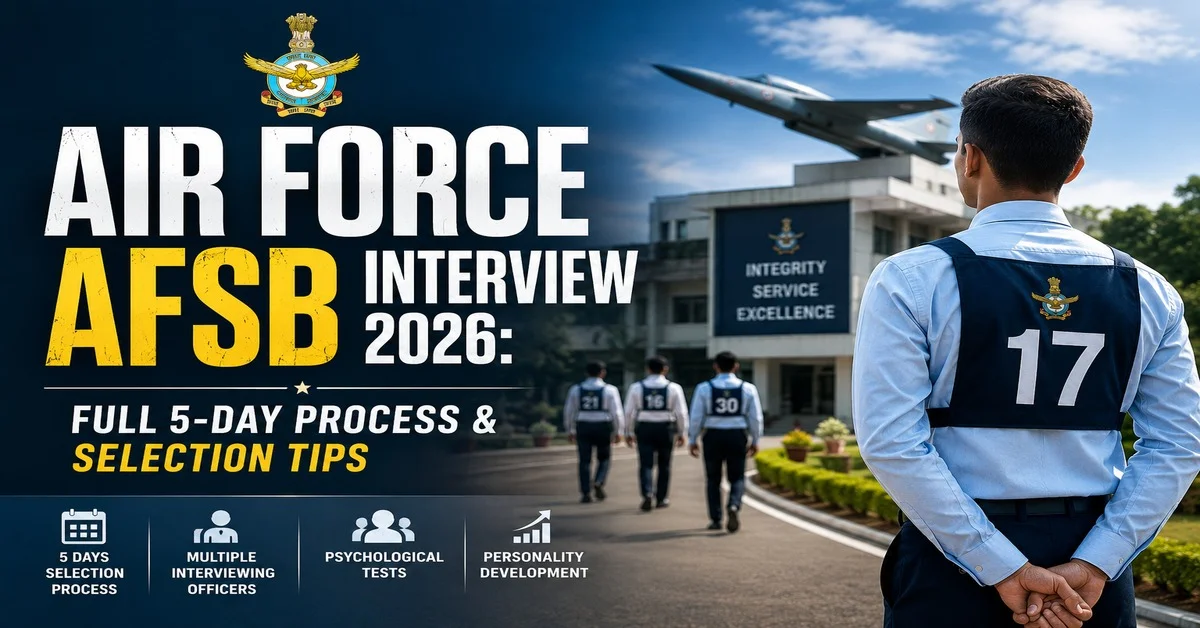
Understand the complete AFSB Interview 2026 process, including the five-day selection stages, psychological tests, GTO tasks, personal interview, and conference round.
Every year, thousands of candidates clear the AFCAT written exam only to feel completely unprepared for what comes next. The Air Force AFSB Interview 2026 is a five-day psychological and physical assessment that most first-timers underestimate, and for many, it is their final age-eligible attempt. This guide gives you stage-specific clarity on every day of the board, explains how the final merit list is actually calculated, and maps out a realistic 30 to 60 day preparation plan, with particular focus on the AFSB selection process.
What Is the AFSB and Who Appears for It?
AFSB stands for Air Force Selection Board. It is the assessment stage that follows AFCAT written exam clearance or NDA written exam clearance for Air Force candidates. The AFSB selection process involves a trained panel of psychologists, a Group Testing Officer, and an Interviewing Officer who collectively evaluate candidates over five days at designated selection centres in Dehradun, Mysuru, or Gandhinagar.
Unlike the SSB used by the Army and Navy, the AFSB is specifically calibrated for Air Force officer roles, with a particular emphasis on situational awareness and decision-making speed. Candidates are assessed against a defined set of Officer Like Qualities across every stage of the board, not just during the interview. This applies equally to the AFSB 5 day process as a whole.
AFSB 2026 Five-Day Schedule at a Glance
Candidates who do not clear the Day 1 screening are sent home immediately. Those who proceed face four more intensive days of observation, so dismissing AFSB preparation tips 2026 at the outset is a costly mistake.
Day 1: Reporting, Documentation & Officer Intelligence Rating (OIR)
Arrive with original documents including your AFCAT admit card, mark sheets, ID proof, and passport-size photographs. Reporting is typically at 6:00 AM, and a single missing document can result in disqualification before the process even begins.
The AFSB OIR and PPDT are the two components of Day 1 screening. The Officer Intelligence Rating test measures verbal and non-verbal reasoning through two booklets of approximately 50 questions each, completed under strict time limits. There is no published cut-off score, but the board uses OIR performance alongside PPDT to decide who continues, making both equally important for AFSB GTO tasks that follow.
For the PPDT, candidates view a hazy image for 30 seconds and write a story around it in four minutes. Groups of 15 to 20 candidates then narrate their stories and work toward a common group story through discussion. Assessors watch for clarity, initiative in the group, and whether the candidate listens as well as speaks.
Day 2 & 3: Psychological Tests: What Each Test Reveals
Psychological tests are administered by the psychologist on the board and are designed to surface Officer Like Qualities that candidates may consciously conceal during face-to-face interactions. Each test targets a different layer of personality, and all of them matter for your overall AFCAT AFSB interview performance.
-
Thematic Apperception Test (TAT): Candidates write short stories for 12 images shown for 30 seconds each. Assessors look for the themes a candidate naturally gravitates toward, particularly initiative, social responsibility, and positive resolution.
-
Word Association Test (WAT): 60 words are flashed one at a time, and the candidate writes the first sentence that comes to mind. Forced responses reveal authentic thought patterns, not rehearsed answers.
-
Situation Reaction Test (SRT): A booklet of 60 real-life situations requires written responses in 30 minutes. Speed matters because slow responders often overthink, which signals low decisiveness to assessors.
-
Self Description Test (SDT): Candidates write short paragraphs on how their parents, friends, teachers, and they themselves perceive them. Inconsistency between self-image and external perception raises flags during conferencing.
Across all four tests, the psychologist is not hunting for perfect answers. The goal is to map whether your responses consistently reflect the qualities the Air Force values in its officers.
Day 3 & 4: GTO Tasks: All Stages and How to Perform
The Group Testing Officer runs a full sequence of outdoor and group tasks spread across Days 3 and 4. Each AFSB GTO task tests a different combination of Officer Like Qualities such as courage, cooperation, planning ability, and initiative under pressure.
-
Group Discussion: Two rounds on current affairs and abstract topics. Contribute early, keep your language clear, and build on others' points rather than simply repeating your own.
-
Group Planning Exercise: A model-based situation requires the group to agree on a practical plan. Speak with logic and a concrete structure.
-
Progressive Group Task (PGT): The whole group crosses four consecutive obstacles with increasing difficulty using limited helping materials. Lead when the group is directionless, and step back when someone else has a better idea.
-
Half Group Task (HGT): Same format as PGT but with half the group, which increases individual visibility. Every action is watched closely.
-
Individual Obstacles: A personal set of ten obstacles each carrying a point value. Attempt higher-value obstacles even if the risk of failure is real.
-
Command Task: As commander, you select two subordinates and plan a crossing. Show clear verbal briefing and calm control under constraints.
-
Final Group Task (FGT): A concluding outdoor task for the full group. Assessors observe whether your energy and initiative hold up after two days of assessment.
Day 4: Personal Interview: What the IO Really Evaluates
The Personal Interview with the Interviewing Officer typically lasts 40 to 60 minutes. This is not a knowledge quiz. The IO uses your Self Description Test responses as a baseline, then probes for consistency between what you wrote and how you speak and reason in person.
Common themes include motivation for joining the Air Force specifically, awareness of current defence news, your educational background, and past leadership experiences. Prepare a clear answer for "Why Air Force and not Army or Navy?" since vague answers here are a frequent eliminator. For broader guidance on evaluating your service branch preference, the Indian Army vs Navy: Which Career Is Better in 2026 guide offers useful comparative context.
Day 5: Conferencing Round and the Final Merit List
The AFSB conferencing round brings together all three assessors: the psychologist, the Group Testing Officer, and the Interviewing Officer. They compare their independent assessments and decide on each candidate. A candidate is recommended only when all three reach consensus, and a single dissent typically means a non-recommendation.
After the board announces results, recommended candidates proceed to a medical examination. For the merit list Air Force selection, the final rank combines AFCAT written exam marks with AFSB marks. The written exam carries significant weight, which means a strong written score can compensate for a borderline AFSB performance. Candidates are allotted branches based on their merit position and branch vacancies.
For a detailed breakdown of the overall AFCAT selection process, the CollegeDekho AFCAT AFSB timeline guide and the Lakshya Academy AFSB preparation guide provide reliable procedural reference.
7 Common AFSB Mistakes First-Timers Make (and How to Avoid Them)
-
Faking personality in psychological tests: Inconsistency between WAT responses and the PI interview is caught during conferencing. Be genuine.
-
Staying silent in group tasks: Silence is never neutral. It reads as low confidence or indifference to the GTO.
-
Ignoring the OIR: Many candidates over-prepare for GTO and neglect reasoning practice. A poor OIR score ends your attempt on Day 1.
-
Bringing incomplete documents: One missing original document can disqualify you before the first test.
-
Dominating group discussions: Constant interruption signals poor team orientation, not leadership.
-
Underestimating the SDT: Vague or generic self-description gives the IO nothing useful to probe, reducing your interview depth.
-
Neglecting current affairs: The IO regularly asks about recent defence acquisitions, Air Force operations, and geopolitical developments.
AFSB Preparation Plan: What to Do in 30 to 60 Days
Weeks 1 and 2: Focus on OIR reasoning practice using verbal and non-verbal test booklets daily. Read one national newspaper and one defence news source every morning to build current affairs depth. Write three TAT stories per day to develop the habit of positive, active narratives.
Weeks 3 and 4: Shift focus to WAT and SRT practice, aiming for 60 WAT responses in under 15 minutes. Join a mock GTO session if accessible, or run timed group discussion practice with peers. Draft your SDT paragraphs and review them for consistency with how you would answer in a live interview.
Final 2 weeks: Run full-length mock interviews covering the IO's typical question themes. Revise your SDT, confirm all documentation, and research your allocated AFSB centre. Physical fitness work should prioritise stamina since the GTO outdoor tasks span several hours.
FAQs
Can you explain the Air Force AFSB Interview 2026 five-day process stage by stage?
Day 1 involves OIR and PPDT screening. Days 2 and 3 cover psychological tests. Days 3 and 4 include GTO tasks. Day 4 also includes the personal interview. Day 5 is the conferencing round where the board decides recommendations.
What are the most common AFSB mistakes first-timers make with only one month to prepare?
Neglecting OIR practice, staying passive in group tasks, giving inconsistent responses across psychological tests and the PI, and arriving without complete documentation are the most reported first-timer errors.
What are the AFSB screening tests including OIR and PPDT and how do I prepare?
The AFSB OIR and PPDT test reasoning speed and communication under observation. Prepare OIR with daily timed booklets and practice PPDT by writing short stories on ambiguous images, then narrating them aloud within strict time limits.
How do I prepare for AFSB psychological tests, GTO tasks, and the personal interview?
Write TAT stories with active heroes and positive outcomes, complete WAT and SRT under timed conditions daily, and build SDT answers that are honest and specific. For GTO tasks, prioritise contributing early, staying calm under physical pressure, and demonstrating initiative without sidelining teammates.
What happens at the AFSB conferencing round and how is the final merit list made?
The AFSB conferencing round means all three assessors compare notes and vote on each candidate. Only unanimous agreement leads to a recommendation. Recommended candidates proceed to medical screening, and the final merit list Air Force selection ranks them using a combined score from the AFCAT written exam and AFSB assessment marks.