Agniveer Vayu 02/2027 Exam Analysis: Difficulty Level, Good Attempts
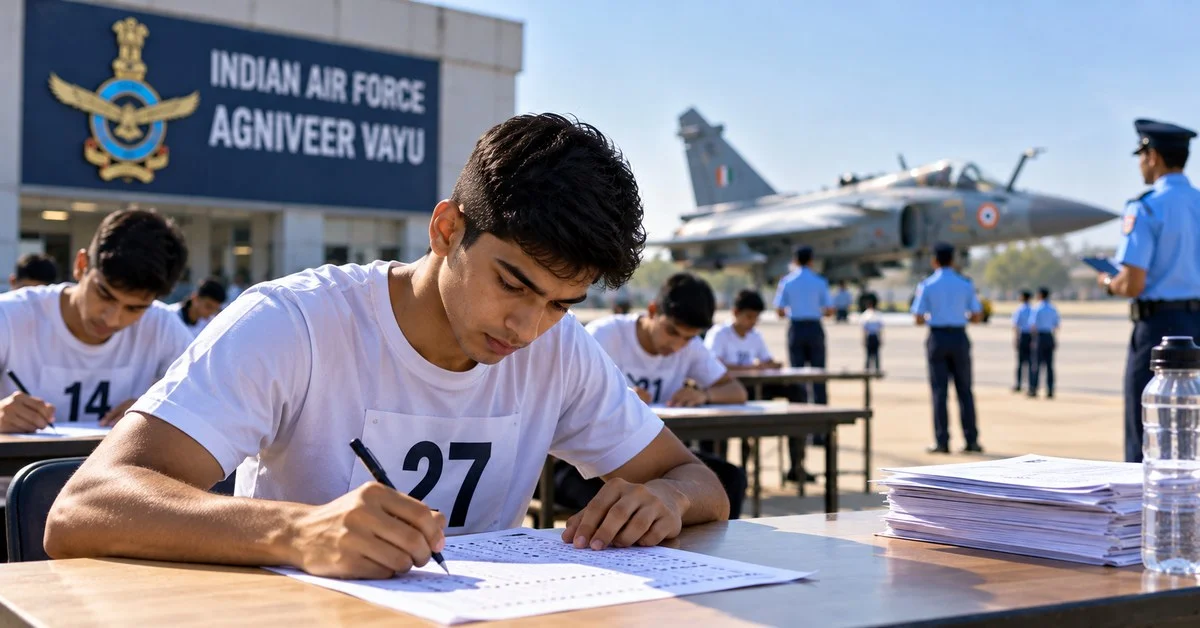
Our Agniveer Vayu exam analysis for 02/2027 covers section-wise difficulty, good attempts for each section, how negative marking affects your net score, changes from earlier papers and the expected cut-off to help you judge your chances.
Thousands of aspirants walk out of the IAF Agniveer Vayu written test asking the same three questions: How tough was the paper? How many attempts are good enough? Am I likely to clear the cut-off? This Agniveer Vayu exam analysis for the 02/2027 cycle answers all three with numeric benchmarks, section-wise ratings, and an expected cut-off guide built on difficulty ratings and community attempt data. If you have just left the exam hall, the sections below give you a clear, data-backed way to gauge your position before official results are out. Keep this as your reference point for Agniveer Vayu 02/2027 difficulty level.
Agniveer Vayu 02/2027 Exam Overview
The STAR exam 2027 is conducted by the Indian Air Force under Indian Air Force recruitment 2027 as part of the Agnipath scheme. Before comparing scores or doing any post-exam benchmarking, understanding the fixed structure of the IAF Agniveer Vayu written test is essential. That foundation shapes every meaningful Agniveer Vayu exam analysis.
-
Total questions: 70 across all sections
-
Total marks: 70 (1 mark per correct answer)
-
Negative marking: 0.25 marks deducted per wrong answer
-
Duration: 60 minutes
-
Sections: Physics, Mathematics, English, Reasoning and General Awareness
The Agniveer Vayu marking scheme makes random guessing genuinely costly. Four wrong answers erase one correct answer's marks, so aspirants who attempted high but answered inaccurately can end up well below what their raw attempt count suggests. That negative marking impact on net score is particularly sharp near the borderline, and the same principle runs through every layer of Agniveer Vayu exam analysis.
Section-Wise Difficulty Level Breakdown
The Agniveer Vayu 02/2027 difficulty level shifted noticeably from section to section. Based on community feedback and topic-level analysis, each section is rated below. Pay close attention here when thinking about Agniveer Vayu good attempts 2027.
-
Physics: High difficulty. Numerical-heavy questions on mechanics, electricity, and waves required multi-step calculation.
-
Mathematics: Moderate to High. Trigonometry, algebra, and coordinate geometry dominated, with time pressure as the main challenge.
-
English section Agniveer difficulty: Low to Moderate. Grammar, fill-in-the-blanks, and reading comprehension were straightforward for well-prepared candidates.
-
Reasoning: Moderate. Series, coding-decoding, and analogies sat at a standard level, with a few tricky sets thrown in.
-
General Awareness Agniveer Vayu: Low to Moderate. Current affairs and static GK questions were manageable and well within standard preparation scope.
This section-wise attempt benchmark lets you quickly place your performance against the overall paper trend before results are declared. The same logic applies when estimating the Agniveer Vayu expected cut-off 2027.
Which Was the Toughest Section in Agniveer Vayu 02/2027?
Physics was rated High difficulty in 02/2027 because of a heavier-than-usual concentration of numerical problems demanding formula application under a strict time limit. Questions from current electricity and ray optics were noticeably more complex compared to earlier cycles. That matters just as much for the toughest section Agniveer Vayu physics math reasoning debate as anything else.
Mathematics followed closely at Moderate to High. The toughest section Agniveer Vayu physics math reasoning discussion typically ends with Physics at the top, and 02/2027 holds to that pattern. Mathematics consumed more time per question, pulling down overall attempt counts across the board. That drag feeds directly into the negative marking impact net score calculation.
Reasoning and General Awareness stayed the scoring anchors of the paper. Aspirants who navigated Physics partially and maintained accuracy on English and General Awareness Agniveer Vayu could still reach a competitive net score. Prioritising accuracy in the easier sections is the pattern that consistently separates cleared candidates from borderline score Agniveer Vayu holders.
Good Attempts in Agniveer Vayu 02/2027: Section-Wise Targets
Agniveer Vayu good attempts 2027 means the number of questions answered correctly or with high confidence, after accounting for negative marking impact on net score. The recommended section-wise attempt benchmarks are listed below.
-
Physics (20 Qs): Safe: 13-15 | Moderate: 10-12 | Risk: below 10
-
Mathematics (20 Qs): Safe: 13-15 | Moderate: 10-12 | Risk: below 10
-
English (20 Qs): Safe: 16-18 | Moderate: 13-15 | Risk: below 13
-
Reasoning and General Awareness (10 Qs each): Safe: 8+ per section | Moderate: 6-7 | Risk: below 6
-
Overall (70 Qs): Safe: 50-55 net | Moderate: 42-49 net | Risk: below 42 net
Negative marking at 0.25 per wrong answer means an aspirant attempting 58 questions with 12 wrong answers nets roughly 46 marks, placing them in the Moderate zone. Accuracy over volume is the consistent takeaway from the Agniveer Vayu question distribution pattern.
Agniveer Vayu 02/2027 vs Previous Years: Paper Pattern Shift
An exam pattern comparison 2026 vs 2027 shows a gradual upward drift in Physics numerical complexity. The Agniveer Vayu paper pattern in 02/2025 and 02/2026 had a more even split between conceptual and numerical questions in Physics, while 02/2027 leaned harder toward numericals.
-
Mathematics topic weightage shifted slightly toward coordinate geometry and probability in 02/2027, compared to a higher algebra weight in 02/2026.
-
English and Reasoning sections remained structurally stable across all three cycles.
-
General Awareness Agniveer Vayu included more defence-specific current affairs in 02/2027 than in previous cycles.
The overall Agniveer Vayu question distribution across sections has not changed. The 70-question, 60-minute format remains intact. What shifted is internal topic weightage and numerical intensity, not the macro structure of the paper.
Agniveer Vayu 02/2027 Expected Cut-Off & Selection Chances
Since official results are still pending, the Agniveer Vayu expected cut-off 2027 below is an analyst estimate based on difficulty ratings and community attempt data. Historically, Agniveer Vayu category-wise cut-off differs by 2-4 marks between General and reserved categories.
-
General category safe score range Agniveer: 48-52 marks
-
OBC / SC / ST estimated cut-off: 43-48 marks
-
Borderline score Agniveer Vayu: 42-47 marks (selection uncertain, depends on state-level competition)
-
At-risk zone: Below 42 marks net
Agniveer Vayu selection chances based on attempts improve considerably once your net score crosses 50. A stronger Physics score signals better candidacy in particular, because Physics difficulty filters out a large number of aspirants every cycle.
FAQs
What is the section-wise difficulty level of Agniveer Vayu 02/2027?
Physics: High. Mathematics: Moderate to High. English: Low to Moderate. Reasoning: Moderate. General Awareness: Low to Moderate.
How many good attempts are needed to clear Agniveer Vayu 02/2027?
A net score of 48-52 is considered safe for the General category. Aim for 50 or above in overall net attempts across all sections.
What are the expected cut-off marks for Agniveer Vayu 02/2027?
Analyst estimate: 48-52 for General, 43-48 for reserved categories. Official cut-offs are pending IAF announcement.
Which is the toughest section: Physics, Math, or Reasoning?
Physics was the toughest in 02/2027, followed by Mathematics. Reasoning and General Awareness were the most scoring sections this cycle.
Has the Agniveer Vayu paper pattern changed in 02/2027 compared to previous years?
The macro structure remains unchanged at 70 questions in 60 minutes. Internal topic weightage in Physics and Mathematics shifted slightly toward numericals and coordinate geometry respectively.
What are my selection chances based on my attempts in 02/2027?
Net score above 50 puts you in a strong position. Between 42 and 49 is borderline, depending on competition in your state. Below 42 is the at-risk zone. Accurately estimating Agniveer Vayu selection chances based on attempts requires applying the 0.25 negative marking to your raw totals first.