NDA vs CDS vs AFCAT: Best Route to Join Indian Defence Forces in 2026
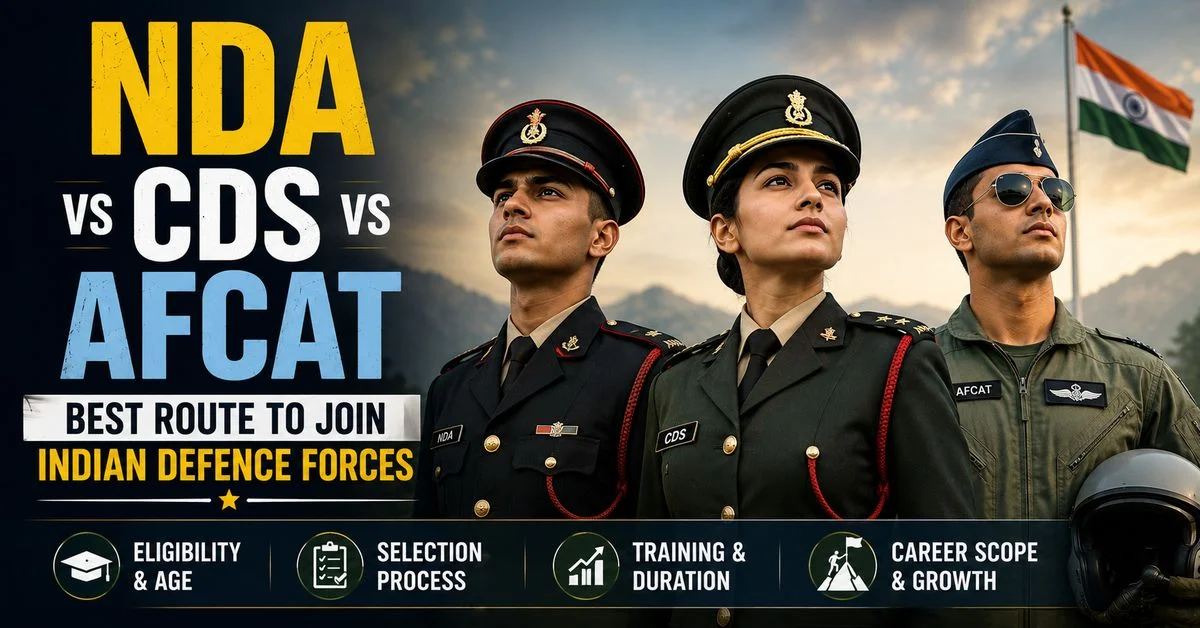
Explore the key differences between NDA, CDS, and AFCAT and find the right defence exam based on your age, qualification, and preferred service.
Three exams. One goal. Yet the path you choose determines your rank seniority, the branch you serve in, and whether you hold a Permanent Commission or a Short Service Commission a decade from now. The NDA vs CDS vs AFCAT comparison sounds like a simple checklist exercise until you realise each exam targets a completely different aspirant profile, qualification level, and service preference. That is especially true when it comes to which defence exam after 12th makes sense for you.
This guide gives you a direct, profile-matched verdict, not a neutral table you have to interpret yourself. If you are between 17 and 26 years old and serious about joining the Indian Armed Forces as a commissioned officer, read every section before you decide. The same applies to understanding CDS vs NDA difficulty in real terms.
What Are NDA, CDS, and AFCAT: Quick Overview
The National Defence Academy (NDA) exam is a UPSC conducted defence exam held twice a year. It is the only route that lets you join the Army, Navy, or Air Force straight after Class 12. Candidates train at the NDA in Khadakwasla for three years before moving to their respective service academies, such as IMA Dehradun, INS Zamorin, or Air Force Academy Dundigal. That is a detail worth keeping in mind for unmarried male and female defence aspirants planning their timelines.
The Combined Defence Services Examination (CDS), also a UPSC-conducted exam, is held twice a year for graduates. It feeds into IMA Dehradun, Officers Training Academy Chennai, Indian Naval Academy, and the Air Force Academy. Graduates targeting the Army, Navy, or Air Force through a graduate entry scheme Indian Army route typically appear for CDS.
The Air Force Common Admission Test (AFCAT) is conducted by the Indian Air Force itself, which makes it distinct from the two UPSC exams above. The IAF AFCAT conducting body releases the exam twice a year, and it is exclusively an Indian Air Force Commission pathway. AFCAT opens doors to Flying, Technical, and Ground Duty branches of the IAF.
All three exams lead to officer-level entry, but they diverge sharply in eligibility, syllabus design, and career trajectory. Sources including The Economic Times and Oswaal Books confirm these three as the most-searched officer entry routes among Indian defence aspirants.
Eligibility Compared: Age, Qualification, and Gender
Understanding the NDA eligibility age limit is the first filter. NDA is open to unmarried male and female defence aspirants who have passed or are appearing in Class 12. The NDA eligibility age limit is 16.5 to 19.5 years. Women became eligible for NDA after a Supreme Court order in 2021, and intake has expanded steadily since then.
CDS eligibility varies by academy. For IMA Dehradun and the Air Force Academy, the age range is 19 to 24 years. For the Naval Academy, it is 19 to 22 years. The officer training academy (OTA Chennai) accepts both men and women up to 25 years. Minimum qualification across all CDS entries is a bachelor's degree in a relevant discipline. Married candidates can apply for OTA but not for IMA or the Air Force Academy.
AFCAT eligibility 2026 requires a graduation degree with at least 60 percent marks. For the Flying branch, the age window is 20 to 24 years. For Technical and Ground Duty branches, it extends to 26 years. Both men and women can apply, and married candidates are permitted, which makes AFCAT more inclusive on marital status than NDA.
-
NDA: Age 16.5 to 19.5, Class 12 pass, unmarried, Army/Navy/Air Force
-
CDS: Age 19 to 25 (varies by academy), graduation required, men and women, some marital flexibility at OTA
-
AFCAT: Age 20 to 26 (branch-dependent), graduation with 60 percent required, men and women, married candidates allowed
Exam Pattern and Syllabus Breakdown
The NDA written exam pattern consists of two papers: Mathematics (300 marks, Class 11 and 12 level) and General Ability Test or GAT (600 marks, covering English, General Knowledge, Physics, Chemistry, and History). Total marks stand at 900, with a negative marking scheme. The NDA written exam pattern demands strong mathematical ability from a relatively young candidate base.
CDS uses a three-paper format for IMA: English, General Knowledge, and Elementary Mathematics, each worth 100 marks. For the officer training academy route, only English and GK are tested. The defence services examination under CDS covers graduation-level comprehension, but the mathematics paper is class 10 standard, making it accessible to arts and commerce graduates targeting OTA.
AFCAT is structured differently from both UPSC-conducted exams. The single paper covers Verbal Ability in English, Numerical Ability, Reasoning and Military Aptitude, and Spatial Ability. The military aptitude test component includes questions on spatial orientation and pattern recognition, skills that directly relate to flying and tactical roles. This gives AFCAT a distinctly Air Force character that neither NDA nor CDS replicates.
Engineering graduates targeting the Technical branch in IAF also take the Engineering Knowledge Test (EKT) alongside AFCAT, adding a domain-specific layer to the selection process.
Selection Process and SSB Interview Stages for Each Route
All three exams follow the same broad sequence: written test, medical examination, and SSB interview. The SSB interview stages are identical in structure across routes, though the assessment center and some logistical details differ.
Stage I of the SSB involves the Officer Intelligence Rating (OIR) test and the Picture Perception and Discussion Test (PPDT). The OIR test is a military aptitude test that measures verbal and non-verbal reasoning. The OIR test PPDT together determine whether a candidate proceeds to Stage II. Roughly 40 to 60 percent of candidates are screened out at this point.
Stage II spans four to five days and includes:
-
Psychological tests: Thematic Apperception Test, Word Association Test, Situation Reaction Test, Self-Description
-
Group Testing Officer (GTO) tasks: group discussions, outdoor group tasks, individual obstacles, command tasks
-
Personal Interview with an assessor
-
Conference: all three assessors jointly review the candidate
NDA candidates appear at SSBs for their chosen service (Army SSBs at Allahabad, Bhopal, Bangalore; Air Force at Mysuru and Varanasi). CDS candidates are allotted centers based on their academy preference. AFCAT candidates are assessed at Air Force SSBs, where the psychological tests place slightly more emphasis on situational awareness and decision-making under pressure, reflecting the demands of an Indian Air Force Commission.
Career Path, Rank Timeline, and Commission Type
The most consequential difference between the three routes is not the exam but the seniority advantage that comes with NDA entry. NDA graduates are commissioned as Lieutenants after roughly four and a half years of combined NDA and academy training. Because they enter service younger, they accumulate seniority faster than CDS or AFCAT entrants, reaching the rank of Colonel or equivalent earlier in their careers.
Officer rank progression Indian Army for an NDA entrant typically follows this timeline: Lieutenant on commissioning, Captain after two years, Major after six years, Lieutenant Colonel after thirteen years, and Colonel after fifteen to seventeen years, subject to vacancies and performance. CDS entrants follow the same rank structure but start with less seniority, which can delay promotion by two to three years at senior ranks.
Permanent Commission vs Short Service Commission is another critical distinction. NDA and CDS (IMA and Naval Academy) entries lead to Permanent Commission by default. CDS through OTA and AFCAT Ground Duty entries lead to Short Service Commission, an initial tenure of 10 to 14 years with an option to apply for Permanent Commission during service.
The Flying branch under AFCAT also starts as Short Service Commission.
Permanent Commission vs Short Service Commission matters most for pension eligibility and long-term service security. Aspirants who value a full career in uniform should target NDA or CDS IMA routes rather than SSC entries.
Which Exam Should You Choose: Decision Guide by Aspirant Profile
This section answers the question of which defence exam after 12th, or after graduation, is right for you. Match your profile below.
Profile 1: Post-12th aspirant targeting the Army. Appear for NDA. It is the only route available at this stage, and the seniority advantage it provides over CDS is significant across a 20-year career. Focus heavily on Class 12 Mathematics and build a broad general knowledge base.
Profile 2: Post-12th aspirant targeting the Air Force. NDA is your path here as well. AFCAT is not open to non-graduates. NDA Air Force entry leads to Air Force Academy Dundigal for flying training or to technical and ground duty roles. Strong scores in Physics and Mathematics will maximise your Air Force stream allocation.
Profile 3: Graduate targeting the Army or Navy. CDS is your primary route. For a Permanent Commission, target IMA Dehradun or the Naval Academy. If you want a faster path with flexibility, OTA Chennai through CDS offers Short Service Commission with a chance to convert later.
Profile 4: Graduate targeting the Air Force. Apply for both CDS and AFCAT. AFCAT eligibility 2026 requirements (graduation with 60 percent marks) are straightforward, the exam is focused, and if your reasoning and spatial skills are strong, your chances here are better than in the broader CDS pool. CDS Air Force entry and AFCAT lead to the same Air Force Academy, so appearing for both in the same cycle maximises your opportunities.
If you are still weighing service branch preferences alongside exam choice, the detailed breakdown in our guide on Indian Army vs Navy After 12th: Which Career Is Better in 2026 will help you narrow down before committing to an exam route.
FAQs
Can I appear for both NDA and AFCAT?
No. NDA is open only to candidates who have passed or are appearing in Class 12 (age 16.5 to 19.5). AFCAT eligibility 2026 requires a graduation degree with 60 percent marks (age 20 to 26). The eligibility windows do not overlap, so appearing for both at the same time is not possible.
Which is better for joining the Indian Air Force after 12th: NDA or AFCAT?
NDA is your only option after 12th. AFCAT is restricted to graduates. After clearing NDA and completing training at Air Force Academy Dundigal, you receive an Indian Air Force Commission. AFCAT becomes relevant only after you complete your degree.
What is the age limit for CDS vs AFCAT in 2026?
For CDS, the age limit is 19 to 24 years for IMA and Air Force Academy entries, 19 to 22 for the Naval Academy, and up to 25 for OTA. For AFCAT, the age limit is 20 to 24 for the Flying branch and 20 to 26 for Technical and Ground Duty branches.
Is AFCAT easier than CDS for graduates?
For most graduates, AFCAT is more focused and therefore more manageable than CDS. The AFCAT syllabus covers verbal ability, numerical ability, and spatial reasoning rather than the broad academic sweep of the defence services examination under CDS. AFCAT leads only to the Air Force, though, while CDS opens Army, Navy, and Air Force entries simultaneously.
Do NDA entrants get promoted faster than CDS entrants?
Yes. Officer rank progression Indian Army rewards seniority, and NDA entrants accumulate more years of service by the time they reach senior ranks. The gap becomes visible from Major onwards and can translate to a two to three year promotion advantage over CDS entrants at the Lieutenant Colonel and Colonel levels.
Can women apply for NDA, CDS, and AFCAT?
Yes to all three. Women became eligible for NDA after the 2021 Supreme Court ruling. CDS accepts women for OTA (Short Service Commission) and, after policy expansion, for IMA and Naval Academy entries. AFCAT accepts women for Flying, Technical, and Ground Duty branches, making it one of the more gender-inclusive routes for an Indian Air Force Commission. For more detail on entry routes and service comparison.