NDA SSB 50 Interview Questions You Must Prepare (With Assessor Intent)
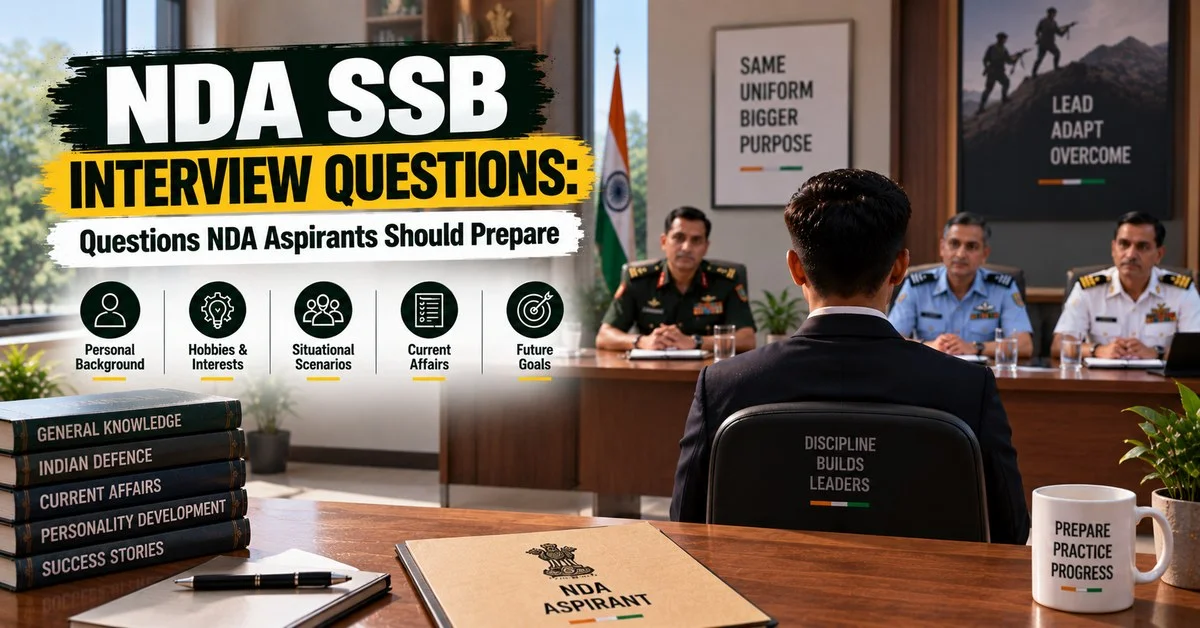
NDA SSB Interview Questions cover personal background, defence motivation, leadership situations, current affairs and rapid-fire questions. Explore 50 important questions, understand the OLQs assessors observe and learn practical tips for SSB interview preparation.
You cleared the NDA written exam. Now the Services Selection Board stands between you and a uniform. Most written exam clearers walk into their SSB centre without a clear picture of what the five-day process actually tests, and that gap is where recommendations are lost. This guide gives you the 50 most important NDA SSB interview questions, mapped to the qualities assessors are actually measuring, so you stop guessing and start preparing with a purpose. The same applies to SSB personal interview questions for NDA.
What Is the SSB Interview and Why It Matters for NDA
The SSB interview is a five-day defence entrance personality assessment conducted by the Services Selection Board to evaluate whether a candidate has the qualities required of a commissioned officer. Clearing the NDA written exam only earns you a seat at the SSB; the actual selection happens here. That is especially true when it comes to NDA SSB interview questions.
The five-day process runs across three assessment streams: Psychology tests on Day 2, Group Testing Officer tasks on Days 3 and 4, and the Personal Interview conducted by the Interviewing Officer, usually on Day 3 or 4. All three streams run simultaneously, and the final board conference integrates observations from every assessor before a candidate is marked as recommended. Keep that in mind as you plan your SSB interview preparation.
The recommended rate at SSB centres for NDA batches sits between 1 and 5 percent of those who report. That number sounds alarming, but it reflects one fact: most candidates are not rejected because they lack potential. They are rejected because they have not understood what the board is looking for. According to SSBCrack's preparation guide for NDA aspirants, the biggest differentiator between selected and rejected candidates is self-awareness, not intelligence. Understanding the evaluation framework gives you a genuine edge, and that is particularly true when preparing for officer like qualities SSB.
How SSB Assessors Evaluate You: The 15 OLQs Explained
Every question an Interviewing Officer asks, every story prompt in the Thematic Apperception Test, and every GTO task maps back to 15 officer like qualities that SSB assessors use as their measurement grid. These qualities fall into four clusters. The same applies to SSB psychology test questions.
-
Planning and Organising: Effective intelligence, reasoning ability, organising ability, power of expression
-
Social Adjustment: Social adaptability, cooperation, sense of responsibility
-
Social Effectiveness: Initiative, self-confidence, ability to influence the group, speed of decision
-
Dynamic Qualities: Liveliness, determination, courage, stamina
Understanding these clusters lets you reverse-engineer every question. When an assessor asks "Tell me about a time you failed," they are not looking for regret. They are measuring determination and self-confidence. When they ask how you handled a conflict in school, they are probing cooperation and social adaptability. According to the full OLQ breakdown on SSBCrack, a recommended candidate does not need to max out all 15 qualities but must show consistent strength across the social effectiveness and dynamic qualities clusters. This matters just as much for SSB psychology test questions.
Military leadership traits, in SSB language, are not about aggression or rank aspiration. They are about calm initiative, measured decision-making, and the ability to bring others along. Every answer you give should communicate at least one of those attributes naturally, and that is especially important for SSB current affairs questions 2026.
Stage 1: Psychology Round Questions (TAT, WAT, SRT, SDT)
The psychology round is where many NDA aspirants underperform because they treat it as a written test rather than a personality mirror. The four instruments used are the Thematic Apperception Test, Word Association Test, Situation Reaction Test, and Self Description Test. The same principle carries over to SSB GD topics for NDA.
The Thematic Apperception Test presents 11 pictures plus one blank slide. You write a short story for each in about 4 minutes. Assessors look for heroes who take initiative, face obstacles calmly, and arrive at socially constructive outcomes. A representative prompt: a blurred image of a person standing at a crossroads. The OLQ being tested is decision-making under ambiguity.
The Word Association Test gives you 60 words, one at a time, with 15 seconds per word. Write the first positive, action-oriented sentence that comes to mind. The OLQ tested varies by word but broadly targets liveliness and self-confidence. One practical tip: avoid negative constructions entirely.
The Situation Reaction Test presents 60 everyday situations in 30 minutes. Each is a micro-leadership scenario. Example: "You are the monitor and two classmates are fighting before an important exam." The OLQ tested is social adaptability and initiative. Your response should show calm intervention, not a display of authority.
The Self Description Test asks you to write how your parents, teachers, friends, and you yourself see you. Responses must align with your PIQ form answers. Contradictions between the Self Description Test and your PIQ are flagged immediately during the board conference.
Stage 2: Group Discussion and GTO Round: What Assessors Observe
The Group Testing Officer tasks span two days and include a group discussion, group planning exercise, progressive group tasks, half group tasks, individual obstacles, and a command task. For NDA batches, the group discussion is often the first impression the GTO forms of you.
Common SSB GD topics for NDA include: social media's effect on youth discipline, whether women should be inducted into combat roles, India's border security challenges, the role of technology in modern warfare, and whether the Agniveer scheme serves India's long-term defence needs.
What the Group Testing Officer actually notes during a GD is not who speaks most. The assessor tracks who initiates, who listens before contributing, who builds on others' points rather than dismissing them, and who steers the group toward a conclusion when time runs short. Assertiveness and aggression are treated as opposites in the SSB framework. Speaking with evidence is assertive; repeated interruptions read as aggressive, and aggressive candidates rarely get recommended.
Prepare 8 to 10 current topic clusters rather than memorising fixed arguments. The ability to pivot and respond to what others say demonstrates effective intelligence, one of the four planning and organising OLQs.
Stage 3: Personal Interview Questions: All 50 (Organised by Theme)
These are the core SSB personal interview questions for NDA that the Interviewing Officer draws from across five thematic areas. Each entry notes the OLQ being probed.
About Yourself (12 Questions)
-
Tell me about yourself. OLQ: Power of expression, self-confidence. Assessors check whether your narrative is coherent and matches your PIQ form answers exactly.
-
Describe your family background. OLQ: Social adaptability. They assess how your environment shaped your values.
-
What was your best subject in school and why? OLQ: Effective intelligence. Vague answers reveal low self-awareness.
-
Tell me about a leadership role you held. OLQ: Initiative, ability to influence the group.
-
What are your strengths? OLQ: Self-confidence. Support every strength with a specific example.
-
What are your weaknesses? OLQ: Sense of responsibility. Name a real weakness and state what you are doing about it.
-
Describe your hobbies and how they have shaped you. OLQ: Liveliness, stamina.
-
Tell me about your school and its culture. OLQ: Cooperation. Assessors look for warmth and team orientation, not self-promotion.
-
What extra-curricular activities did you lead or participate in? OLQ: Initiative.
-
How do your friends describe you? OLQ: Social adaptability. Must align with Self Description Test responses.
-
What is the most difficult challenge you have faced personally? OLQ: Determination, courage.
-
What do you do to stay physically fit? OLQ: Stamina
.
Motivation for Defence / NDA (10 Questions)
-
Why do you want to join the defence forces? OLQ: Sense of responsibility.
-
Why the Army / Navy / Air Force specifically? OLQ: Reasoning ability. Generic answers kill credibility here.
-
Who is your role model and why? OLQ: Determination. Choose someone whose qualities you can demonstrate, not just admire.
-
What do you know about life at the National Defence Academy? OLQ: Effective intelligence.
-
Do you have any family members in the defence forces? How has that influenced you? OLQ: Social adaptability.
-
What will you do if you are not recommended this time? OLQ: Determination, self-confidence.
-
What qualities do you think make a good officer? OLQ: Power of expression.
-
Which arm or branch do you want to serve in and why? OLQ: Reasoning ability.
-
How long have you been preparing for NDA and the SSB? OLQ: Stamina, determination.
-
What sacrifices are you willing to make for a career in uniform? OLQ: Courage.
Situation-Based and Leadership Questions (10 Questions)
-
You are leading a team and a junior member refuses to follow orders. What do you do? OLQ: Ability to influence, cooperation.
-
Your unit is on a relief mission and resources fall short midway. How do you proceed? OLQ: Organising ability, speed of decision.
-
A peer takes credit for your work in front of a senior. How do you respond? OLQ: Courage, social adaptability.
-
You witness a colleague acting unethically. What is your course of action? OLQ: Sense of responsibility, courage.
-
Describe a time you took a decision with incomplete information. OLQ: Speed of decision, determination.
-
How do you motivate a group that has lost morale? OLQ: Initiative, ability to influence.
-
What would you do if your senior gives you an order you believe is wrong? OLQ: Courage, reasoning ability.
-
You are first at the scene of a road accident. Walk me through your actions. OLQ: Initiative, speed of decision.
-
How do you handle failure in a public setting? OLQ: Self-confidence, determination.
-
A team member is struggling with mental stress during a critical task. What do you do? OLQ: Cooperation, social adaptability.
Current Affairs and Defence Knowledge (10 Questions)
-
Name India's most recent major defence acquisition. OLQ: Effective intelligence.
-
What is the significance of the Agni-V missile for India's strategic posture? OLQ: Reasoning ability.
-
Which countries participated in the latest India-hosted military exercise? OLQ: Effective intelligence.
-
What are India's current border challenges and how is the military responding? OLQ: Reasoning ability.
-
What do you know about the Agniveer scheme? OLQ: Effective intelligence.
-
Name an Indian military operation from the past decade and explain its objective. OLQ: Power of expression.
-
What is India's current defence budget and what does it signal? OLQ: Reasoning ability.
-
Which government scheme is most relevant to India's internal security? OLQ: Effective intelligence.
-
How does India's relationship with its neighbours affect the Army's operational priorities? OLQ: Reasoning ability.
-
What is your view on India's role in United Nations peacekeeping missions? OLQ: Power of expression.
Stress and Rapid-Fire Questions (8 Questions)
-
Spell a word I give you backwards, right now. OLQ: Effective intelligence, liveliness.
-
What is wrong with you? OLQ: Self-confidence. The correct response is calm, not defensive.
-
Your scores are average. Why should we recommend you? OLQ: Courage, self-confidence.
-
Name five defence ministers of India in 10 seconds. OLQ: Effective intelligence.
-
You seem nervous. Are you always like this? OLQ: Social adaptability, self-confidence.
-
What is the last book you read? Give me a one-minute summary. OLQ: Power of expression.
-
If your friend told you not to join the forces, what would you say? OLQ: Determination, courage.
-
Convince me in 30 seconds why you deserve to be an officer. OLQ: Self-confidence, power of expression.
How to Answer Current Affairs Questions in SSB PI (2026 Strategy)
SSB current affairs questions 2026 will cluster around four topic areas: India's defence acquisitions (Tejas MK1A induction, S-400 squadrons, DRDO missile tests), border situations (LAC updates, LoC dynamics, maritime boundaries in the Indian Ocean Region), joint military exercises (Yudh Abhyas, Malabar, Tasman Saber), and government schemes affecting the armed forces (Agniveer, Make in India for defence, One Rank One Pension status).
How you frame your answer matters as much as the facts themselves. State what you know, acknowledge the complexity, and connect the issue to India's broader security interest. Assessors are not checking whether you read yesterday's newspaper. They are checking whether you can reason about defence issues with clarity, which is a direct test of effective intelligence and power of expression.
Avoid over-claiming. If you are unsure of a specific figure, say so and offer what you do know. Fabricating statistics in front of an Interviewing Officer damages your credibility across the entire interview, not just that one answer. For a structured approach, SSBCrack's current affairs answer framework recommends this sequence: context, India's position, and your informed perspective.
Common Mistakes NDA Candidates Make in SSB Interview
Four mistakes account for the majority of rejections among NDA aspirants at SSB, according to preparation data from Oliveboard's SSB question analysis.
-
Contradicting PIQ form answers: Candidates list hobbies in the PIQ they cannot discuss fluently in the interview. Fix: write your PIQ only about things you can speak on for two minutes without notes.
-
Over-rehearsed responses: Memorised answers sound hollow and collapse under follow-up questions. Fix: prepare themes and real examples, not scripted monologues.
-
Body language gaps: Slouching, breaking eye contact, and fidgeting signal low self-confidence even when the words are strong. Fix: practise mock interviews on camera and review your posture specifically.
-
Zero current affairs depth: Candidates name a news event but cannot explain its strategic relevance. Fix: spend 20 minutes daily on one defence topic and practise articulating its significance to a peer before your SSB date.
30-Day SSB Interview Preparation Plan for NDA Aspirants
This week-by-week structure is among the most practical SSB interview preparation tips you can follow after clearing the NDA written exam.
-
Week 1 - PIQ and Self-Knowledge: Complete your PIQ form answers in full draft. Cross-check every entry against what you can actually speak about. Write your Self Description Test response and read it aloud daily.
-
Week 2 - Current Affairs: Build a topic file on India's defence acquisitions, military exercises, border situations, and government schemes. Write three sentences on each topic explaining its strategic significance, not just the headline.
-
Week 3 - Mock Personal Interview: Conduct two mock PI sessions with a peer or mentor using the 50 questions in this guide. Record each session and review body language, eye contact, and answer coherence.
-
Week 4 - GTO and Psychology Practice: Write 10 TAT stories under timed conditions. Practise WAT with a timer. Run through 60 SRT situations in 30 minutes. Join a group discussion practice session and deliberately let others speak before you contribute, then work on steering the group toward a conclusion.
FAQs
What questions are asked in the SSB personal interview for NDA?
The Interviewing Officer covers five broad themes: personal background, motivation for defence, situation-based leadership scenarios, current affairs and defence knowledge, and stress or rapid-fire questions. The 50 questions listed above represent the most commonly reported questions across NDA SSB batches.
Which officer like qualities are most important in the SSB interview?
All 15 OLQs are assessed, but the social effectiveness cluster (initiative, self-confidence, ability to influence, speed of decision) carries the most observable weight in the personal interview and GTO rounds. Candidates who demonstrate calm initiative consistently across all stages are most likely to be marked as recommended.
How do I prepare for SSB psychology tests as an NDA aspirant?
Start with the Self Description Test since it anchors all other responses. Practise TAT story writing daily with a 4-minute timer per image. For WAT, train your instinct to respond positively and actively to every word. SRT preparation involves reading through situational scenarios and practising calm, constructive responses rather than reactive ones.
What are the most common mistakes NDA candidates make in SSB and how to avoid them?
The four recurring mistakes are PIQ contradictions, over-rehearsed answers, poor body language, and shallow current affairs knowledge. Each has a direct fix: write your PIQ from real experience, prepare themes not scripts, practise on camera, and build a structured weekly current affairs habit.
How is the SSB interview different for NDA versus CDS candidates?
The SSB structure is identical for both, but NDA candidates are typically 16 to 18 years old during their first attempt, so assessors calibrate expectations for maturity differently. For NDA aspirants, the screening round places more weight on potential and basic officer-like instincts rather than the professional experience a CDS candidate might already have. The five-day SSB process, OLQ framework, and three assessment streams remain the same.
For further reading, see SSB Interview Questions Asked by Interviewing Officer, Complete List.