NDA SSB Interview After Written: Complete Process for Shortlisted Candidates
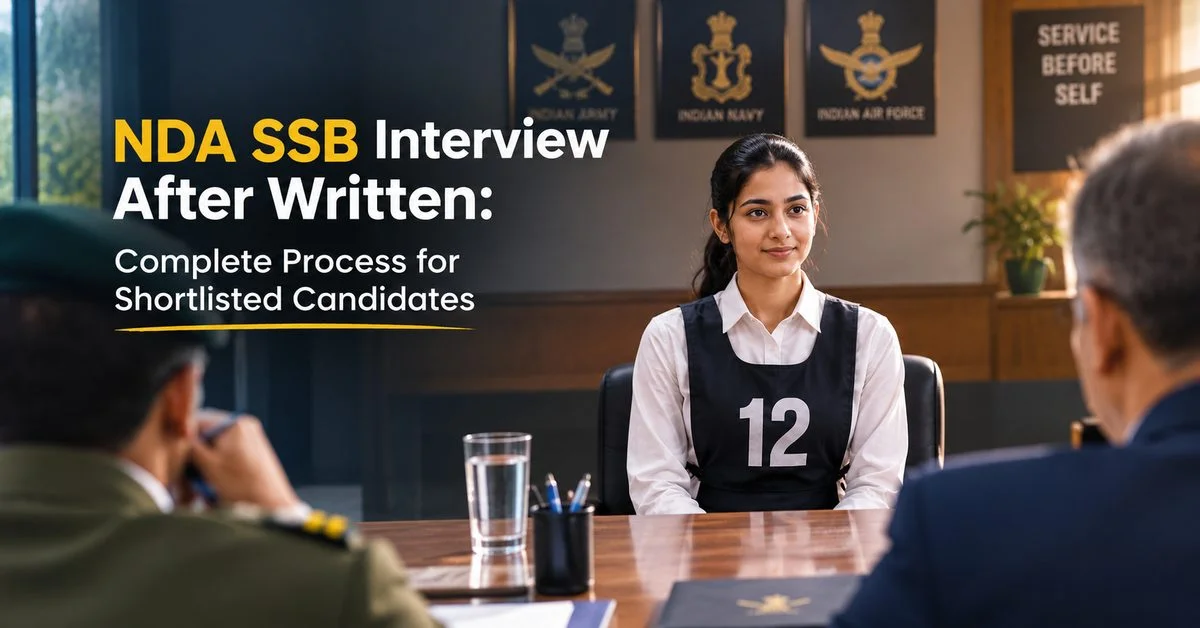
Learn what happens after clearing the NDA written exam, including SSB reporting, the five-day selection process, key tests, GTO tasks, personal interview, and the final merit list.
Clearing the NDA written exam is a genuine achievement, but most candidates discover within hours that it raises more questions than it answers. What happens next? Where do you report? What is actually tested across those five days? The NDA SSB interview is a structured, multi-stage selection process designed to assess far more than academic ability, and understanding it stage by stage is the single most useful thing you can do right now. That is especially true when preparing for the NDA SSB interview after the written exam.
This guide covers the complete process from the UPSC notification to the final merit list, including Day 0 reporting details that most competing guides skip entirely. The same principle applies to SSB psychological tests.
What Happens After You Clear the NDA Written Exam
Once UPSC declares the NDA written result, the shortlisted candidates are published on the official UPSC website. Your name on that UPSC NDA shortlist means you are eligible to appear for the Services Selection Board interview. UPSC does not send individual letters by default. You must check the website yourself and download the call-up letter directly. That detail is worth keeping in mind well before GTO tasks or any SSB interview preparation begins.
After the shortlist is published, UPSC assigns each candidate a reporting date, an SSB centre, and a chest number. The six SSB centres currently operating are Allahabad, Bhopal, Bangalore, Dehradun, Kapurthala, and Visakhapatnam. SSB chest number allotment is done by UPSC and printed on your call-up letter. That number becomes your identity throughout the entire five-day process.
The NDA SSB interview after written exam clearance typically begins several weeks after the result, giving candidates time to prepare documents and travel. According to Trishul Defence Academy, candidates must treat the reporting date as non-negotiable. Arriving late or without the correct documents can lead to immediate withdrawal from the process, and the same holds for what to carry for the SSB interview.
The SSB interview five-day process is the only remaining hurdle between a written qualifier and a seat at the National Defence Academy. Understanding what each day demands is not optional preparation. It is essential planning, and that matters just as much when considering the NDA merit list after SSB.
Documents to Carry for SSB Reporting: Complete Checklist
Knowing what to carry for SSB interview reporting is as important as any psychological preparation. A document shortfall on reporting day can result in immediate rejection, regardless of how well prepared you are for the tests themselves. This applies equally to candidates heading to SSB centres in Allahabad, Bhopal, or Bangalore.
Carry every item below as originals, with two sets of self-attested photocopies. The same applies to travel documents for the reimbursement process if you are screened out.
-
UPSC call-up letter (printed copy, not a screenshot)
-
Class 10 mark sheet and passing certificate (for date of birth proof)
-
Class 12 mark sheet and passing certificate
-
Domicile certificate issued by the competent authority
-
Character certificate from a gazetted officer or school principal
-
A minimum of 20 recent passport-size photographs (white background)
-
Valid government-issued photo ID (Aadhaar, passport, or voter card)
-
Caste certificate, if applicable
-
NCC certificate, if applicable
Candidates screened out on Day 1 receive travel reimbursement, so retain all travel tickets and boarding passes regardless of how confident you feel going in. As confirmed by SSBCrack, UPSC rules on document completeness are strictly enforced at the centre level, with no exceptions granted on the day.
Day 0: Reporting Day and What to Expect at the SSB Centre
Day 0 is the reporting day, and it is the stage almost no competing guide covers in useful detail. Candidates arrive at the SSB centre on the evening before Day 1 begins. This is not a test day, but it sets the foundation for everything that follows.
On arrival, candidates submit their documents for preliminary verification by administrative staff. Once documents are accepted, each candidate receives their chest number physically, confirming SSB chest number allotment is finalised. From that point forward, you are referred to by number rather than name throughout the board process.
After verification, candidates attend an orientation briefing where the schedule, rules, and conduct expectations are explained. Accommodation is allotted within the centre or at a designated location nearby, and meals are typically provided from Day 0 itself.
Use Day 0 to settle in, sort your documents, and get adequate sleep. Conversations among candidates are common, but avoid sharing personal details that might create inconsistencies with what you later write in the Personal Information Questionnaire. First impressions within a group can subtly influence GTO observations in the days ahead, so maintain natural, confident composure from the moment you arrive.
Day 1: Screening Test and the Make-or-Break Stage
Day 1 is the first genuine filter in the SSB interview five-day process, and statistically it is the most brutal. Roughly 50 to 60 percent of candidates are screened out at this stage and asked to leave the centre the same evening.
The day runs as a two-stage filter. First, candidates take the Officer Intelligence Rating test, which consists of verbal and non-verbal reasoning questions. This is not a general knowledge test. It measures reasoning speed and pattern recognition under time pressure, and the OIR score contributes to the overall Officer Intelligence Rating assigned at the end of the board.
Second, candidates take the Picture Perception and Description Test. In the PPDT, a hazy image is displayed for 30 seconds. Candidates then write a story around it in four minutes, covering a central character, a situation, and an outcome. After individual writing, candidates are placed in groups to narrate their stories and arrive at a common group story through discussion.
Assessors watch the PPDT group discussion for communication clarity, leadership behaviour, and the ability to listen and persuade without dominating. Candidates who clear screening proceed to Days 2 through 5. Those who do not are relieved the same evening with travel reimbursement, as confirmed by both Trishul Defence Academy and SSBCrack.
Days 2 and 3: Psychological Tests Including TAT, WAT, SRT, and SDT
SSB psychological tests span Days 2 and 3 and are administered in a single extended session. There are four tests in this battery, each assessing a different layer of personality. The psychologist uses these tests independently of the GTO and interviewing officer, and all three assessors compare notes only on conference day.
The Thematic Apperception Test presents 11 pictures plus one blank slide. For each, you write a story in about four minutes. Assessors look for positive, action-oriented narratives that reflect Officer Like Qualities such as initiative, courage, and social adaptability. Negative or passive stories are a consistent red flag.
The Word Association Test shows 60 words on a screen for 15 seconds each. You write the first response that comes to mind. Because the pace leaves no room for overthinking, your answers reveal subconscious thought patterns and emotional orientation far more honestly than a prepared response ever could.
The Situation Reaction Test presents 60 printed situational problems to be answered within 30 minutes. Responses are judged on practicality, initiative, and social adaptability rather than textbook correctness. Speed matters here. Leaving blanks is worse than an imperfect answer.
The Self Description Test asks you to write what your parents, teachers, friends, and you yourself think of your character. Consistency between what you write here and what you later say in the Personal Interview is carefully checked. Discrepancies signal inauthenticity, which is one of the fastest ways to lose a recommendation. To practice under realistic conditions, work through recent SSB mock interview questions used at actual boards.
Days 3 and 4: GTO Tasks and the Group and Individual Outdoor Challenges
GTO tasks in the NDA SSB interview run across Days 3 and 4 and place candidates in real-world group scenarios where Officer Like Qualities are observable rather than self-reported. The Group Testing Officer watches constantly but intervenes rarely.
Group tasks include two rounds of Group Discussion, one on a factual topic and one on an abstract topic. The Group Planning Exercise, also called the Military Planning Exercise, presents a scenario with multiple problems and the group must produce a coherent plan within a time limit. The Progressive Group Task, Half Group Task, and Final Group Task are obstacle-course exercises completed as a team using materials like planks, ropes, and barrels, with rules about which objects can be touched.
The Command Task is an individual exercise where a candidate acts as commander and chooses two peers to help complete an obstacle. It is one of the clearest windows into natural leadership behaviour. The Snake Race serves as a high-energy final group exercise.
Individual tasks include the Individual Obstacles course, a ten-obstacle circuit scored on speed and number of attempts, and the Lecturette, a three-minute talk on one of four topic options. The GTO assesses decision-making under pressure and the ability to influence a group without dominating it. Physical initiative matters, but candidates who shout commands and ignore teammates consistently underperform those who communicate and collaborate.
Day 4: Personal Interview and What the Interviewing Officer Is Really Assessing
The Personal Interview typically lasts between 40 and 60 minutes and is conducted one on one with a commissioned officer designated as the Interviewing Officer. There is no fixed question set. The IO builds the interview around your Personal Information Questionnaire, which you filled out on Day 1, and follows threads based on your answers.
Key areas covered include self-awareness, family background, schooling and extracurricular achievements, sports and hobbies, current affairs and defence news, and your stated motivation for joining the armed forces. NDA-specific motivation is probed directly. Vague answers like "I want to serve the country" without a personal story or specific context are consistently noted as insufficient.
What is the IO actually measuring? The core objective is to verify whether the candidate's personality is coherent and authentic. A candidate who writes about leadership experiences in the Self Description Test but cannot speak to a single specific example in the interview raises immediate concerns. The IO is not testing recall. They are assessing whether you present yourself to be held up under direct, probing questions.
Consistency with the PIQ is non-negotiable. If you listed a book, a sport, or an event in your PIQ, expect detailed follow-up questions on it.
Day 5: Conference Day and the Final Board Decision
On Day 5, the SSB conference board convenes. The Psychologist, the GTO, and the Interviewing Officer each present their independent assessments of every candidate who cleared Day 1 screening. The President of the Board, typically a Deputy President of the SSB, chairs the session and reconciles the three independent evaluations.
Each candidate is called into the conference room briefly. The board asks if the candidate has anything to add or any clarification to offer. This is not a re-interview and lasts only a few minutes. After all candidates have been seen, the board deliberates and announces results the same day.
The outcome is binary: "Recommended" or "Not Recommended." A candidate confirmed as an NDA recommended candidate is not yet guaranteed a training seat.
Recommended vs. Merit: What the Difference Actually Means
This is the most underserved question in the entire NDA SSB discussion, and the confusion is understandable. Being recommended by the SSB is a significant achievement, but it does not guarantee a seat at the National Defence Academy training campus in Khadakwasla.
After all SSBs across all centres complete their rounds, UPSC compiles the NDA merit list after SSB. This list is built using a combined score derived from the NDA written exam marks and the SSB assessment marks. A candidate who was recommended but scored relatively lower in the written exam can be displaced by a higher-combined-score candidate who was also recommended at a different centre.
The total number of seats available is fixed for each NDA course. If 600 candidates are recommended nationally and only 370 seats are available, the bottom 230 recommended candidates are merited out. Being recommended means you cleared the personality and suitability filter. Being within the merit means your combined score was competitive enough to fill an available seat.
This is why strong written exam performance still matters even after you clear screening. Treat both stages as equally important, and check the final UPSC merit list on the official UPS C website once it is published after all SSBs conclude.
Your next practical step is to begin building answers to the specific questions boards ask most often, starting with a focused review of your PIQ entries and self-awareness narratives. The SSB rewards consistency and authenticity above everything else.