NDA Medical Test 2026: What Is Checked, CPSS & How to Prepare
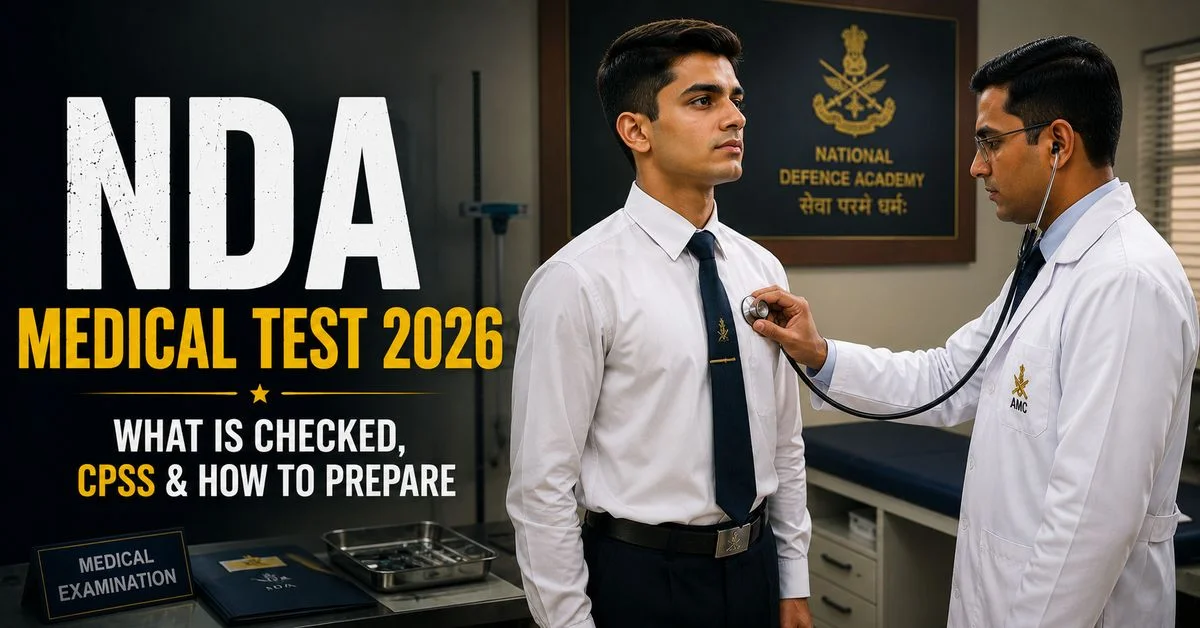
Learn what to expect in the NDA Medical Test 2026, from physical and medical standards to CPSS, common issues, and preparation.
Most NDA aspirants spend months on the written exam and SSB interview, then arrive at the medical board underprepared. The NDA Medical Test 2026 is the final filter before merit listing, and it assesses far more than height and weight. Doctors examine at least eight body systems, and a single borderline finding can result in temporary rejection. This guide covers every standard you must meet, explains CPSS for pilot aspirants, and gives you a concrete 12-week preparation plan, particularly when it comes to NDA medical standards.
What Is the NDA Medical Test and When Does It Happen?
The NDA medical test comes after SSB interview selection, making it the third and final stage of the NDA selection process. Only candidates who clear SSB receive a call for the medical examination. The sequence matters: a fail at this stage does not nullify your SSB result, but it does prevent final merit listing. The same principle applies when thinking about how to prepare for NDA medical test.
Examinations are conducted at designated military hospital medical board facilities across India. The board is constituted by serving military doctors following standardised UPSC-prescribed NDA medical standards. The process typically spans one to three days depending on candidate load at that particular board. Worth factoring this into your planning for how to prepare for NDA medical test.
Knowing when the medical test happens gives you a defined window between SSB recommendation and the board date. Use that window strategically rather than waiting for a call letter to prompt action, and keep this in mind when planning for NDA height weight requirement as well.
NDA Medical Test 2026: Full Standards at a Glance
The following standards apply to male candidates under general NDA physical fitness standards. Female-specific standards are covered separately below, as are correctable medical conditions NDA.
-
Height (Army): Minimum 157.5 cm
-
Height (Navy): Minimum 157 cm
-
Height (Air Force): 162.5 cm to 196 cm
-
Weight: Proportionate to height and age; BMI for NDA candidates must fall within the acceptable range for their age group
-
Distant vision (corrected): 6/6 in the better eye and 6/9 in the worse eye for Army and Navy; stricter unaided standards apply for Air Force flying branch
-
Near vision: N5 in the better eye, N10 in the worse eye
-
Colour vision: CP-1 (normal colour perception) required for Air Force; CP-3 acceptable for Army and Navy
-
Hearing: No hearing loss beyond 30 dB in either ear
-
Dental: 14 dental points minimum; no untreated decay or severe misalignment
Candidates should review the complete current standards on Prepp's NDA physical test page and Testbook's NDA medical test guide before their board date, as thresholds can be updated each cycle.
What Do Doctors Actually Check? A System-by-System Breakdown
The medical board is not a single physical check. Doctors conduct a structured, multi-system examination, and here is what each stage involves.
General body and orthopaedic fitness check: Doctors assess posture, spine alignment, limb symmetry, and joint mobility. The orthopaedic fitness check specifically looks for flat feet, knock knees, bow legs, and any limb deformity. Flat feet NDA eligibility depends on the degree of arching, with mild flat feet potentially acceptable but a complete absence of arch typically disqualifying.
ENT examination defence: This stage checks for nasal septum deviation, ear infections, perforated eardrums, and chronic sinusitis. Even partially blocked hearing passages can result in a temporary hold.
Ophthalmology: Distant vision, near vision, and the colour vision test NDA using Ishihara plates are all tested here. Refractive error limits, squint, and night vision are also assessed at this stage.
Cardiovascular: An ECG is conducted. Any irregularity, murmur, or elevated blood pressure reading triggers further investigation.
Mental health screening: A brief psychiatric evaluation assesses behavioural history and psychological stability. This is distinct from SSB psychological tests but draws on a similar framework.
Skin and general systemic check: Doctors look for psoriasis, eczema, and other skin conditions that could affect operational fitness. Internal organs are assessed by palpation and relevant clinical tests.
What Is CPSS and Do You Have to Appear for It?
CPSS refers to the Computerised Pilot Selection System. It is a specialised aptitude battery administered by the Indian Air Force and is mandatory only for candidates who have marked the NDA Air Force flying branch as a preference. Army and Navy aspirants do not appear for CPSS at all.
The Computerised Pilot Selection System involves three primary assessments. First, a psychomotor aptitude test measures hand-eye coordination, reaction time, and limb independence under dynamic conditions. Second, instrument-reading aptitude is tested through simulated cockpit-style tasks. Third, spatial orientation tasks evaluate the candidate's ability to interpret orientation cues accurately.
CPSS is conducted at Air Force Selection Boards, not at military hospitals. Failing CPSS does not mean you fail the general NDA medical test, it means you are not recommended for the flying branch specifically. Candidates who fail CPSS can still be considered for ground-duty branches of the Air Force if otherwise medically fit.
One important detail: CPSS can only be attempted twice in a lifetime. This cap applies regardless of how many NDA attempts a candidate makes overall.
NDA CPSS vs. NDA Medical Test: Key Differences
Confusion between CPSS NDA and the standard medical test is common, and the distinction matters significantly for planning your preparation.
-
Who appears: All SSB-recommended candidates appear for the NDA medical test. Only flying branch aspirants appear for CPSS NDA.
-
What is tested: The medical test examines physical and systemic health. CPSS tests psychomotor aptitude, hand-eye coordination, and instrument-reading ability through a psychomotor aptitude test.
-
Where it happens: Medical boards are held at military hospitals. CPSS takes place at Air Force Selection Boards.
-
Pass/fail impact: Failing the medical test bars you from all NDA branches. Failing CPSS bars you only from flying roles, not from other Air Force or service branches.
-
Attempt limit: The medical test can be revisited through a review medical board. CPSS carries a strict two-attempt lifetime cap.
Candidates applying for Army or Navy should ignore CPSS preparation entirely and focus on the standard medical board requirements.
Common NDA Medical Rejection Reasons and How to Avoid Them
NDA medical rejection reasons fall into two categories: correctable and non-correctable. Knowing which is which shapes how urgently you need to act.
Eyesight beyond permissible limits: This ranks among the most frequent NDA medical rejection reasons. For Army and Navy, spectacles or contact lenses bringing vision to the required standard are acceptable. For Air Force flying, unaided vision requirements are strict. Begin monitoring your eye health at least six months before your board date. Corrective surgery like LASIK may be considered but is subject to a mandatory waiting period before the medical examination.
BMI outside range: Being significantly underweight or overweight triggers rejection. BMI for NDA candidates is assessed against age-correlated tables. Structured nutrition and training over 10 to 12 weeks can correct this.
Colour blindness: Detected through the colour vision test NDA, this is non-correctable. Candidates with colour vision deficiency beyond CP-3 are ineligible for Army and Navy, and any deficiency beyond CP-1 rules out flying roles entirely.
Flat feet: Flat feet NDA eligibility depends on severity. Grade 1 flat feet may pass; Grade 2 and above typically result in rejection. Corrective insoles and specific exercises over several months can help mild cases but cannot reverse structural issues.
Varicose veins disqualification: Varicose veins disqualification applies even to mild cases visible on examination. This is generally non-correctable through conservative means before the board date.
Dental deficiency: Insufficient dental points or active decay is correctable. Visit a dentist at least eight weeks before the medical board to address cavities, calculus, and alignment issues.
NDA Medical Test for Female Candidates 2026
Female NDA candidates, admitted since 2021, follow a distinct set of physical standards under the current framework.
-
Minimum height: 152 cm for most branches
-
Weight: Proportionate to height; BMI assessment follows the same age-correlated tables used for male candidates
-
Eyesight: NDA medical test eyesight standards for female candidates mirror those applicable to the branch they are applying for, with the same distant vision, near vision, and colour vision requirements
Procedurally, female candidates undergo the same system-by-system examination at the military hospital medical board. The ENT examination defence, orthopaedic fitness check, cardiovascular assessment, and mental health screening apply identically. There is no waiver on colour vision or flat feet standards for female aspirants.
For preparation, female candidates should follow the same 12-week plan outlined in the next section, with weight management calibrated to the female BMI tables rather than male standards. Consulting a sports physician familiar with military fitness requirements is advisable.
Step-by-Step NDA Medical Test Preparation Guide 2026
The most effective approach is to treat the medical board like a structured fitness programme, not a last-minute checklist review.
Weeks 1 to 4: Baseline assessment and BMI correction
-
Get a full health check-up including blood pressure, blood sugar, and BMI
-
Begin a structured diet and exercise programme if BMI is borderline
-
Note any orthopaedic concerns, particularly flat feet or knee alignment
-
Start cardiovascular conditioning: running 5 km daily builds baseline NDA physical fitness standards
Weeks 5 to 8: Specialist consultations
-
Visit an ophthalmologist to test eyesight and check NDA medical test eyesight standards against your current refraction
-
Attend a dental appointment; complete all restorative work by week 7 to allow healing time
-
See an orthopaedic specialist if flat feet or knee concerns were identified in weeks 1 to 4
-
Complete the ENT examination defence consultation to rule out septal deviation or ear issues
Weeks 9 to 12: Consolidation and final readiness
-
Maintain the fitness programme without introducing new drills that could cause injury
-
Prioritise 7 to 8 hours of sleep nightly to ensure stable blood pressure readings on board day
-
Avoid corrective medical interventions in this final phase; the body needs to present in its stable, trained state
-
Revise the standards checklist and confirm all correctable conditions have been addressed
FAQs
What are the exact height, weight, and eyesight standards for the NDA medical test 2026, and what happens if I fall slightly short?
The NDA height weight requirement for Army is a minimum of 157.5 cm for males. Navy requires 157 cm and Air Force requires between 162.5 cm and 196 cm. Weight must be proportionate to height using the official age-correlated BMI tables. For eyesight, corrected vision of 6/6 and 6/9 is required for Army and Navy. Falling slightly short on a correctable measure such as weight triggers a temporary rejection; you can reappear once corrected in a future cycle.
What is CPSS in NDA, how is it different from the regular medical test, and do all candidates have to appear for it?
CPSS NDA refers to the Computerised Pilot Selection System, a psychomotor and aptitude battery tested at Air Force Selection Boards. It is mandatory only for NDA Air Force flying branch candidates. Army and Navy candidates do not sit for CPSS. The general medical test is a physical and systemic health examination at a military hospital; CPSS tests cognitive and coordination aptitude in a simulated environment.
What is the step-by-step process of the NDA medical examination and which systems do doctors check?
The examination follows a fixed sequence: general body and orthopaedic fitness check, ENT examination defence, ophthalmology including the colour vision test NDA, cardiovascular assessment including ECG, mental health screening, and a skin and systemic examination. The entire process typically takes one to three days at the designated military hospital medical board.
What are the most common reasons for NDA medical rejection and which ones are correctable?
Common NDA medical rejection reasons include eyesight beyond permissible limits, BMI outside the acceptable range, colour blindness, flat feet, varicose veins, and dental deficiency. Correctable conditions include BMI, dental issues, and mild refractive errors within the correctable range. Non-correctable conditions include colour blindness beyond the permitted category and varicose veins disqualification.
Can I appear for NDA if I have flat feet or use spectacles?
Flat feet NDA eligibility depends on the grade identified during the orthopaedic fitness check. Mild cases may pass; severe structural flat feet are disqualifying. Spectacles are permitted for Army and Navy branches provided corrected vision meets the 6/6 and 6/9 standard. Air Force flying branch requires much stricter unaided vision, making spectacle dependence a significant barrier for that specific role. For additional guidance on which service branch suits your profile, review our Army vs Navy career comparison guide.