NDA GAT History Preparation: Important Ancient, Medieval and Modern History Topics
Quick summary
A focused guide to NDA history preparation for GAT, covering history’s weightage, the official syllabus, important ancient, medieval and modern topics, world history, sources and an 8-week plan for NDA (I) 2027.
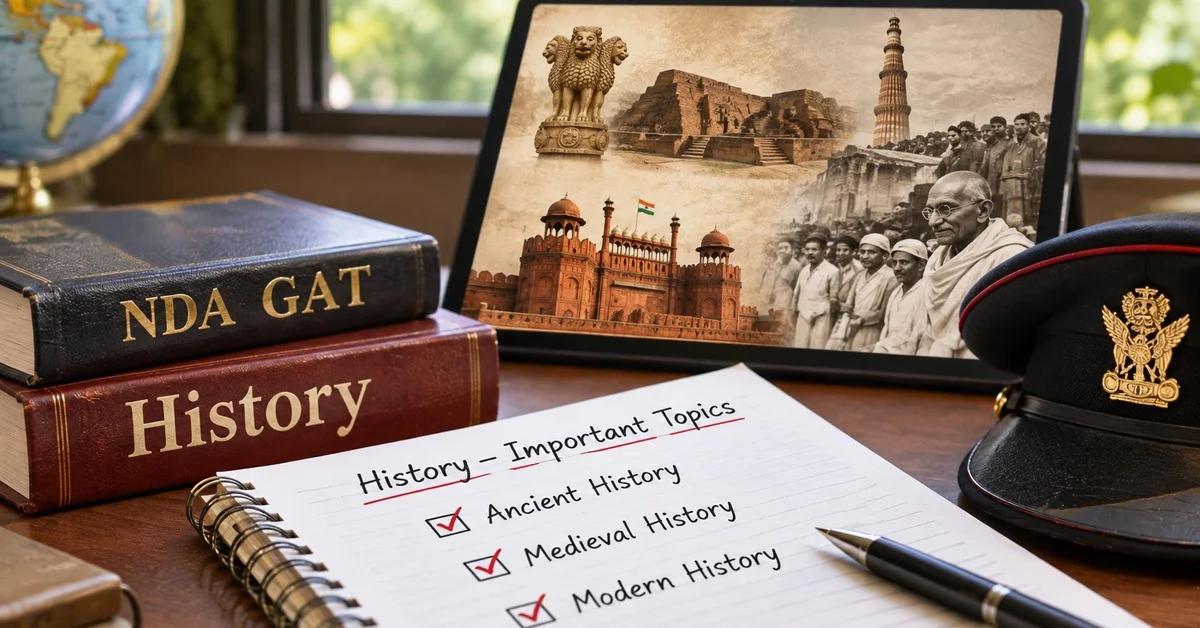
History is one of the few GAT sections where steady reading turns straight into marks. The topics repeat, the questions are mostly factual, and you don’t need to solve anything under time pressure. Most aspirants still lose easy marks here. They read Ancient India in the same depth as the freedom struggle, mix up dates, and guess when they shouldn’t.
This guide breaks NDA history preparation into what the syllabus actually covers, the topics that matter most in each period, and a simple plan to finish and revise them before NDA (I) 2027. UPSC’s calendar puts the notification on 2 December 2026 and the exam on 11 April 2027, so you have about 21 weeks from today.
How Much History Is Worth in NDA GAT
The General Ability Test (Paper II) has 150 questions for 600 marks in 2 hours 30 minutes. Part A is English (200 marks). Part B is General Knowledge (400 marks), split into six sections by approximate weightage:
| Section (Part B) | Weightage | Approx. Marks |
|---|---|---|
| Physics | 25% | 100 |
| Chemistry | 15% | 60 |
| General Science | 10% | 40 |
| History, Freedom Movement etc. | 20% | 80 |
| Geography | 20% | 80 |
| Current Events | 10% | 40 |
At 4 marks per question, history is worth about 20 questions. Each wrong answer costs you 1.33 marks, which is one-third of a question’s value. In real papers the count changes from year to year, but history and geography together are always a big part of the GK section.
Two points shape your preparation:
- Modern India gets the most weight: Past papers lean heavily towards British rule and the freedom struggle. Ancient and medieval India usually get fewer questions.
- The syllabus is wider than Indian history: UPSC’s history section also covers world history (the Renaissance, revolutions, the UN) and some basics of Indian polity and development, such as Panchayati Raj, the Five Year Plans and Bhoodan.
The Official History Syllabus in Plain Words
UPSC’s NDA syllabus for this section includes:
- A broad survey of Indian history, with emphasis on culture and civilisation
- The Freedom Movement in India
- An elementary study of the Indian Constitution and administration
- Elementary knowledge of the Five Year Plans of India
- Panchayati Raj, Co-operatives and Community Development
- Bhoodan, Sarvodaya, National Integration and the Welfare State
- The basic teachings of Mahatma Gandhi
- Forces shaping the modern world: the Renaissance, Exploration and Discovery, the War of American Independence, the French Revolution, the Industrial Revolution and the Russian Revolution
- The impact of science and technology on society
- The concepts of One World, the United Nations, Panchsheel, Democracy, Socialism and Communism
- India’s role in the present world
The phrase “with emphasis on culture and civilisation” matters. Many ancient and medieval questions ask about art, architecture, religion, literature and travellers, not just kings and battles.
Ancient History: Important Topics for NDA
Treat ancient India as a culture-first chapter. Learn who built what, which texts belong to which period, and which religious ideas came from where.
- Indus Valley Civilisation: Major sites (Harappa, Mohenjo-daro, Lothal, Kalibangan, Dholavira) and what each is known for, such as the Great Bath at Mohenjo-daro and the dockyard at Lothal. Town planning, the seals and the undeciphered script.
- Vedic period: The four Vedas, with the Rigveda as the oldest. The sabha and samiti. The shift from the Early to the Later Vedic period.
- Buddhism and Jainism: The lives and core teachings of Gautama Buddha and Mahavira, the Buddhist councils, and the Hinayana and Mahayana schools.
- Mauryan Empire: Chandragupta Maurya, Kautilya’s Arthashastra, Megasthenes’ Indica, and Ashoka’s Kalinga war, edicts and Dhamma.
- Post-Mauryan period: The Kushanas under Kanishka, and the Gandhara and Mathura schools of art.
- Gupta period: Why it is called a classical age. Aryabhata, Kalidasa and the development of temple architecture.
- South India: Sangam literature, the Pallava monuments at Mahabalipuram, and Chola administration and naval power under Rajaraja I and Rajendra I.
- Harsha and foreign travellers: Harshavardhana and Hiuen Tsang’s account of India.
Make one table with these columns: dynasty, founder, famous ruler, capital, and key cultural contribution. It covers most ancient questions in a form you can revise in ten minutes.
Medieval History: Important Topics for NDA
Medieval India is where a lot of date and ruler confusion happens. Learn it as a timeline first, then add the details.
- Delhi Sultanate (1206 onwards): The five dynasties in order (Slave, Khilji, Tughlaq, Sayyid, Lodi). Qutb-ud-din Aibak and the Qutb Minar, Alauddin Khilji’s market reforms, and Muhammad bin Tughlaq’s token currency and his attempt to move the capital to Daulatabad.
- Vijayanagara and Bahmani kingdoms: Vijayanagara’s founding by Harihara and Bukka in 1336, Krishnadeva Raya, Hampi, and the Battle of Talikota in 1565.
- Mughal Empire: Babur’s victory at the First Battle of Panipat in 1526, Sher Shah Suri’s rupiya and road network, Akbar’s mansabdari system, religious policy and the Second Battle of Panipat in 1556, Shah Jahan’s architecture, and Aurangzeb’s reign and the empire’s decline.
- Bhakti and Sufi movements: Kabir, Guru Nanak, Mirabai and the Chishti order. These are popular “match the saint with the teaching” questions.
- Marathas: Shivaji’s administration, the Ashtapradhan council, his coronation in 1674, and the Third Battle of Panipat in 1761.
The three Battles of Panipat (1526, 1556 and 1761) are an easy memory anchor. Learn who fought each one and what changed afterwards.
Modern History and the Freedom Movement: Highest-Priority Topics
This is where most of your history marks will come from, so it deserves the most time. Learn it in three layers: how British power was established, the reform and early nationalist phase, and the Gandhian mass movements.
- Coming of the Europeans: Vasco da Gama’s arrival at Calicut in 1498, and the Portuguese, Dutch, French and English trading companies.
- Expansion of British rule: The Battle of Plassey (1757), the Battle of Buxar (1764), Wellesley’s Subsidiary Alliance and Dalhousie’s Doctrine of Lapse.
- Revolt of 1857: Its causes, main centres and leaders, why it failed, and the end of Company rule in 1858.
- Social and religious reform: Raja Ram Mohan Roy and the Brahmo Samaj, the abolition of sati in 1829, Dayanand Saraswati and the Arya Samaj, Swami Vivekananda and the Ramakrishna Mission, and Jyotiba Phule’s Satyashodhak Samaj.
- Early nationalism: The founding of the Indian National Congress in 1885, the Moderates and Extremists, the Partition of Bengal and the Swadeshi movement (1905), the Surat Split (1907), the Morley-Minto Reforms (1909), the Lucknow Pact and the Home Rule movements (1916).
- Gandhian phase: Champaran (1917), the Rowlatt Act and the Jallianwala Bagh massacre (1919), the Non-Cooperation Movement and Chauri Chaura (1922), the Simon Commission (1928), the Purna Swaraj resolution at Lahore (1929), the Dandi March and the Civil Disobedience Movement (1930), the Gandhi-Irwin Pact (1931), the Poona Pact (1932), the Government of India Act (1935) and the Quit India Movement (1942).
- Road to independence: Subhas Chandra Bose and the INA, the Cabinet Mission (1946), the Mountbatten Plan and Independence (1947).
- Gandhi’s ideas: Satyagraha, ahimsa, Sarvodaya and trusteeship. These are part of the syllabus in their own right.
Build one chronology sheet for 1885 to 1947 that shows the year, the event, the Viceroy at the time, and the leader linked to it. Many questions are really chronology questions in disguise, like “which of these happened first?”
World History and Post-Independence Topics
These short syllabus items are often skipped, which is exactly why they’re worth covering. One revision page each is enough:
- Forces shaping the modern world: The Renaissance, voyages of discovery, the American War of Independence (1776), the French Revolution (1789), the Industrial Revolution and the Russian Revolution (1917)
- Ideas and institutions: Democracy, socialism and communism, the United Nations (1945), and Panchsheel (1954)
- India after 1947: The Five Year Plans, Panchayati Raj, the co-operative movement, and Vinoba Bhave’s Bhoodan movement
Best Sources for NDA History Preparation
Fewer sources, revised more often, works better than many books read once.
- NCERTs first: The Class 6–8 history books for basics, and the Class 11 and 12 books for depth on themes and the national movement
- One modern history book: A standard single-volume book on modern India, used to fill gaps after NCERT
- Previous-year papers: The last 8–10 years of NDA GAT history questions, sorted by period. They show you the depth UPSC actually tests.
- Your own notes: Dynasty tables, the 1885–1947 chronology, and a sheet of commonly confused pairs (Plassey/Buxar, Morley-Minto/Montagu-Chelmsford, Bhakti/Sufi saints)
8-Week History Plan Alongside Your Other Subjects
This plan assumes about 45 minutes of history a day, so Maths, English and science still get most of your time. Start it now and you’ll still have time for two full revision rounds before 11 April 2027.
| Week | Focus | Output |
|---|---|---|
| 1 | Indus Valley, Vedic period, Buddhism and Jainism | Ancient culture table started |
| 2 | Mauryas to Guptas, South Indian dynasties | Dynasty table complete |
| 3 | Delhi Sultanate, Vijayanagara, Bhakti and Sufi | Medieval timeline |
| 4 | Mughals and Marathas | Panipat and Mughal sheet |
| 5 | Europeans to 1857, social reformers | Modern India part 1 notes |
| 6 | 1885–1919: early nationalism to Jallianwala Bagh | Chronology sheet part 1 |
| 7 | 1920–1947: Gandhian movements to Independence | Chronology sheet complete |
| 8 | World history, post-independence topics, PYQ practice | One timed history section test |
After week 8, spend 10 minutes a day reading your sheets, and solve a set of history PYQs every week until the exam.
How to Handle History Questions in the Exam
- Use elimination: History options often include one obviously wrong date or name. If you can rule out two options, an attempt is usually worth it.
- Don’t guess blindly: A wrong answer costs 1.33 marks. If you can’t rule out any option, leave the question.
- Read statement questions carefully: Watch for “only”, “all”, and “first” in statement-based questions. These words decide the answer more often than the facts do.
- Check chronology twice: For “arrange in order” questions, find the earliest and the latest event first, then place the middle ones.
Common Mistakes in NDA History Preparation
- Equal time on every period: Ancient and medieval India deserve attention, but modern India deserves the most.
- Reading without revising: History fades fast. Without weekly revision, the facts are gone by exam day.
- Ignoring the non-history parts of the section: Gandhi’s ideas, Panchayati Raj, Panchsheel and world revolutions are in the syllabus and appear in papers.
- Skipping PYQs: Without previous papers, you can’t judge how deep to go, and you’ll either over-read or under-read.
FAQs
How many history questions come in NDA GAT?
History, Freedom Movement and related topics carry about 20% of the GK part of GAT, which is about 80 marks or roughly 20 questions. The exact count changes from paper to paper.
Which period of history is most important for NDA?
Modern Indian history and the freedom movement usually get the most questions. Ancient and medieval India are still asked, mostly on culture, religion, architecture and major rulers.
Is NCERT enough for NDA history preparation?
NCERT books cover most of what NDA asks, especially for ancient and medieval India. For modern India, add one standard modern history book and practise previous-year questions.
Does NDA history include world history?
Yes. The syllabus includes the Renaissance, the American, French, Industrial and Russian Revolutions, the United Nations, Panchsheel, and ideas like democracy and socialism.
How should I revise history before the NDA exam?
Keep short notes: a dynasty table, a medieval timeline and a 1885–1947 chronology sheet. Read them for 10 minutes daily in the last few weeks and solve history PYQs every week.
Tags
- NDA history preparation
- NDA GAT history
- NDA history syllabus
- important history topics for NDA
- NDA modern history
- NDA freedom movement questions
- NDA ancient history
- NDA medieval history
- NDA GAT weightage
- NDA (I) 2027