NDA Current Affairs 2026-2027: Important Defence and National Topics
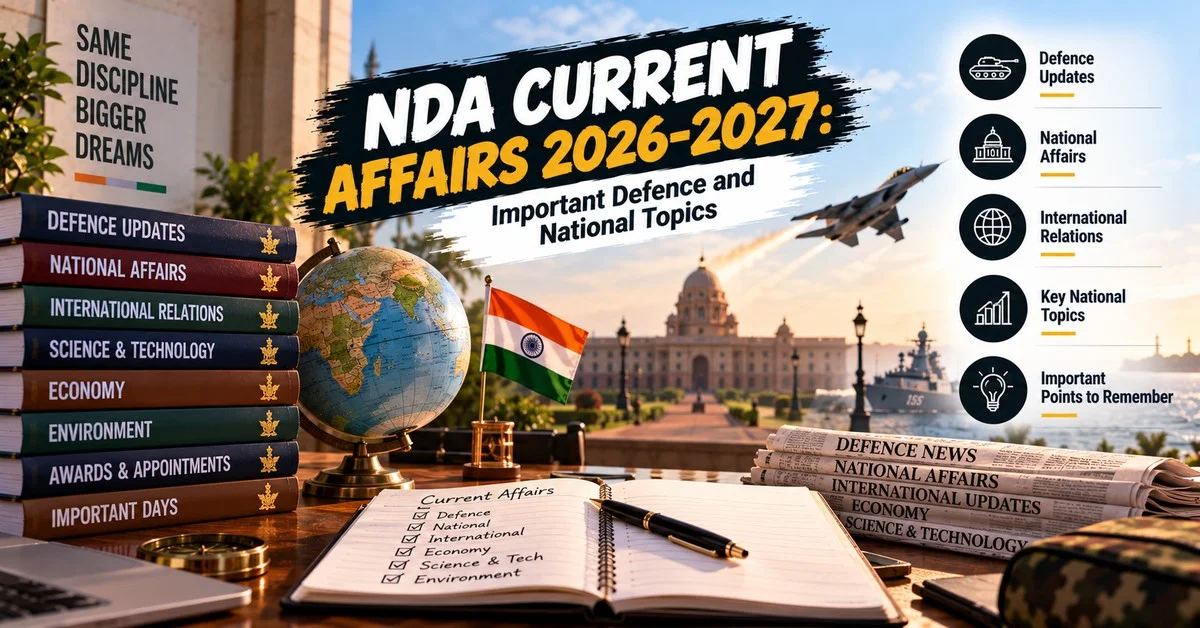
Prepare for NDA Current Affairs Topics 2026-2027 with key areas covering defence, national and international events, science, economy, sports, awards and other important current affairs for the exam.
Preparing current affairs for NDA can become confusing very quickly. There is new news every day, but you do not need to remember everything you read.
For NDA Current Affairs Topics 2027, focus on recent developments that have national or international importance, especially defence, national security, international relations, government policies, science and technology, economy, sports, awards and major personalities.
The official NDA syllabus places Current Events in Part B of the General Ability Test. It covers important events in India in recent years, important world events and prominent Indian and international personalities, including those connected with cultural activities and sports.
This guide gives you a practical list of NDA Current Affairs Topics 2027, what to study under each area, how much detail to remember and how to prepare without getting buried under daily news.
NDA Current Affairs Topics 2027: What Should You Study?
You do not need to prepare current affairs as one huge subject.
Break it into these major areas:
-
Indian Defence and Security
-
Military Exercises
-
Defence Technology and Indigenous Production
-
Defence Appointments and Important Personalities
-
National Security
-
International Relations
-
India and Neighbouring Countries
-
Major International Events
-
Government Schemes and Policies
-
Indian Economy
-
Science and Technology
-
Space and ISRO
-
Environment and Climate
-
Awards and Honours
-
Sports
-
Important Days and Events
-
Important Personalities
-
Books, Authors, Culture and Heritage
You do not need the same level of detail for every category.
For defence, security and international relations, understand the background and significance of major developments.
For awards, appointments and sports, factual recall is usually more important.
1. Indian Defence Current Affairs
This should be one of the main areas in your NDA Current Affairs Preparation.
Follow major developments involving the:
-
Indian Army
-
Indian Navy
-
Indian Air Force
-
Integrated Defence Staff
-
Ministry of Defence
-
DRDO
-
Defence Public Sector Undertakings
-
Indigenous defence industry
What to Study
Keep track of:
-
Major defence acquisitions
-
New aircraft and helicopters
-
New ships and submarines
-
Missile developments
-
Artillery systems
-
Air-defence systems
-
Drones and unmanned systems
-
Military modernisation
-
Indigenous defence production
-
Defence exports
-
Major defence agreements
-
Important defence contracts
-
New capabilities inducted into the armed forces
For every important development, remember:
What is it?
Which service uses it?
What is its purpose?
Why is it important for India?
That is more useful than memorising only the name of a weapon or platform.
2. Military Exercises
Military exercises are another important part of NDA Current Affairs Topics 2027.
When an exercise appears in the news, don't only remember its name.
Prepare:
-
Exercise name
-
Participating countries
-
Participating services
-
Location
-
Type of exercise
-
Main objective
-
Whether it is bilateral or multilateral
-
Any important new development associated with it
For example, if India participates in a multinational naval exercise, understand why the exercise matters for maritime cooperation and India's wider strategic interests.
You should also revise important exercises involving the Indian Army, Navy and Air Force.
3. Defence Technology and Indigenous Production
Modern defence news is increasingly connected with technology.
Follow developments involving:
-
Artificial intelligence
-
Drones
-
Unmanned combat systems
-
Electronic warfare
-
Cybersecurity
-
Surveillance systems
-
Radar technology
-
Missile systems
-
Space-based defence applications
-
Robotics
-
Advanced communication systems
-
Indigenous aircraft
-
Semiconductor and electronics capabilities
Also follow major developments related to self-reliance in defence and domestic production.
The important thing is to understand the connection:
Technology → Capability → Defence requirement → Strategic importance
For example, don't just memorise that a new surveillance system was developed.
Know what problem it is designed to solve.
4. Defence Appointments
Important appointments can appear in current-affairs preparation.
Keep track of major appointments involving:
-
Chief of Defence Staff
-
Service Chiefs
-
Senior military leadership
-
Defence organisations
-
Important national security institutions
For an appointment, remember:
Name + Position + Organisation + Relevant background
Do not waste time memorising every minor transfer.
Focus on nationally significant appointments.
5. National Security
Current affairs preparation should go beyond weapons and military exercises.
Follow major developments involving:
-
Border security
-
Terrorism
-
Counter-terrorism
-
Cybersecurity
-
Maritime security
-
Drone threats
-
Internal security
-
Critical infrastructure
-
Intelligence and surveillance
-
Disaster response
-
Border infrastructure
When studying a security issue, ask:
What happened?
Why is it a security issue?
Which part of India's security does it affect?
What response has India taken?
This makes the topic easier to remember.
6. India and Neighbouring Countries
India's neighbourhood should have a dedicated place in your current-affairs notebook.
Follow major developments involving:
-
China
-
Pakistan
-
Nepal
-
Bhutan
-
Bangladesh
-
Myanmar
-
Sri Lanka
-
Maldives
-
Afghanistan
You don't need every political development in these countries.
Focus on events that affect India through:
-
Border issues
-
Security
-
Trade
-
Connectivity
-
Defence cooperation
-
Maritime interests
-
Water resources
-
Regional organisations
-
Diplomatic relations
A good preparation question is:
“Why does this development matter to India?”
If you can answer that, you have moved beyond headline-based preparation.
7. International Relations
International relations is broader than India's neighbouring countries.
Follow major developments involving India's relationships with:
-
United States
-
Russia
-
France
-
United Kingdom
-
Japan
-
Australia
-
European countries
-
West Asian countries
-
Major Indo-Pacific partners
Also follow India's participation in important groupings and organisations.
Pay attention to:
-
Strategic partnerships
-
Defence cooperation
-
Bilateral agreements
-
Trade relations
-
Maritime cooperation
-
Technology partnerships
-
Energy relations
-
Diplomatic visits
-
Major summits
You do not need to memorise every statement made by world leaders.
Focus on developments that have a clear connection with India.
8. Major International Events and Conflicts
Major international developments can become relevant to NDA preparation when they have an impact on India or global security.
Follow:
-
Major armed conflicts
-
Peace agreements
-
Diplomatic developments
-
International sanctions
-
Humanitarian crises
-
Major geopolitical shifts
-
Global security developments
-
Changes affecting energy or trade
For a major conflict, don't try to memorise every battlefield development.
Understand:
Who is involved?
What is the background?
What is the current development?
What is India's position or interest?
What could be the impact on India?
That is a much more manageable approach.
9. Government Schemes and National Policies
Important government schemes and policies can also be part of Current Affairs for NDA.
Focus on major initiatives related to:
-
Defence
-
Education
-
Skill development
-
Manufacturing
-
Infrastructure
-
Agriculture
-
Digital technology
-
Employment
-
Health
-
Energy
-
Women and youth
-
Rural development
For every major scheme, remember:
Name → Ministry → Objective → Target group → Major feature
You do not need to memorise every number mentioned in a government announcement.
Focus on the core purpose and important facts.
10. Indian Economy
You do not need to prepare the economy like an economics student.
Focus on major developments such as:
-
Union Budget
-
Economic growth
-
Inflation
-
Employment
-
Manufacturing
-
Infrastructure
-
Banking
-
Digital payments
-
Major economic policies
-
Foreign investment
-
Exports and imports
-
Energy security
Important terms that appear repeatedly in the news should also be understood.
For example:
GDP, inflation, fiscal deficit, repo rate, exports, imports and foreign exchange reserves.
If an economic development has a direct connection with national security or defence, give it extra attention.
11. Science and Technology
Science and technology current affairs can cover a wide range of developments.
Prioritise:
-
Artificial intelligence
-
Semiconductors
-
Biotechnology
-
Quantum technology
-
Cybersecurity
-
Robotics
-
Space technology
-
Defence technology
-
New scientific discoveries
-
Major technology missions
-
Digital infrastructure
For NDA preparation, you usually don't need highly technical explanations.
Know:
What the technology is → what it does → why it matters.
12. Space and ISRO Current Affairs
Space developments deserve separate revision because they combine science, technology and national capability.
Follow:
-
Major satellite launches
-
Launch vehicles
-
Human spaceflight programmes
-
Lunar missions
-
Solar missions
-
Earth observation
-
Navigation systems
-
Space research
-
International space cooperation
-
Important developments involving India's space programme
Also connect space technology with:
-
Communication
-
Navigation
-
Weather forecasting
-
Disaster management
-
Defence
-
Agriculture
This makes individual facts easier to remember.
13. Environment and Climate
Do not completely ignore environment-related current affairs.
Follow major developments involving:
-
Climate change
-
International climate conferences
-
Renewable energy
-
Green hydrogen
-
Biodiversity
-
Wildlife conservation
-
Pollution
-
Environmental agreements
-
Major environmental reports
-
Protected areas and conservation initiatives
Important national parks, wetlands, biosphere reserves and UNESCO-related developments can also be useful for revision when they appear in current news.
14. Awards and Honours
Awards are more fact-based than analytical.
Maintain a separate list of major:
-
Civilian awards
-
Gallantry awards
-
National awards
-
International awards
-
Science awards
-
Literature awards
-
Sports awards
-
Important international honours
For each award, remember:
Award → Winner → Field → Reason
Don't spend too much time on minor awards.
15. Sports Current Affairs
Sports can produce straightforward factual questions.
Follow major:
-
Cricket tournaments
-
Olympics-related developments
-
Asian Games
-
Commonwealth events
-
World Championships
-
Football tournaments
-
Badminton
-
Hockey
-
Athletics
-
Shooting
-
Chess
-
Other major international sporting events involving India
Focus especially on:
-
Winners
-
Indian medal winners
-
Hosts
-
Records
-
Important tournaments
-
Major appointments
-
Major sports awards
16. Important Days and Events
Revise important national and international days when they are connected with major campaigns or themes.
Examples include:
-
Republic Day
-
Independence Day
-
Armed Forces Flag Day
-
National Youth Day
-
National Science Day
-
World Environment Day
-
International Yoga Day
-
United Nations Day
Don't turn this into a massive list.
Focus on important days that repeatedly appear in general-awareness preparation.
17. Important Personalities
The official NDA syllabus specifically includes prominent Indian and international personalities, including those connected with cultural activities and sports.
Follow major personalities who are in the news because of:
-
Important appointments
-
Awards
-
Scientific achievements
-
Defence leadership
-
Sports achievements
-
International positions
-
Cultural contributions
-
Major national contributions
Remember the person's:
Name + position/field + reason they are in the news
18. Books, Authors, Culture and Heritage
Keep an eye on major developments involving:
-
Important books
-
Authors
-
Literary awards
-
Cultural festivals
-
Classical arts
-
UNESCO World Heritage developments
-
Important archaeological discoveries
-
Indian cultural heritage
-
Major museums and institutions
This area should be a part of your revision, but it does not need to consume the same amount of time as defence and national-security topics.
NDA Current Affairs Topics 2027: What Should You Prioritise?
Not every topic deserves equal study time.
A practical priority structure is:
Priority 1: Defence and Security
Spend the most time on:
-
Defence acquisitions
-
Military exercises
-
Defence technology
-
Armed forces developments
-
National security
-
Important military appointments
-
Defence production
Priority 2: National and International Affairs
Next focus on:
-
Government policies
-
Major national developments
-
India and neighbouring countries
-
International relations
-
Major global events
-
Important summits
Priority 3: Science, Economy and Environment
Then cover:
-
Space
-
AI and emerging technology
-
Economy
-
Energy
-
Environment
-
Climate developments
Priority 4: Factual Current Affairs
Finally revise:
-
Awards
-
Sports
-
Important personalities
-
Books
-
Important days
-
Culture and heritage
This does not mean lower-priority topics can be ignored.
It means your revision time should match the relevance and depth of the topic.
How Many Months of Current Affairs Should You Study for NDA 2027?
There is no official UPSC rule that says candidates must study exactly six months or exactly one year of current affairs.
A practical approach is to cover the recent 6–12 months before your examination, with greater attention to major events closer to the exam.
For NDA I 2027, UPSC's current annual calendar lists the examination for 11 April 2027. That means candidates should keep their current-affairs coverage updated through the months leading up to the exam.
For NDA II 2027, the calendar lists the examination for 19 September 2027, so the relevant preparation window will naturally shift forward.
The important thing is not to stop your preparation at an arbitrary date.
Keep updating your notes until close to the examination.
How to Prepare NDA Current Affairs 2026-2027
A simple routine is more useful than trying to read everything.
Daily: 30–45 Minutes
Spend your daily session on:
10–15 minutes: Read important national, defence and international news.
10 minutes: Study one important issue in slightly more detail.
5–10 minutes: Make short notes.
5 minutes: Revise yesterday's notes.
The exact time can be adjusted according to your schedule.
The important part is consistency.
Regular reading, short notes, revision and practice are also recommended across the preparation guidance reviewed for this topic.
How to Make NDA Current Affairs Notes
Don't write complete newspaper articles in your notebook.
Use a simple format:
Topic
Defence Exercise
What happened?
One or two lines.
Important facts
-
Countries involved
-
Location
-
Service
-
Purpose
Why it matters
One or two lines.
Related static GK
One or two facts connected with the topic.
This makes revision much faster.
Use the 5-Point Rule
For most current-affairs stories, try to remember:
1. What happened?
2. Who was involved?
3. Where did it happen?
4. Why is it important?
5. What is the India connection?
You won't need all five for every minor story, but this framework is particularly useful for major defence and international developments.
Connect Current Affairs With Static GK
This is one of the easiest ways to improve retention.
Suppose you read about a military exercise.
Don't stop at the exercise name.
Revise:
-
Participating countries
-
Their geography
-
Their capitals
-
Relevant seas or regions
-
Defence relationship with India
If you read about a missile test, revise:
-
Missile category
-
Organisation involved
-
Launch location if relevant
-
Basic purpose
-
Related defence technology
Current affairs becomes much easier when you connect it to static GK instead of studying both separately.
How to Revise NDA Current Affairs
Use three revision cycles.
First Revision
Revise within a week.
Second Revision
Revise at the end of the month.
Third Revision
Use a consolidated revision set before the examination.
This is much more useful than reading the same newspaper repeatedly.
You can also test yourself through current-affairs quizzes and previous-year question papers.
Common Mistakes in NDA Current Affairs Preparation
Trying to Read Everything
You cannot follow every headline.
Select news that has national, defence, international, economic, scientific or major social relevance.
Studying Only Defence
NDA is a defence examination, but the official Current Events section is broader. It includes important events in India, world events and prominent personalities, including cultural and sports figures.
Memorising Without Understanding
Knowing the name of an international organisation is not enough if you don't know what it does.
Ignoring Revision
Current affairs has a short memory cycle.
Read → note → revise → test.
Depending on Social Media Headlines
Social media can help you spot breaking news, but important information should be verified before adding it to your notes.
Preparing Only One Month Before the Exam
Current affairs becomes much harder when you try to compress months of news into a few days.
Daily preparation is easier.
NDA Current Affairs 2027 Checklist
Before the exam, make sure your notes cover:
Defence
-
Major defence acquisitions
-
Military exercises
-
New weapons and platforms
-
Defence technology
-
Indigenous defence production
-
Defence agreements
-
Important military appointments
National
-
Government schemes
-
Major national policies
-
National security
-
Economy
-
Infrastructure
-
Major national developments
International
-
India-neighbour relations
-
Major international organisations
-
Important summits
-
Strategic partnerships
-
Major global conflicts
-
International agreements
Science and Environment
-
Space missions
-
AI and emerging technologies
-
Major scientific developments
-
Climate change
-
Environment
-
Renewable energy
Factual Current Affairs
-
Awards
-
Sports
-
Important personalities
-
Books and authors
-
Important days
-
Culture and heritage
Final Takeaway
The right way to prepare NDA Current Affairs Topics 2027 is not to collect thousands of one-liners.
Build your preparation around a few important areas and revise them repeatedly.
Start with defence, military exercises, national security and India's international relations. Then cover government policies, economy, science and technology, space, environment, sports, awards and important personalities.
For every major story, try to understand more than the headline:
What happened → Who was involved → Why it matters → India connection → Related facts
And keep your notes updated as the examination approaches. UPSC's current calendar places NDA I 2027 on 11 April 2027 and NDA II 2027 on 19 September 2027, although the Commission notes that scheduled dates can change.
Current affairs is not about knowing every news story.
It is about knowing the right stories, understanding their context and being able to recall the important facts when you need them.