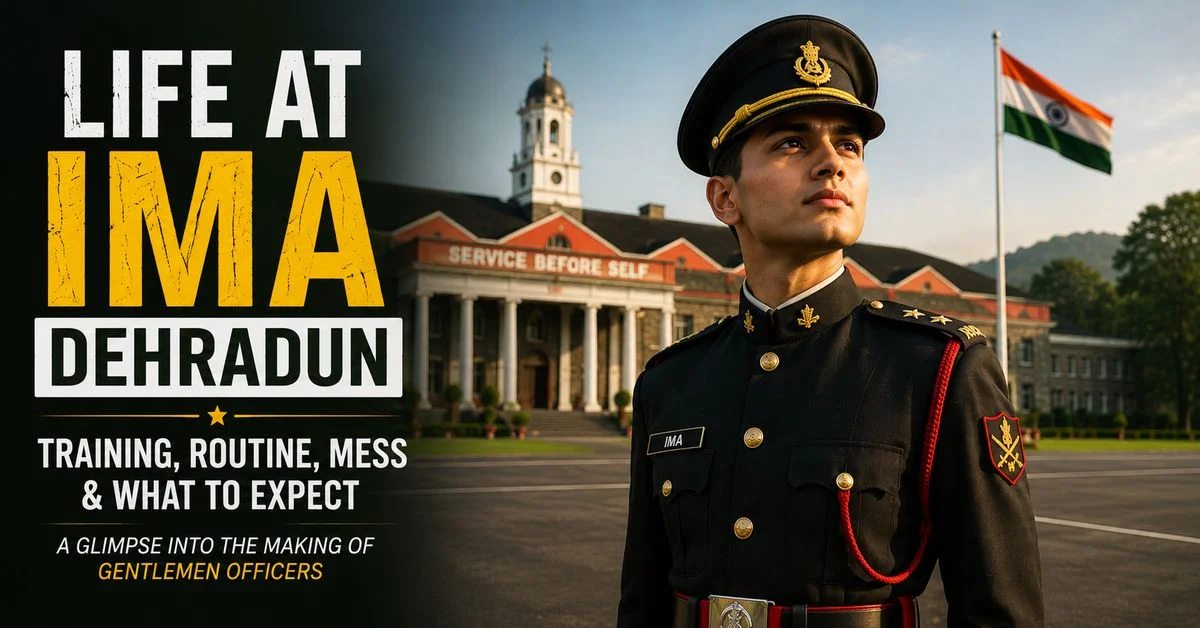
Life at IMA Dehradun: Training, Routine, Mess & What to Expect
Explore life at IMA Dehradun, including cadet training, daily routine, physical activities, academics, mess life, discipline, and what to expect.
The Indian Military Academy in Dehradun is the Indian Army's officer-training academy. It was established in 1932 and has trained generations of officers since then.
Once you're a cadet, your day isn't really divided into "college hours" and "free time" in the way you're probably used to.
Training, physical conditioning, drill, academics, inspections, sports and other activities all become part of your routine.
The bigger change is discipline.
You are expected to be punctual, maintain your turnout, follow instructions and perform even when you're tired. That is intentional. IMA is preparing future officers, not simply conducting a fitness camp.
The President of India described the IMA programme completed by the 158th Regular Course and 141st Technical Graduate Course in June 2026 as one of the country's most rigorous training programmes.
How Does Training at IMA Dehradun Work?
IMA training isn't based on one activity.There are several parts working together.
Physical Training
Physical fitness is a major part of cadet life.
Running, strength work, endurance activities and other physical training help cadets build the fitness needed for military service.
But here's the thing.
Being physically strong isn't the only goal.
The Army also needs officers who can continue thinking clearly when they're tired, uncomfortable or under pressure. That's why physical conditioning sits alongside military subjects, leadership development and outdoor training.
Drill
Drill is another major part of IMA life.
You learn how to move, march and respond together as a group. It looks highly polished during a Passing Out Parade, but that precision doesn't appear overnight.
It comes from repetition.
Again and again.
The crisp and synchronised drill movements seen at IMA's Passing Out Parades are specifically highlighted by the Ministry of Defence as evidence of the discipline and training developed by officer cadets.
Military and Outdoor Training
Cadets also undergo training connected with the practical side of military service.
Depending on the training schedule, this can include areas such as fieldcraft, map reading, weapons and other military subjects.
The point isn't simply memorising information.
You're gradually learning how to apply knowledge, make decisions and work with others.
Academics and Intellectual Development
This part is easy to overlook when people talk about IMA.
There is an academic side to training too.
Future officers need more than physical fitness. They need professional knowledge, judgement, awareness and the ability to understand situations before making decisions.
That is why IMA training focuses on intellectual development along with physical and moral qualities.
What Does a Typical Day at IMA Look Like?
This is probably the question most aspirants actually want answered.
And there is one important clarification first.
There isn't a single publicly confirmed hour-by-hour timetable that applies to every cadet, every day and every term. Training schedules can change according to the course, activities, training phase and academy requirements.
So be careful with articles claiming that every IMA cadet wakes up at exactly the same time and follows exactly the same schedule every day.
A typical training day can broadly involve:
Think of this as the general rhythm, not an official fixed timetable.
The important part is that the day is structured. You aren't deciding at 8 AM whether you feel like attending training.
Physical Fitness at IMA
You don't arrive at IMA with the expectation that you'll suddenly become fit there.
You should already have a solid fitness base.
For candidates reporting to IMA and OTA, government documentation lists minimum physical standards on arrival. For officer cadets, these include a 2.4 km run in 10 minutes 30 seconds, 40 push-ups, 6 pull-ups and 30 sit-ups, along with prescribed squats, lunges and knowledge of swimming fundamentals.
These numbers give you a good idea of the physical standard expected.
But don't prepare just to scrape past a benchmark.
Imagine trying to complete training while you're constantly struggling to recover from the previous day's physical workload.
That's why building endurance before joining is much smarter.
What Is the Mess Life Like at IMA?
The mess is another part of cadet life that people are curious about.
Meals aren't simply about sitting down whenever you're hungry and leaving whenever you're finished.
Mess life is connected with military discipline and etiquette. Cadets eat as part of a structured routine, and conduct matters too.
Food also has a practical purpose.
You're training hard, so nutrition needs to support that workload.
You should expect regular meals rather than the kind of casual eating schedule many students have at home or college.
And there is another side to mess life.
It's where cadets spend time together.
You eat with your coursemates, interact with others and become part of the social environment of the academy. Those everyday interactions gradually build the camaraderie that becomes important in military life.
Is Life at IMA Very Strict?
Yes.
But "strict" doesn't mean that someone is shouting at you every minute of the day.
A lot of the discipline comes through routine.
You have to be on time.
Your turnout matters.
Your equipment needs to be maintained.
Instructions have to be followed.
Training has to be completed whether you're having a great day or a terrible one.
That's the point.
The Army's own descriptions of IMA repeatedly connect training with discipline, leadership, character, initiative and self-discipline.
Slowly, these things stop feeling like separate rules and become part of how you operate.
Do Cadets Get Free Time at IMA?
Yes, but don't imagine long stretches of completely free time every day.
Your schedule is demanding, and available personal time can depend on the training programme.
When you do get some breathing space, it can be used for things like:
-
Personal preparation
-
Studying or revision
-
Reading
-
Maintaining personal equipment
-
Speaking with family when permitted
-
Rest and recovery
And honestly, after a physically demanding day, even a little quiet time can feel valuable.
You learn to use it properly.
What About Sports and Other Activities?
Life at IMA isn't only classroom work and military drills.
Physical development also includes sports and outdoor activities.
The broader training environment is meant to develop qualities such as teamwork, confidence, leadership and the ability to operate under pressure.
The academy also recognises individual performance through awards and competitions. At the 2024 Passing Out Parade, for example, awards included the Sword of Honour, medals for order of merit and the Chief of Army Staff Banner for the best-performing company.
So you're not simply trying to "survive" training.
There is also an element of competition and excellence.
What Is the Most Difficult Part of Life at IMA?
This will be different for every cadet.
For one person, physical training may be the hardest part.
For another, it could be maintaining performance while tired, keeping up academically or adjusting to the strict routine.
But there's a common theme.
Consistency.
Anyone can push hard for one day.
The challenge is doing it repeatedly.
You may have a difficult training session in the morning and still have to maintain your concentration later. You may be tired, but your turnout still needs attention. You may make a mistake, learn from it and then be expected to perform better the next time.
That's where the real adjustment happens.
What Changes in You at IMA?
This is probably the most important part of understanding Life at IMA Dehradun.
The academy isn't only trying to make you fitter.
You're being prepared to take responsibility for other people.
The Army describes IMA training as developing leadership, self-discipline, patriotism, character, initiative and other qualities required of future officers.
You slowly become more comfortable with responsibility.
You learn to work as part of a team.
You learn that your decisions affect other people.
And you start understanding why military training is so particular about small things like punctuality, turnout and discipline.
Those habits aren't really about the habit itself.
They're preparing you for a larger responsibility.
What Happens After IMA Training?
The Passing Out Parade marks the end of the pre-commission training for the graduating course and the beginning of the cadets' professional careers.
At the June 2026 Passing Out Parade, the President of India reviewed the 158th Regular Course and 141st Technical Graduate Course at IMA Dehradun.
The ceremony is more than a formal parade.
It represents the point where a cadet moves from training into commissioned service.
That's why the Passing Out Parade carries so much importance for cadets and their families.
Things to Know Before Joining IMA
If you're seriously planning to reach IMA, don't wait until your selection to start preparing for this lifestyle.
Work on your fitness early.
Get comfortable with running.
Build strength gradually.
Develop a habit of waking up and working even when you don't feel like it.
Read regularly and stay aware of what's happening around you.
Most importantly, understand that IMA is not meant to be comfortable all the time.
There will be difficult days.
That's normal.
The aim is to come out of those days more capable than you were before.
FAQs
Is life at IMA Dehradun difficult?
Yes. IMA training is rigorous and demanding. It combines physical training, drill, military instruction, academics, discipline and leadership development. The President of India described the programme completed in June 2026 as one of the country's most rigorous training programmes.
What time do IMA cadets wake up?
There is no single publicly confirmed wake-up time that applies to every cadet and every training day. Daily schedules can vary according to the course and training programme. Physical training is generally an important part of the early part of the day.
What do cadets eat at the IMA mess?
Cadets receive regular meals as part of their structured routine. Mess life also involves discipline and etiquette. The exact daily menu can vary, so claims about a fixed menu should not be treated as an official IMA rule.
Is there any free time at IMA?
Cadets do get personal time, but the amount depends on the training schedule. It is generally limited compared with normal college life and has to fit around training and other responsibilities.
What physical activities are required at IMA?
Physical training forms a major part of academy life. Government documentation lists arrival standards including a 2.4 km run, push-ups, pull-ups, sit-ups, squats, lunges and swimming fundamentals for officer cadets reporting to IMA and OTA.
Is IMA only about physical training?
No. Physical fitness is only one part. Training also develops military knowledge, drill, leadership, discipline, intellectual ability and other qualities needed for an Army officer.