Indian Navy 10+2 B.Tech Cadet Entry, Eligibility Selection
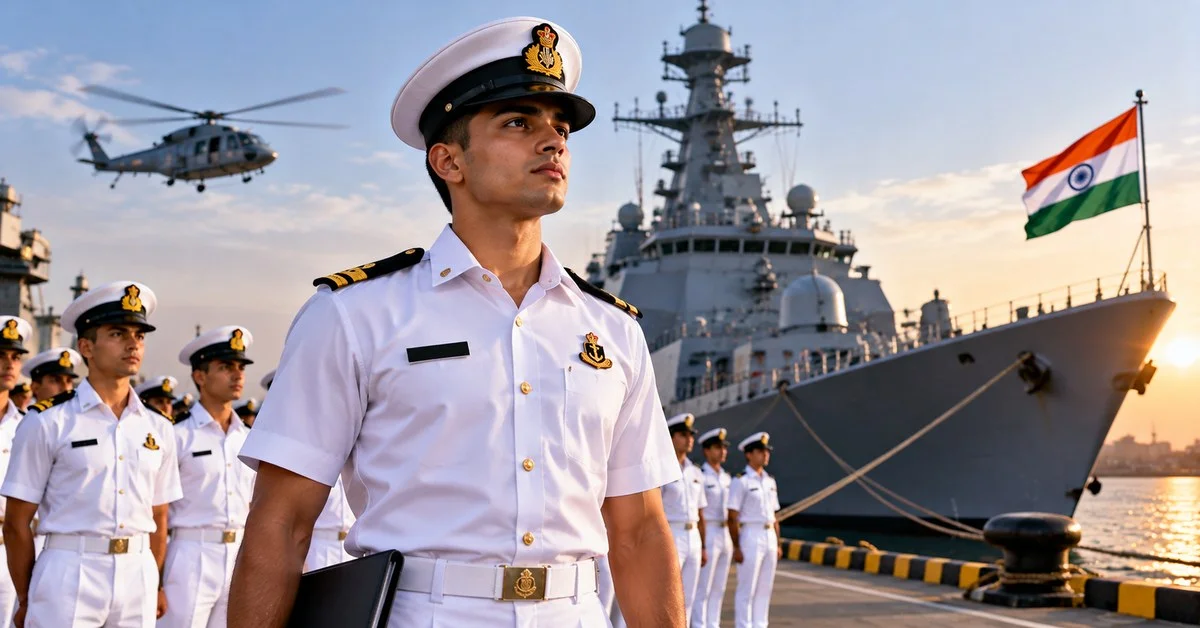
Planning to join the Indian Navy after Class 12? Learn about the 10+2 B.Tech Cadet Entry scheme, including eligibility criteria, PCM percentage requirements, JEE Main shortlisting, SSB interview stages, medical standards, four-year training at Indian Naval Academy Ezhimala and permanent commission career prospects.
Most Science stream students researching officer entry routes after 12th eventually come across the 10+2 btech entry navy scheme, then spend hours piecing together eligibility rules, JEE Main shortlisting logic, and SSB stages from half a dozen different pages. This guide puts everything in one place. From PCM percentage requirements and age limits to the five stages of the Services Selection Board interview and what happens on your first day at Ezhimala, every detail is covered here, including indian navy btech cadet entry eligibility .
What Is the 10+2 B.Tech Cadet Entry Scheme?
The 10+2 B.Tech Cadet Entry scheme is the Indian Navy's dedicated pathway for Class 12 Science students to enter as officer cadets and earn a permanent commission Indian Navy career. Unlike Short Service Commission routes that cap your service at 10 to 14 years, this entry grants a full career commission from day one, making it one of the most sought-after options for navy officer entry after 12th science, particularly under the 10+2 btech entry navy route.
Selected cadets join the Indian Naval Academy at Ezhimala in Kerala, where they complete a four-year B.Tech programme that blends academic study with naval and sea training. Branches available on completion include the Executive branch Navy, Engineering, Electrical, and naval architecture marine engineering. That branch spread is worth keeping in mind when thinking about the navy 10+2 entry jee main cutoff and which technical stream you want to pursue.
The scheme is built to develop technical officer cadres from the ground up. Rather than recruiting degree holders and then training them, the Navy shapes its officers through a structured residential programme that begins the moment a cadet walks through the gates at Ezhimala. This end-to-end model produces officers who are academically grounded in engineering and simultaneously conditioned for naval service from the start, something that also applies to the navy btech cadet ssb interview stages.
Eligibility Criteria for Navy B.Tech Cadet Entry 2025-26
Before you apply, check every criterion on this list. Missing even one makes your application invalid at the screening stage, and the same applies to indian naval academy ezhimala btech training requirements.
According to the official joinindiannavy.gov.in notification, the indian navy btech cadet entry eligibility requirements are as follows, and these matter equally for navy officer entry after 12th science:
-
Nationality: Indian citizens only (male and female candidates are both eligible; check the specific notification for gender-wise vacancy split).
-
Educational qualification: Must have passed or be appearing in Class 12 with Physics, Chemistry, and Mathematics as core subjects. The PCM minimum percentage navy requires is 70% aggregate in PCM combined.
-
Age limit: Candidates must be between 16.5 and 19.5 years of age on the date of commencement of the course. This is a strict band with no relaxation.
-
JEE Main: A valid JEE Main score is mandatory. Candidates who have not appeared for JEE Main are not eligible to apply, regardless of their academic marks.
-
Marital status: Candidates must be unmarried at the time of joining. Marriages contracted after selection but before joining will result in cancellation.
The combination of a 70% PCM bar and a mandatory JEE Main score means this scheme draws candidates with genuine Science stream preparation, filtering out applicants who excel in one area but fall short in another.
How JEE Main Scores Are Used for SSB Shortlisting
This is the section most guides skip, and it is also the most-asked question in defence forums. Understanding this mechanism is critical to planning your application timeline.
The Navy does not hold its own written examination. Instead, it uses your JEE Main rank and score to build a JEE Main shortlisting merit list for issuing SSB call letters. Candidates who meet the basic eligibility criteria and apply through joinindiannavy.gov.in are ranked against each other purely on JEE Main performance. Those ranked highest on this internal merit list receive SSB interview invitations, in order of available vacancies.
Physics and Mathematics scores carry the most weight in JEE Main for this purpose because the B.Tech programme at Ezhimala is engineering-intensive. Forum data from previous cycles suggests that competitive candidates in the navy 10+2 entry jee main cutoff range typically score above 150 out of 300, though the Navy does not publish an official cutoff figure. The actual threshold shifts each cycle depending on the number of applicants and vacancies notified.
Your JEE Main preparation directly determines whether you receive an SSB invitation. A strong PCM percentage alone will not compensate for a poor JEE Main score. Treat both as equally important, rather than assuming board marks will carry you through.
Selection Process: From Application to Commission
The selection follows a sequential, elimination-based structure. Each stage must be cleared before the next applies.
-
Online application: Submitted through joinindiannavy.gov.in during the notification window. Documents uploaded at this stage include mark sheets, JEE Main scorecard, and identity proof.
-
JEE Main shortlisting: The Navy generates an internal merit list based on JEE Main scores. Shortlisted candidates receive SSB call letters with date and centre allotment.
-
SSB Interview, Stage 1: Conducted at Services Selection Board centres across India. Stage 1 covers the Officer Intelligence Rating test (OIR), a standardised verbal and non-verbal reasoning assessment, followed by the Picture Perception Discussion Test (PPDT). Candidates who clear Stage 1 are retained; others are sent back the same day.
-
SSB Interview, Stage 2: Spans four days and covers psychological testing (WAT, SRT, SDT, TAT), Group Testing Officer tasks including command tasks, outdoor group activities and lecturette, and a personal interview with a senior officer.
-
Medical examination: Recommended candidates attend a Service Medical Board. Navy medical standards officer entry criteria are stringent and are covered in detail in the next section.
-
Merit list and offer: A final merit list is drawn from medically fit recommended candidates. Those on the list receive pre-commission training offers for the upcoming course at Indian Naval Academy Ezhimala.
For a closer look at the navy btech cadet ssb interview stages, the guide on SSBCrack provides additional interview preparation detail worth reviewing.
Physical and Medical Standards: What Qualifies and What Disqualifies
Physical fitness standards are assessed during the medical examination after SSB recommendation. The standards below apply specifically to the B.Tech Cadet Entry.
Height and weight: Minimum height for male candidates is 157 cm; for female candidates it is 152 cm. Weight must fall within the acceptable range for the candidate's height and age as defined by the Navy's medical tables.
Vision standards:
-
Uncorrected visual acuity: 6/6 in one eye and 6/9 in the other (better eye first).
-
Corrected visual acuity is permissible up to specified limits for certain branches; Executive branch candidates face stricter uncorrected vision standards.
-
The colour vision requirement navy sets is CP I (Martin-Lantern test), meaning candidates must distinguish colours correctly under operational conditions. Colour blindness at any level is a disqualifier.
Common disqualifiers include:
-
Flat feet (pes planus) beyond acceptable grade.
-
Colour blindness (any form).
-
Underweight or overweight beyond permitted range.
-
History of psychiatric illness, cardiac anomalies, or orthopaedic deformities affecting function.
-
Hearing impairment in either ear.
Get a pre-medical check at a government hospital before the SSB to identify any correctable issues in advance. Conditions such as mild refractive errors sometimes fall within permissible limits, but colour blindness and flat feet are absolute bars with no exceptions.
Training at Indian Naval Academy, Ezhimala
The indian naval academy ezhimala btech training programme is a four-year residential course that combines an engineering degree with full naval officer preparation. The Academy in Kerala is one of the largest naval academies in Asia, spread across approximately 2,500 acres and equipped with its own jetty, seamanship school, and academic blocks.
The first two years focus on foundational engineering subjects, naval science, and physical conditioning. Cadets study subjects common to all branches before specialising. The third and fourth years introduce branch-specific technical content alongside sea training deployments aboard naval ships, giving cadets operational exposure well before they are commissioned.
On successful completion of the four-year programme, cadets receive a B.Tech degree from Jawaharlal Nehru University (JNU), New Delhi, and are simultaneously granted their commission into the Indian Navy. The degree is a full University Grants Commission-recognised qualification, not a certificate or diploma.
Specialisation branches assigned on completion include the Executive branch (seamanship and warfare), Engineering branch (marine propulsion and mechanical systems), Electrical branch (weapons and sensors), and naval architecture marine engineering. Branch allocation is based on performance during training and available vacancies at the time of passing out.
Career Progression After B.Tech Cadet Entry
Every officer commissioned through this scheme starts at the Sub Lieutenant commission rank, the entry-level commissioned rank in the Indian Navy, equivalent to Second Lieutenant in the Army.
Promotion from Sub Lieutenant follows a time-based structure with performance overlays:
-
Sub Lieutenant to Lieutenant: Approximately two years of qualifying service.
-
Lieutenant to Lieutenant Commander: After about six years of reckonable service.
-
Lieutenant Commander to Commander: Selection-based at approximately 13 years.
-
Commander and above: Competitive selection boards determine promotion to Captain and beyond.
Because this entry grants a permanent commission Indian Navy career, officers remain eligible for promotion all the way to Flag rank (Admiral), unlike Short Service Commission officers who exit after a fixed tenure unless they seek extension or permanent commission conversion.
Officers specialise progressively after commissioning, with options in submarines, aviation, hydrography, information warfare, and technical sub-specialisations depending on the branch. The career arc is long, demanding, and varied, spanning sea postings, shore appointments, and overseas training deputation. If you are weighing this against Army options, this comparison of Indian Army vs Navy career paths after 12th covers the lifestyle and posting differences in detail.
How to Apply: Notification, Dates and Application Steps
All notifications for the 10+2 btech entry navy scheme are published on the official joinindiannavy.gov.in notification portal. The Navy typically releases two cycles per year, with notifications appearing approximately six to eight weeks before the application window closes.
For the cycle, candidates should monitor the official site from early onwards. Exact dates are published only when the notification goes live; no advance date is guaranteed.
Step-by-step application process:
-
Visit joinindiannavy.gov.in and navigate to the "Officer Entry" section.
-
Register with a valid email address and mobile number.
-
Fill in personal details, academic marks, and JEE Main roll number and score.
-
Upload scanned copies of Class 10 and 12 mark sheets, JEE Main scorecard, a recent photograph, and signature.
-
Review the filled application carefully; corrections after submission are not permitted in most cycles.
-
Submit and save the acknowledgement number for future reference.
There is no application fee for this entry. Candidates should ensure their JEE Main score is from a valid attempt within the notified eligibility period, as outdated scores are not accepted.
FAQs
What is the age limit for Navy 10+2 B.Tech Cadet Entry?
Candidates must be between 16.5 and 19.5 years of age on the date the course commences. This window is fixed and applies uniformly to all candidates regardless of category.
Is JEE Main mandatory for Navy B.Tech Cadet Entry?
Yes, a valid JEE Main score is mandatory. Candidates without a JEE Main scorecard cannot apply, regardless of how strong their Class 12 PCM percentage is.
How does JEE Main score determine SSB shortlisting for Navy B.Tech entry?
The Navy uses JEE Main scores to rank eligible applicants and build a JEE Main shortlisting merit list internally. SSB call letters are issued top-down from this list until all available interview slots are filled. This is why maximising your JEE Main score matters just as much as meeting the PCM minimum percentage navy requires.
What medical conditions disqualify a candidate from Navy B.Tech Cadet Entry?
Colour blindness, flat feet beyond permissible grade, significant hearing impairment, cardiac defects, and weight outside the permitted range for height are among the most common disqualifiers under navy medical standards officer entry rules. Vision must meet the specified uncorrected and corrected standards depending on the branch applied for.
How long is the training at Indian Naval Academy for B.Tech cadets?
The training programme at Indian Naval Academy Ezhimala is four years long. It combines academic engineering coursework with naval training and sea deployments, concluding in a B.Tech degree awarded by Jawaharlal Nehru University.
What rank do I get after completing the Navy 10+2 B.Tech Cadet Entry training?
Officers are commissioned at the Sub Lieutenant rank upon passing out from the Academy. From this starting point, the permanent commission Indian Navy career offers a clear progression path through Lieutenant, Lieutenant Commander, Commander, Captain, and Flag ranks based on service and selection.