How to Prepare for NDA SSB After the Written Exam: A Complete First-Timer's Guide
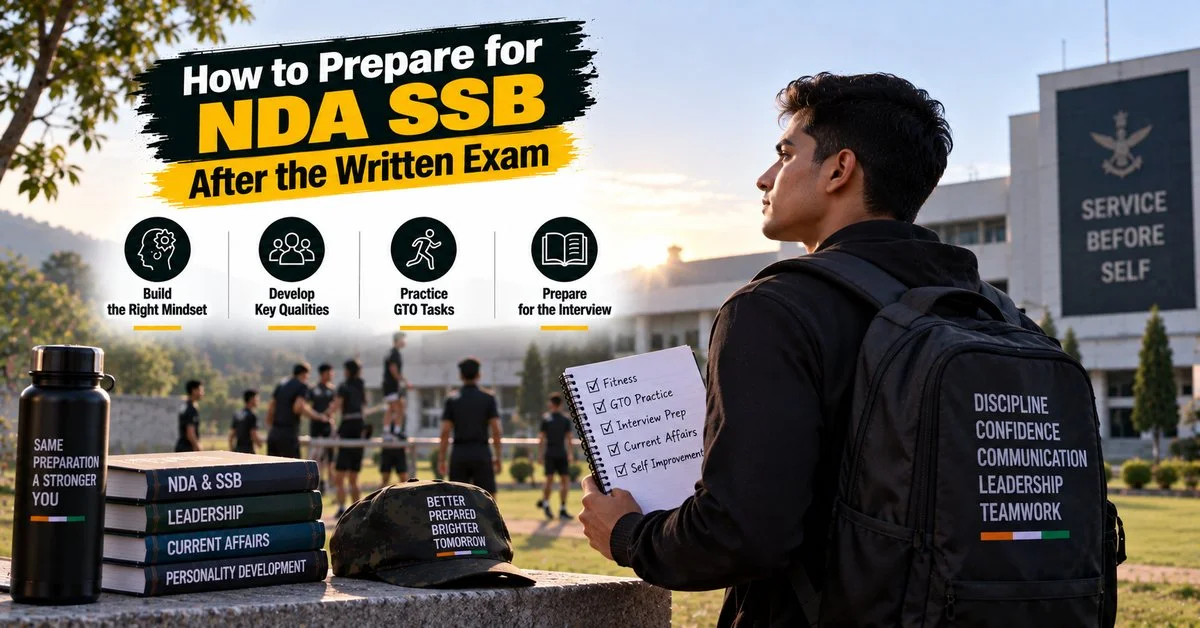
Cleared the NDA written exam? Learn how to prepare for SSB with a practical 4–10 week plan covering OIR, PPDT, psychology tests, GTO tasks, interview preparation, fitness, and common mistakes.
Clearing the NDA written exam is a significant milestone, but it is only the first gate. The real assessment begins at the Services Selection Board, where your personality, reasoning ability, and leadership potential are tested across five days. NDA SSB preparation requires a fundamentally different approach from written exam study, and starting it correctly matters more than starting it early. This guide walks you through every stage, gives you a preparation schedule, and tells you exactly what mistakes to avoid, including what trips up most candidates at the SSB interview stages for NDA.
What Happens After You Clear the NDA Written Exam
Once UPSC declares written results, successful candidates receive an SSB call-up letter from the respective service headquarters, Army, Navy, or Air Force, specifying a reporting date and an allotted SSB centre. Reporting is typically done on Day 0, and testing begins on Day 1. Carry your original Class 10 and 12 marksheets, admit card, call-up letter, NDA written exam qualifier certificate, and passport-sized photographs. Getting this documentation right is a basic part of any serious NDA SSB preparation
The mindset shift here is critical. Written exams reward recall and speed. The SSB rewards consistency of character across five days of observation. Assessors are not grading a single test; they are building a picture of who you are under different conditions. Arriving with that understanding will help you perform far more naturally than candidates who treat SSB like another written paper. This is especially relevant when thinking about how to clear SSB Stage 1 OIR and PPDT.
NDA SSB Interview: Stage-by-Stage Breakdown
The SSB interview stages for NDA are divided into two main stages. Stage 1, called the screening test SSB, takes place on Day 1 and includes the Officer Intelligence Rating (OIR) test and the Picture Perception and Description Test (PPDT). Candidates who clear Stage 1 continue; the rest are sent home the same day. This makes your approach to SSB psychology tests TAT WAT SRT and related tasks far more meaningful once you cross that first filter.
Stage 2 runs from Day 2 to Day 4 and covers the Psychology Test battery, Group Testing Officer (GTO) tasks, and the personal interview SSB. Day 5 is the SSB conference round, where a board of assessors reviews all evidence and delivers a final recommendation. According to Jagran Josh, only about 10 to 15 percent of candidates who attend SSB receive a final recommendation, which underscores how precisely each stage must be approached. The same precision applies to GTO tasks SSB interview performance.
How to Clear SSB Stage 1: OIR Test and PPDT Strategy
Knowing how to clear SSB Stage 1 OIR and PPDT gives you the foundation for everything that follows. The OIR test measures verbal and non-verbal intelligence through two booklets answered under strict time limits. Speed-accuracy balance is essential here: attempting every question recklessly hurts your score more than leaving a few unanswered. Practice non-verbal reasoning sets and verbal analogy questions daily to improve processing speed without sacrificing accuracy. Building this habit early also feeds directly into your broader SSB interview preparation schedule.
The PPDT requires you to write a brief story about a blurred image in four minutes, then participate in a group discussion where the group narrates a common story. Write a positive, action-oriented story with a clearly named hero. During the group discussion, speak early, keep your tone inclusive, and never dominate by interrupting others. Assessors observe how well you listen and contribute, not just how loudly you argue.
Mastering SSB Psychology Tests: TAT, WAT, SRT, and Self Description
The SSB psychology tests TAT WAT SRT form the backbone of Stage 2 assessment. According to SSBCrack's psychology test guide, assessors use your responses to map patterns against Officer-Like Qualities (OLQs) such as initiative, social adaptability, and mental resilience.
The Thematic Apperception Test (TAT) involves writing stories for 11 images in 30 seconds per image. Keep your protagonist active and solution-focused. The Word Association Test (WAT) gives you 15 seconds per word to write the first meaningful sentence that comes to mind. Avoid stock phrases. The Situation Reaction Test (SRT) presents 60 practical scenarios in 30 minutes; respond with practical, decisive actions. The self description test SSB asks you to write what your parents, friends, teachers, and you yourself think of you. Be honest and specific, not a catalogue of virtues.
GTO Tasks Explained: How to Perform Well in Group Testing
GTO tasks SSB interview activities span two days and include progressive group tasks (PGT), half group task (HGT), final group task (FGT), individual obstacles SSB, command task SSB, lecturette topics NDA, and the group planning exercise. Each task is designed to observe how Officer-Like Qualities (OLQs) show up under physical and intellectual pressure.
For progressive group tasks, contribute ideas concisely and help implement others' good suggestions. The command task SSB places you as a leader with two subordinates; use clear, calm instructions and adapt quickly when your plan runs into an obstacle. For the lecturette, prepare four current-affairs topics in advance. Speak for three minutes without notes, make eye contact with the group, and structure your talk with a clear opening and conclusion. Individual obstacles SSB demands physical confidence, so train your body alongside your mind throughout the preparation period.
Building Your SSB Preparation Schedule After NDA Written
A practical SSB interview preparation schedule for candidates with 4 to 10 weeks available looks like this:
-
Week 1 (Orientation): Study all SSB stages in detail, read about OLQs, start a daily newspaper habit for current affairs and lecturette topics NDA.
-
Weeks 2 to 3 (Stage 1 focus): Solve two OIR booklets daily, practice PPDT story-writing with blurred images, and conduct mock group discussions with peers.
-
Weeks 4 to 6 (Stage 2 deep-dive): Write five TAT stories and 20 WAT responses daily, complete SRT sets, run 5 km daily, and practice obstacle drills for individual obstacles SSB.
-
Final week (Mock SSB): Simulate a full mock SSB with a trusted group or a coaching mock board to identify gaps before your actual reporting date.
Common SSB Mistakes NDA Candidates Make: and How to Avoid Them
The most damaging SSB mistakes to avoid centre on inauthenticity. Many first-timers memorize scripted answers for the personal interview SSB, which assessors detect immediately through follow-up questions. Speak from real experiences, even ordinary ones, and build your responses around honest reflection rather than rehearsed lines.
A second frequent error is neglecting physical fitness before Day 1. GTO tasks and individual obstacles SSB demand functional strength and stamina. Arriving unfit signals poor self-discipline, an OLQ that is directly assessed. Third, many candidates ignore current affairs entirely, then struggle during the personal interview SSB and lecturette topics NDA. Read defence and national news daily for at least 30 minutes throughout your preparation. Finally, avoid performing a personality type you think assessors want to see. The five-day format is specifically designed to expose inconsistency.
FAQs
What is the full SSB process for NDA written exam qualifiers?
The SSB runs over five days. Day 1 covers the screening test SSB with OIR and PPDT. Days 2 to 4 cover the psychology test battery, GTO tasks, and personal interview SSB. Day 5 is the SSB conference round, where the board announces recommendations.
How do I prepare for SSB OIR and PPDT as a first-time NDA aspirant?
Practice verbal and non-verbal intelligence questions daily. For PPDT, write positive, action-driven stories and practice structured speaking in group settings to build confidence in the PPDT group discussion.
What are the best strategies for SSB TAT, WAT, SRT, and GTO tasks?
Keep TAT and WAT responses positive and genuine. Answer SRT scenarios with decisive, practical actions. For GTO, balance leadership with cooperation and prepare physically for individual obstacles SSB and the command task SSB.
What mistakes do NDA candidates make in SSB and how can I avoid them?
The biggest SSB mistakes to avoid are scripted answers, poor fitness, ignoring current affairs, and performing a manufactured personality. Build habits around authenticity, physical training, and daily reading well before your SSB date.
How long does it take to prepare for SSB after clearing the NDA written exam?
A focused 4 to 6 week plan is sufficient for most first-time NDA SSB preparation candidates if followed consistently. Those with 10 weeks can add mock SSBs and deeper reading on Officer-Like Qualities (OLQs) to strengthen their Stage 2 performance. If you are still deciding between service branches, read our guide on Indian Army vs Navy after 12th to clarify your long-term direction before your SSB interview.