How to Prepare for CDS SSB After the Written Exam: A Stage-by-Stage Plan
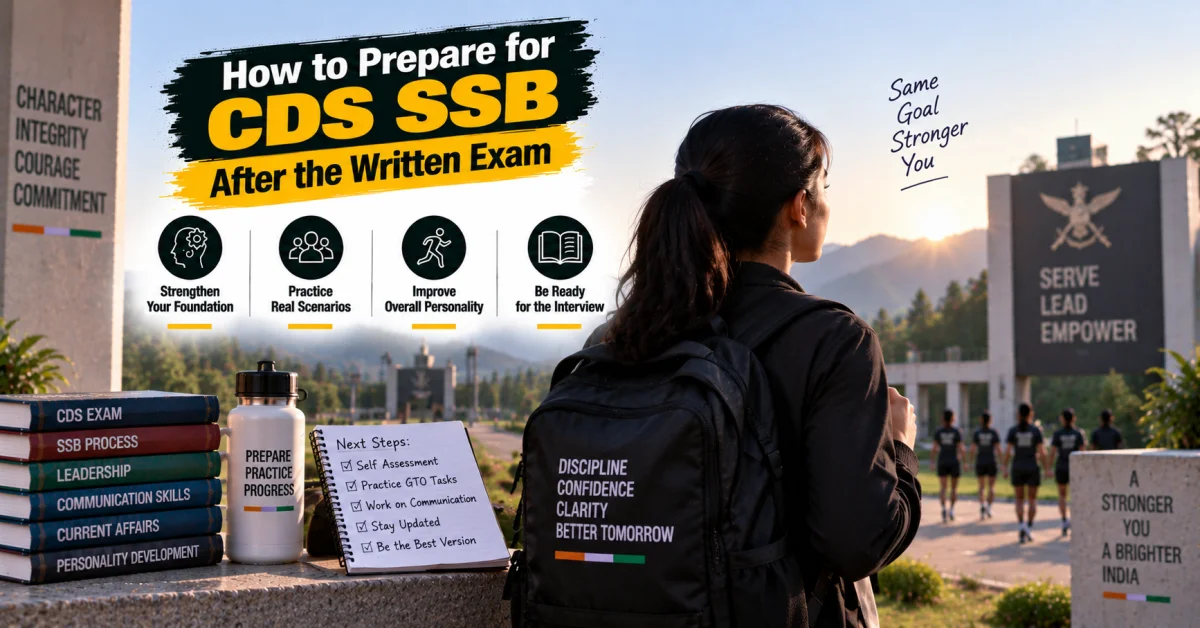
Cleared the CDS written exam? Follow this 60-day SSB preparation plan covering OIR, PPDT, psychology tests, GTO tasks, personal interview, fitness, and common mistakes to avoid at every stage.
Clearing the CDS written exam is a genuine achievement, but it is only the first gate. The Services Selection Board interview is where the real selection happens, and most first-timers underestimate how quickly the process can end if they arrive unprepared. Structured CDS SSB preparation must begin the day your result is out, not the week before your reporting date. The same principle applies to CDS SSB preparation after written exam.
This guide gives you a concrete, stage-specific action plan covering every phase from centre allotment to conference day, so you walk in knowing exactly what to expect and what to do.
What Happens After You Clear the CDS Written Exam
Once UPSC declares the CDS written result, shortlisted candidates receive an official call-up letter specifying their SSB centre allotment, reporting date, and required documents. Centres are located at Allahabad, Bhopal, Bangalore, and other designated cities depending on the arm you applied for. This detail matters when planning your OIR test approach and overall SSB timeline.
Your documentation checklist typically includes the UPSC call letter, original educational certificates, ID proof, and passport-size photographs. Reporting is usually on Day 0, with screening beginning on Day 1. According to the CDS 2026 notification published by UPSC, candidates must carry all originals for document verification before any test begins. Missing a single document can result in immediate disqualification, so treat this checklist as seriously as PPDT story writing tips for SSB.
Understanding the Two Stages of SSB Selection
The SSB Interview Process is structured into two distinct stages. Stage 1 involves the Officer Intelligence Rating test and the Picture Perception and Description Test. Only candidates who qualify Stage 1 proceed to Stage 2; the rest are sent home on Day 1 itself.
Stage 2 spans four days and includes psychology tests, Group Testing Officer tasks, and a personal interview. A final SSB conference day concludes the process, where assessors collectively decide who earns the recommended candidate status. Your preparation strategy for Stage 1 and Stage 2 must be completely different in approach and priority, and this distinction matters just as much when thinking about SSB interview mistakes to avoid.
How to Crack Stage 1: OIR Test and PPDT Tips
Screening day elimination catches a large proportion of candidates off guard. The OIR test measures verbal and non-verbal reasoning under strict time pressure. The best OIR test tips for SSB involve daily timed drills using standard reasoning books, focusing on series completion, analogy, pattern recognition, and spatial reasoning. Speed matters as much as accuracy here.
PPDT story writing tips for SSB centre on three principles: write a clear story with a positive protagonist, include a problem and a resolution, and keep the narrative structured within the 4-minute limit. During group narration, speak clearly, maintain eye contact, and do not contradict your written story. Confidence in narration signals the assertiveness assessors are watching for. Read more on how to write and narrate confidently in PPDT.
Stage 2 Deep Dive: Psychology Tests, GTO, and Personal Interview
Stage 2 opens with psychologist assessment through four tools: Thematic Apperception Test, Word Association Test, Situation Reaction Test, and Self-Description. TAT WAT SRT consistency is critical because assessors compare your responses across all four instruments to build a personality picture. Contradictions across tests are a red flag that signals coached or fabricated responses.
GTO outdoor tasks span two days and include the progressive group task, half group task, command task SSB, individual obstacles, and the lecturette. Each task measures a different combination of officer like qualities for SSB. Personal interview preparation should begin with a detailed self-assessment: know your background, your strengths, your choices, and current affairs at a level where you can hold a 30-minute conversation without notes.
How to Build Officer-Like Qualities Before Your SSB Date
Officer like qualities for SSB refers to the 15 behavioural traits the board assesses across all tests, including effective intelligence, reasoning ability, initiative, self-confidence, and the ability to influence a group. These qualities cannot be faked or crammed. They are observed through consistent behaviour across five days.
Build them through daily practice. Lead a group project at your institute or in your locality. Speak publicly at every opportunity, even if it is a brief address to 10 people. Practice making quick decisions under mild pressure, such as navigating unfamiliar situations or resolving small disputes. These habits make your behaviour in GTO outdoor tasks feel natural rather than performed.
60-Day SSB Preparation Plan After CDS Written Result
A focused 60-day SSB preparation plan after CDS written result keeps your effort structured rather than scattered. Follow this week-by-week breakdown:
-
Weeks 1 and 2: OIR drills daily, 30 minutes timed verbal and non-verbal reasoning sets. Track accuracy and speed separately.
-
Weeks 3 and 4: PPDT practice using newspaper photographs. Write one story daily, narrate it aloud, and record yourself to review delivery.
-
Weeks 5, 6, and 7: Focus on GTO task concepts and psychology test practice. Write 10 WAT responses daily, complete SRT sets, and read one TAT picture per day. Join a mock GTO group if possible.
-
Week 8: Full mock SSB with a peer group or coaching centre. Review personal interview answers, current affairs knowledge, and physical fitness benchmarks.
Physical fitness is part of CDS SSB preparation after written exam, not an afterthought. Run at least 3 km daily throughout all 8 weeks.
Common Mistakes CDS Qualifiers Make at SSB (And How to Avoid Them)
The most damaging SSB interview mistakes to avoid are well-documented. Faking a personality type causes visible inconsistency across psychology tests, GTO behaviour, and the personal interview. Assessors are trained to detect it. The fix is straightforward: be yourself and work on genuine improvement before your date.
Poor physical fitness often surprises candidates during outdoor GTO tasks that demand stamina and coordination. Conference day nervousness causes many otherwise strong candidates to appear unsure of themselves at the final hurdle. Walk in with a calm demeanour, answer directly, and do not over-explain. Reviewing common SSB interview mistakes before your reporting date takes less than an hour and can prevent costly errors.
FAQs
What is the best first step after clearing the CDS written exam for SSB?
Start with OIR drills and read the official SSB process document immediately. Know the structure before you begin practicing individual components.
How long does SSB preparation take after CDS written result?
A 60-day SSB preparation plan is sufficient for most candidates if followed consistently. Candidates with weaker reasoning skills may need an additional two weeks on OIR specifically.
What are the most common reasons candidates fail SSB after clearing CDS written?
Inconsistency in TAT WAT SRT consistency, poor physical readiness, and screening day elimination due to low OIR scores are the three leading causes in the CDS 2026 selection process.
How should I prepare for OIR and PPDT as a first-time SSB candidate?
Follow daily timed reasoning drills for OIR and practice one PPDT story narration every day. Consistency over four weeks produces measurable improvement.
What is a realistic 60-day SSB schedule covering OIR, PPDT, and GTO?
Weeks 1 and 2 for OIR, Weeks 3 and 4 for PPDT, Weeks 5 through 7 for GTO and psychology, and Week 8 for a full mock SSB with personal interview review.