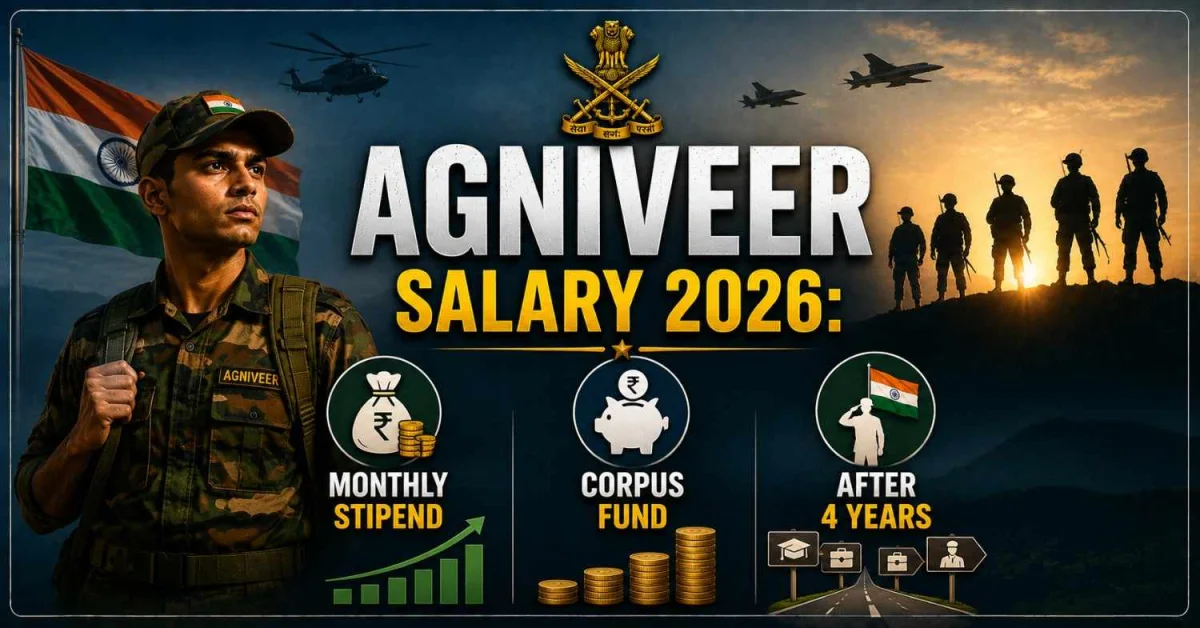
First Agniveer Batch Exit 2026-27: Retention, Seva Nidhi Payout and Jobs
The first Agniveer batch exit has begun. Here is how the 25% retention works, the ₹11.71 lakh Seva Nidhi payout, the new 50% quota in BSF and Assam Rifles, age relaxation, IGNOU degree credits and a checklist for exit.
The first Agniveer batch exit has begun. Young men and women who joined the Army, Navy and Air Force in late 2022 and early 2023 are now reaching the end of their four-year engagement. For most of them, the big questions are simple: Will I be retained? How much money will I get? Which jobs can I apply for next?
This guide answers all three using official figures and the latest notifications, and ends with a practical checklist for the final months of service.
When Does the First Batch Complete Its Tenure?
The Agnipath scheme 2022 announcement set a fixed four-year engagement, including training. Since the first intakes reported for training between November 2022 and early 2023, their tenure ends between late 2026 and early 2027.
The exit is not on a single date. It depends on when each batch joined:
-
Navy: The first batch of about 2,600 Agniveers reported to INS Chilka in November 2022. Its exit falls around October to November 2026.
-
Air Force: The first batch of Agniveervayu began training in December 2022 and completes its tenure around the same window.
-
Army: The first large batches joined in late December 2022 and early 2023, so they are expected to complete in December 2026 and January 2027.
Exact release dates are issued by each service to its own personnel, so always go by your unit’s instructions.
How Retention Into the Regular Cadre Works
Agniveer permanent cadre selection is not automatic. Under the approved scheme, up to 25% of each batch can be enrolled as regular soldiers, sailors or airmen. Only those who volunteer are considered.
The process works like this:
-
Centralised and merit-based: Each service draws up its own merit list. Selection is not left to individual units.
-
Based on your service record: Performance over four years is assessed through regular evaluations, such as the annual performance appraisal, along with medical fitness and the service’s needs.
-
Long commitment: Those selected join the regular cadre and must serve a further minimum period of 15 years.
There has been a lot of discussion about raising this limit. In July 2026, media reports said the Navy may seek retention of up to 75% and the Army and Air Force about 50%. These are proposals only. No change has been notified so far, so the existing Agniveer retention criteria 25 percent ceiling still applies to the first batch.
Agniveer Seva Nidhi Amount 2026: What the First Batch Gets
Every Agniveer puts 30% of their monthly package into the Seva Nidhi fund, and the government adds an equal amount. The year-wise figures are:
Over four years, each side contributes about ₹5.02 lakh, making ₹10.04 lakh. With interest, the total payout comes to about ₹11.71 lakh. This amount is exempt from income tax.
Two points are worth remembering:
-
No pension or gratuity: Agniveers who leave after four years do not get a pension or gratuity. The Seva Nidhi is the main financial package.
-
Insurance during service: A non-contributory life insurance cover of ₹48 lakh applies during the engagement period.
What Happens After Agniveer Tenure Ends for the 75%
By design, about three out of four Agniveers will leave the forces after four years. This is not a judgement on their ability. It is how the Agnipath scheme was built from the start.
On exit, each Agniveer receives a discharge certificate along with an Agniveer Skill Certificate, which lists the skills learnt during service. Keep both safe, along with your service completion certificate and other service records, because recruiting bodies will ask for them.
Agniveer Government Jobs After Exit: Central and State Quotas
The biggest change since 2022 is the size of the central quota. When the scheme was first announced, the Ministry of Home Affairs promised 10% reservation in the Central Armed Police Forces (CAPFs) and Assam Rifles. That figure has since gone up sharply:
-
BSF: A notification in December 2025 raised the ex-Agniveer quota in Constable (GD) recruitment from 10% to 50%.
-
Assam Rifles: A notification in August 2026 reserved 50% of Rifleman (GD) vacancies for ex-Agniveers.
-
CRPF, CISF and SSB: The ministry has also amended their recruitment rules to give ex-Agniveers a larger share.
The CAPF reservation Agniveer candidates can now claim also comes with these relaxations:
-
Age relaxation: Up to five years for the first batch, and up to three years for later batches.
-
Test exemptions: Exemption from the Physical Efficiency Test and Physical Standard Test. Recent notifications also exempt eligible ex-Agniveers from the written exam.
Several states also give reservation or preference in police and other uniformed posts. Uttar Pradesh, Haryana, Uttarakhand, Maharashtra, Gujarat and Chhattisgarh are among them, with quotas of up to 20% in some cases. The exact terms differ from state to state, so check your own state’s notification.
Higher Education and Skill Recognition
Exiting Agniveers can also continue their studies. In June 2022, the Ministry of Education announced a three-year degree programme for Agniveers, run by IGNOU. Its key features are:
-
Credit for service: Half the credits come from the skill training received in service, and the rest from academic courses.
-
Recognised degree: The degree is awarded as BA, BCom or a similar course under UGC rules and is recognised for jobs and further study.
-
Flexible exit: A certificate after one year, a diploma after two years and a degree after three years.
Note that there is no separate document called a UGC credit equivalency letter. Credit for service is given through this IGNOU programme, based on your skill certificate and service records.
Transition Checklist for the Final Months
Use this checklist to avoid last-minute problems:
-
Six months before exit: Decide whether you will volunteer for retention, and prepare a backup plan in case you are not selected.
-
Four months before exit: Check your Seva Nidhi account statement with your unit and make sure all your contributions and the government’s share are recorded.
-
Three months before exit: Track CAPF, Assam Rifles and state police notifications, and note the ex-Agniveer quota and age relaxation in each.
-
Two months before exit: Make sure your bank details, address and other personal records with your unit are correct.
-
At exit: Collect your discharge papers, Skill Certificate and service documents, and keep several attested copies.
-
After exit: Apply in the open recruitment windows and, if you wish, enrol in the IGNOU degree programme.
FAQs
How much Seva Nidhi will the first Agniveer batch receive?
Each Agniveer will receive about ₹11.71 lakh, which includes their own contribution, the government’s equal share and interest. The amount is tax-free.
How is the 25% retention decided?
Retention is open only to those who volunteer. Each service selects candidates through a centralised, merit-based process that looks at performance during service, medical fitness and organisational needs. Proposals to raise the limit are under discussion, but no change has been notified yet.
How much reservation do ex-Agniveers get in the CAPFs?
The original promise was 10%. Recent notifications have raised it to 50% of Constable (GD) vacancies in the BSF and 50% of Rifleman (GD) vacancies in the Assam Rifles, and other CAPFs have also amended their rules. The first batch gets up to five years of age relaxation and is exempt from physical tests.
What documents should I keep when I leave?
Keep your discharge certificate, Agniveer Skill Certificate, service records and Seva Nidhi account details. Recruiting bodies and universities will ask for these.
The first Agniveer batch exit is a test for the whole scheme, and for each Agniveer it is the start of a new chapter. Start planning early, keep your documents ready and watch for the latest notifications.