CDS SSB Interview Questions: 50 Questions CDS Aspirants Should Prepare
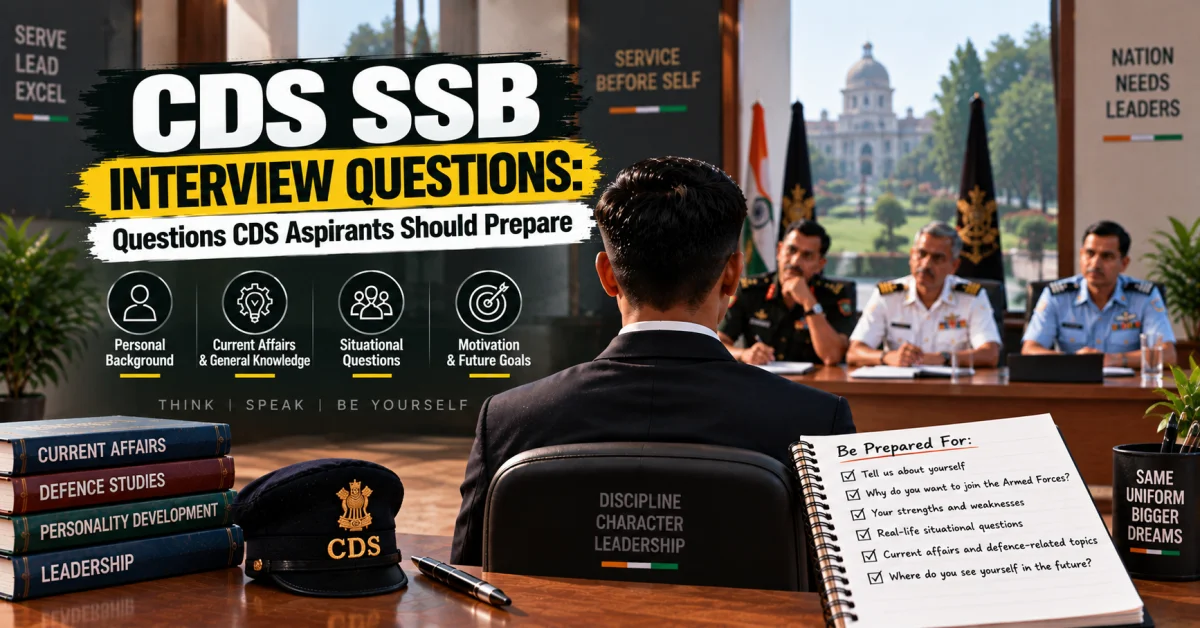
Clearing the CDS written exam is a real achievement, but the harder test comes at the Services Selection Board. Most candidates who reach this stage have put in enough work to clear the paper. Very few have actually prepared for the specific questions waiting inside that interview room. This guide covers 50 CDS SSB interview questions across every round, with sample answer frameworks and the OLQ assessment logic behind each one, so you walk in knowing exactly what the assessors are looking for. That clarity matters most when it comes to SSB personal interview questions.
What the SSB Personal Interview Is Really Testing
The SSB personal interview is not a knowledge quiz. Assessors are not checking whether you can name every missile in India's arsenal. The five-day SSB process is built to measure 15 Officer Like Qualities, including courage, initiative, determination, intelligence, and responsibility. Every question the Interviewing Officer asks maps to one or more of these traits. The same logic applies to SSB interview questions with answers.
OLQ assessment means the assessor is reading how you think, not just what you say. A candidate who pauses, structures a genuine answer, and owns a past failure will almost always score higher than someone reciting a memorised response. Assessors are trained to spot rehearsed scripts within seconds. Keep that in mind when preparing SSB interview questions with answers.
According to SSBCrack's personal interview guide, the Interviewing Officer evaluates candidates across the same 15 OLQs that the psychologist and GTO assess. The PI is not a standalone round; it is the third data point in a triangulated picture. Contradictions between your PPDT picture perception story, your psychology responses, and your PI answers will reduce your chances of being a recommended candidate SSB. This is equally relevant when thinking about SSB GTO questions.
SSB board testing works on convergence. If your TAT story shows a passive protagonist but your PI answer claims you always lead from the front, that inconsistency raises a flag. Understand which quality each question targets, then answer authentically within that frame. The same principle applies to how to answer SSB interview questions.
Personal Background and Motivation Questions (Q1: Q12)
These questions come first and feel easy. They are not. Assessors use your background answers to establish your baseline character before testing it under pressure. Each question below is followed by the OLQ it primarily tests and a brief framework for your answer. This matters just as much for SSB psychology test questions.
-
Q1. Tell me about yourself. Tests: Self-confidence, communication. Framework: Cover hometown, educational background, one defining experience, and why defence. Keep it under 90 seconds.
-
Q2. Why do you want to join the defence forces? Tests: Motivation, sense of duty. Framework: Cite a specific incident or influence, not generic patriotism.
-
Q3. Why CDS and not UPSC Civil Services? Tests: Clarity of purpose. Framework: Acknowledge both are prestigious, then name a concrete reason such as operational leadership or the physical environment.
-
Q4. What are your strengths and weaknesses? Tests: Self-awareness. Framework: Give one real weakness with a correction plan, not a disguised strength.
-
Q5. Describe a situation where you led a team. Tests: Leadership. Framework: Use a real, small example; outcomes matter more than scale.
-
Q6. What do your friends say about you? Tests: Social adjustment. Framework: Name one or two specific qualities peers have commented on, with an example to support each.
-
Q7. How does your family feel about your joining the armed forces? Tests: Emotional stability. Framework: Be honest; if there was resistance, describe how you handled it.
-
Q8. Tell me about a failure you experienced. Tests: Courage, determination. Framework: Describe the failure clearly, state what you learned, show what changed afterward.
-
Q9. What did you do in the past year to prepare for SSB? Tests: Initiative. Framework: List specific actions, physical training, reading, mock interviews.
-
Q10. Who is your role model and why? Tests: Intelligence, values. Framework: Choose someone whose specific quality you are actively working to build in yourself.
-
Q11. Where do you see yourself in ten years? Tests: Determination. Framework: Name a realistic rank or responsibility, not a vague aspiration.
-
Q12. Why should we select you over other candidates? Tests: Confidence. Framework: Do not compare yourself to others; state two or three genuine qualities and connect them to what service requires.
For detailed sample answers to these SSB personal interview questions, SSBCrack's 50-question guide provides structured responses from recommended candidates.
Defence Knowledge and Current Affairs Questions (Q13: Q22)
This block tests whether you follow defence modernisation India, military developments, and the structure of the armed forces. Assessors use these questions to check awareness, not to trap you on trivia.
-
Q13. What is the role of the Chief of Defence Staff?
-
Q14. Name India's recently commissioned aircraft carrier and its significance.
-
Q15. What is the Agnipath scheme and how does it affect the armed forces?
-
Q16. Explain the difference between the Line of Actual Control and the Line of Control.
-
Q17. What are the major joint military exercises India conducted in the last year?
-
Q18. What is DRDO's most recent notable development?
-
Q19. What is theatre command and where does India stand on implementing it?
-
Q20. Name the three commands of the Indian Air Force and their headquarters.
-
Q21. What is India's stance on border security in the current strategic environment?
-
Q22. Which recent military exercise involved both India and the United States?
Current affairs for SSB interview demand preparation beyond newspaper headlines. You need to discuss why each development matters strategically, not just state the fact. Assessors follow up shallow answers with "why does this matter to the armed forces?" Candidates who track defence modernisation India through sources such as PIB, Ministry of Defence press releases, and structured defence news platforms consistently perform better at this stage.
Situational and Stress Questions (Q23: Q32)
These are the questions that break underprepared candidates. The stress interview military format involves the Interviewing Officer challenging your answers, sitting in silence, or posing dilemmas with no clean resolution. The purpose is to watch how you handle pressure.
-
Q23. You are the only officer in a remote post. Communication lines are down and an enemy patrol is approaching. What do you do?
-
Q24. Your commanding officer gives you an order you believe is wrong. What is your course of action?
-
Q25. A soldier under your command is caught stealing from civilians. How do you handle it?
-
Q26. You failed SSB twice before. Why should we believe you have what it takes now?
-
Q27. Your family needs you urgently, but your unit is deployed for an operation. What do you do?
-
Q28. If you are not selected today, what will you do next?
-
Q29. You think your team is heading in the wrong direction during a GTO task. How do you respond?
-
Q30. A fellow officer is displaying signs of mental stress before a critical mission. What steps do you take?
-
Q31. How do you handle a situation where your personal values conflict with a military order?
-
Q32. You are asked to take a decision with incomplete information under time pressure. Walk me through your process.
Assessors are looking for calm reasoning, not heroic bravado. Give answers that reflect genuine decision-making, not answers designed to impress. Avoid responses that dismiss the dilemma or claim you would "always follow orders without question," since that signals a lack of independent thinking, which is itself an OLQ deficit.
GTO Round: Group Discussion Topics and Task-Related Questions (Q33: Q40)
SSB GTO questions are not always verbal. The Group Testing Officer observes group task discussion topics as they unfold through behaviour, body language, and contribution patterns. The questions below represent both themes given to groups and the implicit questions the GTO is answering through observation.
-
Q33. GD Topic: Should women be inducted into combat roles in the Indian Army?
-
Q34. GD Topic: Is the Agnipath scheme beneficial for national security?
-
Q35. GD Topic: How should India respond to cross-border terrorism?
-
Q36. GD Topic: Technology vs. manpower: What should India prioritise in defence?
-
Q37. Progressive Group Task: How does this candidate perform when the group is stuck? (GTO is observing, not asking)
-
Q38. Individual Obstacles: Does the candidate display physical initiative or wait for the group?
-
Q39. Command Task: How does the candidate brief a team when given authority?
-
Q40. Final Group Task: Does the candidate apply feedback from earlier rounds?
Performing well in the GTO round means contributing ideas clearly, accepting others' input without ego, and stepping up without stepping over teammates. The assessor evaluation criteria here rewards initiative combined with cooperation, not dominance on its own.
Psychology Round: TAT, WAT, SRT and Self-Description Themes (Q41: Q50)
SSB psychology test questions are not direct. TAT WAT SRT and self-description SSB are indirect instruments that reveal your personality through patterns rather than explicit answers. Aspirants who underestimate this round often score inconsistently across the board.
-
Q41. TAT Theme: A figure is standing alone at a crossroads. Write a story showing initiative, a constructive goal, and a positive outcome.
-
Q42. TAT Theme: Two people appear to be in conflict. The protagonist should resolve the conflict through leadership, not avoidance.
-
Q43. WAT Word: "Challenge." Write a sentence treating the word as an opportunity, not a threat.
-
Q44. WAT Word: "Responsibility." Connect it to action, not obligation.
-
Q45. SRT Situation: You miss your bus to the exam centre. Your response should show calmness, quick problem-solving, and no self-pity.
-
Q46. SRT Situation: A senior colleague discredits your work in front of others. Response should show composure and constructive redress.
-
Q47. SRT Situation: You find a wallet with cash on the road. Response should reflect integrity without hesitation.
-
Q48. Self-description SSB: How your parents describe you. Should reflect warmth and reliability.
-
Q49. Self-description SSB: How your best friend describes you. Should reflect loyalty and honesty.
-
Q50. Self-description SSB: How you describe yourself. Should be grounded, specific, and free of exaggeration.
According to Jagran Josh's psychology round guide, consistency across all four instruments is what separates recommended candidates from borderline cases. Your TAT protagonist should carry the same values as your SRT responses and your self-description.
How to Answer Difficult SSB Interview Questions Without Losing Composure
Candidates who perform well in the PI tend to follow three steps: pause, frame, answer. Taking two to three seconds before responding is not a sign of weakness; it shows you process before you speak, which is exactly what assessors want to see in an officer candidate.
Framing means briefly naming the core tension in the question before resolving it. For something like "What if you fail again?", acknowledge the difficulty first, then pivot to what you have done differently this time. Jumping straight to a confident declaration without acknowledging the challenge sounds rehearsed.
When a question involves a personal failure, use the structure: situation, action, result, learning. Do not dramatise the failure or minimise it. Assessors score authenticity over polish. Roughly 85 percent of candidates who struggle in the PI round do so because they chase the "right" answer rather than an honest one.
For hypothetical dilemmas, avoid absolute statements. "I would always." and "I would never." both signal inflexibility. Real officers operate in ambiguous conditions. Show that you can hold competing priorities and reason through them calmly.
Understanding how to answer SSB interview questions under pressure comes down to self-knowledge. The more clearly you know your own values, experiences, and motivations, the more naturally your answers will reflect the Officer Like Qualities the board is looking for.
FAQs
What are the most commonly asked CDS SSB interview questions by assessors?
Assessors consistently ask about motivation for joining the armed forces, personal background, a leadership experience, a failure and its lesson, current defence developments, and situational dilemmas. Questions around defence modernisation India and India's border security environment come up in nearly every PI session. The full list of CDS SSB interview questions in this article covers the 50 most frequent across all rounds.
How should I answer tricky SSB interview questions to impress the board?
The word "impress" is worth reframing here. Assessors are not looking for impressive performances; they are looking for authentic responses that reflect Officer Like Qualities. Use the pause-frame-answer method, stay specific rather than vague, and do not try to hide a genuine weakness behind a disguised strength.
What current affairs topics are typically asked in the SSB personal interview?
Current affairs for SSB interview cluster around three themes: India's defence acquisitions and modernisation, recent joint military exercises, and India's strategic relationships with neighbouring countries and major powers. Aspirants should follow Ministry of Defence press releases and CDS written exam clearance-era news for at least three months before their board date.
What questions are asked in the SSB GTO and psychology rounds for CDS?
The GTO round involves group task discussion topics on social, national, and defence themes, along with physical task observation. The psychology round uses TAT WAT SRT and self-description SSB instruments. None of these are direct questions in the traditional sense; assessors evaluate patterns across all responses, not individual answers in isolation.
How long is the SSB personal interview for CDS candidates?
The personal interview typically runs between 40 and 60 minutes, though it can stretch beyond an hour when the Interviewing Officer finds a candidate worth probing further. It is the longest one-on-one interaction in the five-day SSB process and the most directly weighted component of the final assessor evaluation criteria.
For further reading, see SSB Interview Questions Asked by Assessors , Personal Interview Guide and CDS SSB Interview: What Assessors Look For and Common Questions.