CDS General Knowledge Preparation: Important Topics, Weightage
Make your CDS GK preparation focused. This guide covers the GK paper format, CDS GK subject-wise weightage, the most repeated topics from previous year papers, a 3-month study plan, best books and the mistakes that cost marks.
Most CDS aspirants open the GK paper and immediately feel the pressure of breadth. One hundred questions, drawn from history, geography, science, current affairs, and defence topics, all sitting under a single 100-mark paper with a penalty for every wrong answer. Unfocused preparation punishes you twice: once through unanswered questions and once through negative marking. Smart CDS GK preparation means knowing exactly which subjects to prioritize, which topics repeat year after year, and how to structure three months of study so nothing important gets skipped. That applies directly to CDS General Knowledge important topics.
This guide covers all three: a subject-wise weightage breakdown, a topic-level analysis of CDS GK previous year papers topics, a practical 3-month plan, and a curated book list for CDS exam 2026. The same principle applies to CDS General Knowledge important topics.
What Is the CDS GK Paper? Format and Marks at a Glance
The Combined Defence Services exam is conducted by UPSC twice a year. It tests candidates across three subjects: English, Elementary Mathematics, and General Knowledge. The GK paper is the most demanding in terms of syllabus breadth and is where marks are most commonly lost through guesswork. Keep this in mind when thinking about CDS GK subject-wise weightage.
According to the UPSC CDS I 2026 notification, the General Knowledge paper carries 100 questions for 100 marks. Each correct answer earns 1 mark. The CDS negative marking rule deducts 0.33 marks for every wrong answer, which works out to roughly 0.83 marks lost for every three wrong responses. This asymmetry means random guessing destroys your score faster than most aspirants realise. Factor this in carefully when building your CDS GK study plan for 3 months.
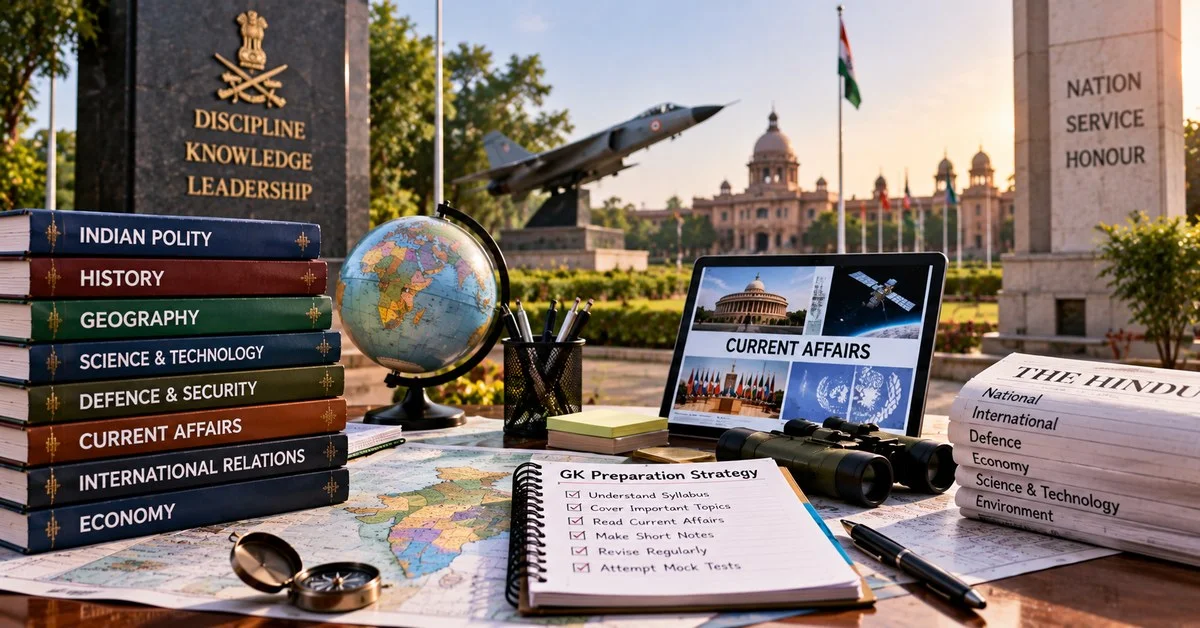
The UPSC CDS syllabus for GK covers a deliberately wide scope. Per the official notification, the paper tests a candidate's general awareness of the world and events happening around them. In practice, questions span the following areas, all of which matter for CDS GK study plan 3 months:
-
History (ancient, medieval, and modern India)
-
Physical and political Geography
-
Indian Polity and Constitution
-
General Economics
-
General Science (Physics, Chemistry, Biology basics)
-
Current Affairs (national and international)
-
Defence and military GK specific to India
The paper runs for two hours. There is no sectional cut-off within GK, but a low GK score rarely survives the overall merit list. Candidates appearing for the Indian Military Academy, Naval Academy, and Air Force Academy all sit the same GK paper, so the standard is uniform across services. This matters just as much for CDS exam 2026.
Subject-wise Weightage: Where the Marks Actually Come From
CDS GK subject-wise weightage is the question asked most often in preparation forums, and it is the data point missing from most competitor articles. Based on analysis of CDS GK previous year question paper trends compiled by Jagran Josh and the official UPSC question archives, the approximate distribution across subjects is as follows:
History, Current Affairs, and Geography together account for roughly 50 questions out of 100. Polity adds another 10-14. Mastering these four subjects alone puts you in a position to attempt 60-70 percent of the paper with genuine confidence, which is exactly where your preparation time should go first.
Most Repeated Topics in CDS GK Previous Year Papers
Analysing CDS GK previous year papers topics across multiple exam cycles reveals a clear pattern. Some subject areas appear in almost every paper; others shift unpredictably. Knowing the difference is central to any intelligent approach for CDS aspirants.
Evergreen, high-frequency topics (appear consistently across papers):
-
Indian national movement questions: The freedom struggle from 1857 to 1947, key leaders, sessions of the Indian National Congress, and major acts like the Government of India Act 1935 appear in nearly every CDS GK paper.
-
Constitutional articles CDS: Fundamental Rights (Articles 12-35), Directive Principles, the Preamble, emergency provisions, and amendment procedures are tested repeatedly under Indian polity for CDS.
-
Physical geography topics: River systems, monsoon patterns, soil types, natural vegetation zones, and the Himalayan ranges appear in 12-15 questions per paper on average.
-
Defence and military GK: Indian Army ranks, recent defence acquisitions, major exercises, and the structure of India's armed forces are standard inclusions.
Variable topics (useful but less predictable):
-
General Economics: Budget terminology, inflation, RBI functions, and trade balances appear inconsistently.
-
General Science: Questions cover school-level concepts in Physics, Chemistry, and Biology, but topic selection varies between papers.
-
Static GK for defence exams: Awards, sports records, and miscellaneous facts appear in small numbers but are difficult to predict.
3-Month CDS GK Study Plan for Beginners
A structured CDS GK study plan covering 3 months is realistic for most beginners if the first month is treated as non-negotiable foundation time. Here is a week-by-week breakdown:
Month 1: Foundation (History, Polity, Geography Core)
-
Weeks 1-2: Modern Indian History, with a focus on the Indian national movement from 1857 to 1947. Target 10-12 hours per week.
-
Weeks 3-4: Indian Polity basics, covering constitutional articles relevant to CDS, the structure of Parliament, and the judiciary. Target 10 hours per week.
-
Parallel activity: Physical geography topics daily, 30 minutes, using NCERT Class 11 Geography.
Month 2: Extension (Economy, Science, Static GK)
-
Weeks 5-6: General Science revision using NCERT Class 9 and 10 textbooks. Target 8 hours per week.
-
Weeks 7-8: Basic Economics concepts and static GK for defence exams, including defence-specific knowledge. Target 8 hours per week.
-
Parallel activity: Begin CDS current affairs preparation using one reliable daily news source, 20 minutes each morning.
Month 3: Current Affairs, Revision, and CDS Mock Test Practice
-
Weeks 9-10: Consolidate the last 6 months of current affairs. Target 10 hours per week on news and compiled monthly digests.
-
Weeks 11-12: Full-length CDS mock test practice, minimum 2 tests per week. Review every incorrect answer by subject. Target 12 hours per week including review time.
Best Books and Free Resources for CDS GK 2026
The best books for CDS GK preparation depend on the subject, since no single book covers all seven areas well. A subject-matched reading list avoids both gaps and redundancy.
Subject-wise book recommendations:
-
History: Spectrum's "A Brief History of Modern India" by Rajiv Ahir for the freedom struggle; NCERT Class 12 Themes in Indian History for ancient and medieval coverage.
-
Indian Polity: "Indian Polity" by M. Laxmikanth, specifically the chapters covering constitutional articles relevant to CDS, Parliament, and Centre-State relations.
-
Geography: NCERT Class 11 "Fundamentals of Physical Geography" for physical geography topics; NCERT Class 12 "India: People and Economy" for applied geography.
-
General Science: NCERT Class 9 and 10 Science textbooks cover the full scope of what CDS General Studies demands in this section.
-
Economy: NCERT Class 11 "Indian Economic Development" and basic notes on budget and monetary policy are sufficient for the low-medium priority Economics section.
-
CDS Current Affairs preparation: Monthly current affairs compilations from reliable defence-focused platforms work better than daily newspaper reading for most beginners.
-
Defence and Military GK: No single dedicated book covers this fully. Maintain a self-prepared notes file updated monthly from defence news sources.
Free resources that work:
-
UPSC official question papers (previous CDS exams) available at upsc.gov.in
-
CDS mock test practice platforms that provide section-level performance analysis
-
Compiled monthly current affairs PDFs, particularly for the last 6 months before the exam
Common Mistakes to Avoid in CDS GK: Including Negative Marking Traps
The CDS negative marking rule (0.33 marks deducted per wrong answer) turns a careless attempt into a liability. Most aspirants understand this in theory but still fall into predictable traps during the exam.
Mistake 1: Attempting unfamiliar Current Affairs questions. CDS current affairs preparation requires knowing which news items are genuinely in scope. If you cannot place a current affairs question within a clear context, skip it. A 50-50 guess on a current affairs question costs you 0.33 marks for roughly even odds, a negative expected value.
Mistake 2: Ignoring defence and military GK. Many aspirants skip this section during preparation because it feels niche. In the exam, 8-10 questions from this area can decide whether you clear the cut-off. Build a monthly habit of reading defence acquisition news and noting major Indian military exercises.
Mistake 3: Skipping revision of static topics. Evergreen areas like Indian national movement questions and constitutional articles CDS reward aspirants who revise consistently. Reading a topic once in Month 1 and never returning to it means retaining roughly 20 percent of the detail by exam day. Schedule at least one full revision cycle in Month 3.
Mistake 4: Over-relying on a single book. No one book covers CDS General Studies completely. Using only one source creates blind spots, particularly in Geography and Science, where NCERT textbooks remain more accurate than most coaching materials.
Mistake 5: No CDS mock test practice before the real exam. Attempting past papers under timed conditions is irreplaceable. It teaches you which question types to attempt first, where your accuracy drops, and how fatigue affects decision-making in the final 30 minutes.
FAQs
What are the most repeated topics in CDS GK?
History, particularly Indian national movement questions covering the period 1857 to 1947, appears in nearly every paper. Constitutional articles, physical geography topics, general science and current affairs are the other consistent high-frequency areas. Reviewing five to six years of CDS GK previous year papers topics confirms this pattern clearly.
Which subject has the highest weightage in CDS GK?
UPSC does not publish an official CDS GK subject-wise weightage. Based on previous year papers, History, Current Affairs, Geography, Indian Polity and General Science carry most of the 120 questions, with Economy and Defence GK forming a smaller share. The exact split changes from paper to paper.
Can I prepare CDS GK in 3 months as a beginner?
Yes. The CDS GK study plan covering 3 months outlined above is designed for beginners. The key is spending Month 1 on foundation subjects rather than spreading attention across all areas from day one. A phased plan, followed consistently, usually works better than studying every subject at once without priorities.
Which are the best books for CDS GK preparation?
Spectrum for Modern History, M. Laxmikanth for Polity, NCERT Class 11 and 12 for Geography, and NCERT Class 9 and 10 for Science form the core reading list. No single book replaces this combination. Many of these books also overlap well with the GK sections of other defence exams.
How should I handle negative marking in CDS GK?
Under the CDS negative marking rule, one-third of a question's marks is deducted for each wrong answer. Attempt a question only when you are at least 70 percent confident in your answer. If you recognise the topic but cannot recall the specific answer, use elimination to narrow the options before deciding. Questions from a current affairs area you did not cover during your CDS current affairs preparation should be skipped.