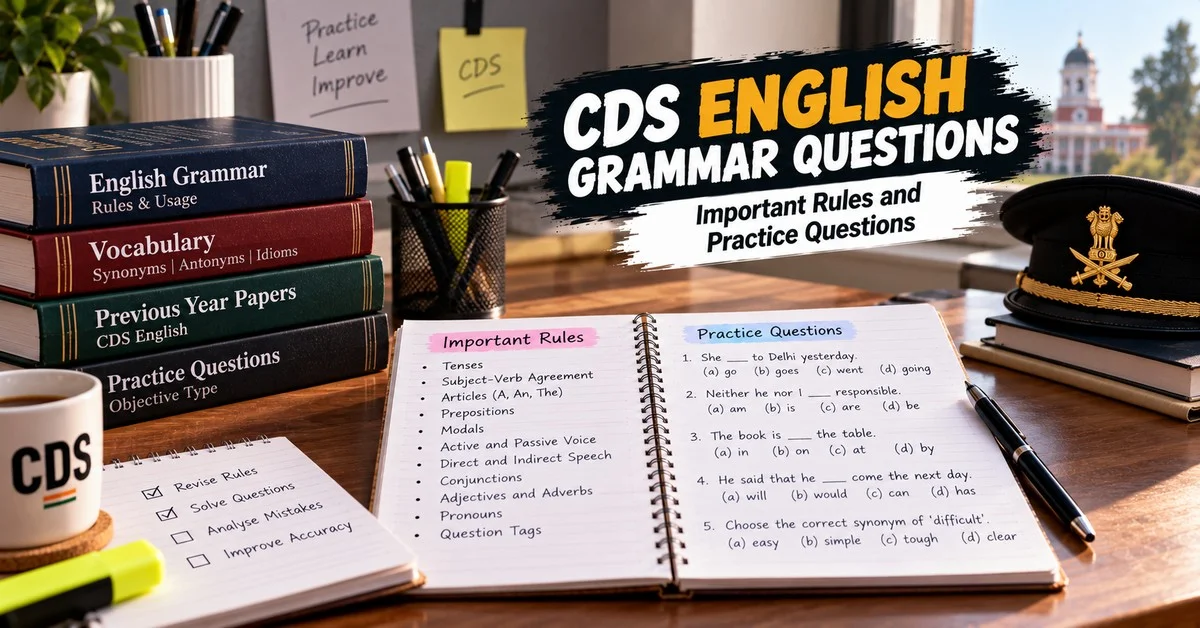
CDS English Grammar Questions, as most aspirants use the term, cover the entire 120-question CDS English paper, split across 13 recurring categories: vocabulary, grammar error-spotting, reading comprehension, confusable words, synonyms, homophones, sentence relationships, word definitions, paragraph sequencing, parts of speech, prepositions, idioms, and antonyms. Only a portion of these are grammar in the strict textbook sense; the rest test vocabulary and word relationships using the same underlying language skill. This guide covers every category with 36 original practice questions, each with the answer and a short explanation.
The CDS English paper carries 100 marks across 120 questions, for IMA, INA, and AFA candidates.
Grammar in the strict sense, subject-verb agreement, tense, articles, is only one slice of that paper. The rest is built from vocabulary, word relationships, comprehension, and structure, all under the same "English" heading, which is why CDS English Grammar Questions ends up covering so much more ground than a grammar textbook would suggest.
This guide breaks down all 13 categories the way a recent CDS English paper was actually structured, then gives 36 practice questions covering each one.
CDS English Paper Pattern: All 13 Categories
This breakdown reflects how a recent CDS English paper (CDS 1, April 2026) was actually structured, and it's the clearest picture available of what CDS English Grammar Questions actually cover. The exact split can vary slightly from one exam to the next, but the categories themselves repeat consistently.
|
Category
|
Approximate questions
|
|
Vocabulary & Word Meanings
|
10
|
|
Grammar & Error Spotting
|
5
|
|
Reading Comprehension
|
5
|
|
Confusable Word Pairs
|
10
|
|
Synonym Selection
|
10
|
|
Homophones
|
10
|
|
Sentence Relationships
|
10
|
|
Word Definitions
|
10
|
|
Paragraph Sequencing
|
10
|
|
Parts of Speech
|
10
|
|
Prepositions & Determiners
|
10
|
|
Idioms & Phrases
|
10
|
|
Antonyms
|
10
|
Grammar & Error Spotting is genuinely one of the smaller categories by count. Vocabulary, word relationships, and usage make up most of the paper.
CDS English Grammar Questions: Practice Set Across All 13 Categories
These 36 questions are written fresh for this guide, spread across every category above, not lifted from any specific past paper.
1. Vocabulary & Word Meanings
|
#
|
Question
|
Answer
|
Why
|
|
1
|
"Frugal" means: Wasteful / Thrifty / Generous / Careless
|
Thrifty
|
"Frugal" describes someone careful and sparing with money or resources.
|
|
2
|
"Ambiguous" means: Clear / Open to more than one interpretation / Certain / Obvious
|
Open to more than one interpretation
|
"Ambiguous" describes something unclear because it can be read more than one way.
|
|
3
|
"Candid" means: Deceptive / Honest and direct / Secretive / Formal
|
Honest and direct
|
"Candid" describes speaking frankly, without holding back.
|
2. Grammar & Error Spotting
|
#
|
Question
|
Answer
|
Why
|
|
4
|
"The pair of shoes (a) / were kept (b) / near the door (c) / No error (d)."
|
(b)
|
"Pair" is singular here, so it should be "was kept."
|
|
5
|
"Having finished the drill (a) / the recruits was asked (b) / to fall back in line (c) / No error (d)."
|
(b)
|
The subject "recruits" is plural, so it should be "were asked."
|
|
6
|
"She along with her colleagues (a) / were praised (b) / for their discipline (c) / No error (d)."
|
(b)
|
"Along with" doesn't make the subject plural, so it should be "was praised."
|
3. Reading Comprehension
Passage: "Officers who lead by example earn more respect than those who rely only on rank. A soldier is more likely to follow someone who shares the hardship, not just gives the order."
|
#
|
Question
|
Answer
|
Why
|
|
7
|
What does the passage suggest builds respect in leadership? Rank alone / Sharing hardship with the team / Giving strict orders / Avoiding difficult tasks
|
Sharing hardship with the team
|
The passage directly contrasts rank alone with leading by sharing hardship.
|
|
8
|
"Hardship" in the passage most nearly means: Comfort / Difficulty / Authority / Reward
|
Difficulty
|
"Hardship" refers to difficult or challenging conditions.
|
4. Confusable Word Pairs
|
#
|
Question
|
Answer
|
Why
|
|
9
|
"The tank remained ___ throughout the ceasefire." (stationary / stationery)
|
stationary
|
"Stationary" means not moving; "stationery" refers to writing materials.
|
|
10
|
"The officer paid him a ___ for his sharp thinking." (complement / compliment)
|
compliment
|
A "compliment" is praise; a "complement" completes something.
|
|
11
|
"The soldier showed great ___ during the operation." (courage / currage)
|
courage
|
"Currage" isn't a word; "courage" is the correct spelling.
|
5. Synonym Selection
|
#
|
Question
|
Answer
|
Why
|
|
12
|
Nearest meaning of "Resilient": Fragile / Able to recover quickly / Stubborn / Weak
|
Able to recover quickly
|
"Resilient" describes bouncing back from difficulty.
|
|
13
|
Nearest meaning of "Meticulous": Careless / Extremely careful and precise / Lazy / Slow
|
Extremely careful and precise
|
"Meticulous" describes close attention to detail.
|
|
14
|
Nearest meaning of "Formidable": Weak / Impressive and daunting / Friendly / Simple
|
Impressive and daunting
|
"Formidable" describes something that inspires respect through its strength.
|
6. Homophones
|
#
|
Question
|
Answer
|
Why
|
|
15
|
"He was ___ into the academy after the interview." (accepted / excepted)
|
accepted
|
"Accepted" means admitted; "excepted" means left out.
|
|
16
|
"The ship reached its ___ at dawn." (berth / birth)
|
berth
|
A "berth" is a docking spot for a ship; "birth" refers to being born.
|
|
17
|
"The general gave a ___ to the young officers." (council / counsel)
|
counsel
|
"Counsel" means advice; a "council" is a group that makes decisions.
|
7. Sentence Relationships
|
#
|
Question
|
Answer
|
Why
|
|
18
|
Sentence 1: "The weather forecast predicted heavy rain." Sentence 2: "The exercise was conducted without any delay." What's the relationship? Confirms / Contradicts / Qualifies / Contrasts
|
Contrasts
|
The second sentence describes an outcome that goes against what the first would suggest.
|
|
19
|
Sentence 1: "He was known for his discipline." Sentence 2: "He always followed the rules strictly." What's the relationship?
|
Confirms
|
The second sentence provides direct evidence supporting the first.
|
8. Word Definitions
|
#
|
Question
|
Answer
|
Why
|
|
20
|
"Autonomy" means: Dependence / Self-governance / Obedience / Weakness
|
Self-governance
|
"Autonomy" refers to the ability to govern or act independently.
|
|
21
|
"Pragmatic" means: Idealistic / Practical and realistic / Emotional / Careless
|
Practical and realistic
|
"Pragmatic" describes dealing with things sensibly and realistically.
|
|
22
|
"Coherent" means: Confusing / Logical and consistent / Random / Silent
|
Logical and consistent
|
"Coherent" describes something that holds together logically.
|
9. Paragraph Sequencing
Arrange in logical order: P: "The recruits gathered at dawn." Q: "They had trained for this moment for months." R: "The final assessment would decide their fate." S: "Now, only discipline and focus mattered."
|
#
|
Question
|
Answer
|
Why
|
|
23
|
What is the correct sequence?
|
Q, P, R, S
|
The training background (Q) comes first, then the gathering (P), the stakes (R), and the closing thought (S).
|
10. Parts of Speech
|
#
|
Question
|
Answer
|
Why
|
|
24
|
In "He runs swiftly every morning," what part of speech is "swiftly"?
|
Adverb
|
It describes how the action "runs" is performed.
|
|
25
|
In "The commanding officer briefed the troops," what part of speech is "briefed"?
|
Verb
|
It's the action word in the sentence.
|
|
26
|
In "Discipline is the backbone of the forces," what part of speech is "backbone"?
|
Noun
|
It names a thing, the core support of the forces.
|
11. Prepositions & Determiners
|
#
|
Question
|
Answer
|
Why
|
|
27
|
"He was accused ___ negligence during duty." (of / for / with / at)
|
of
|
"Accused of" is the fixed preposition pairing.
|
|
28
|
"The unit consists ___ fifty soldiers." (of / in / with / for)
|
of
|
"Consists of" is the standard pairing.
|
|
29
|
"___ officer must lead by example." (A / An / The / No article)
|
An
|
"Officer" begins with a vowel sound.
|
12. Idioms & Phrases
|
#
|
Question
|
Answer
|
Why
|
|
30
|
"To hold the fort" means: To attack first / To take charge temporarily / To retreat / To celebrate
|
To take charge temporarily
|
The idiom refers to managing responsibilities while someone else is away.
|
|
31
|
"To toe the line" means: To disobey / To conform to rules / To walk carefully / To argue
|
To conform to rules
|
The idiom means following expected rules or standards.
|
|
32
|
"To turn the tide" means: To change the course of a situation / To swim / To surrender / To wait patiently
|
To change the course of a situation
|
The idiom describes reversing an unfavorable situation.
|
13. Antonyms
|
#
|
Question
|
Answer
|
Why
|
|
33
|
Antonym of "Diligent": Hardworking / Lazy / Careful / Honest
|
Lazy
|
"Diligent" means hardworking, so its opposite is "lazy."
|
|
34
|
Antonym of "Reticent": Silent / Talkative / Shy / Calm
|
Talkative
|
"Reticent" means reserved or quiet, so its opposite is "talkative."
|
|
35
|
Antonym of "Tranquil": Peaceful / Chaotic / Quiet / Still
|
Chaotic
|
"Tranquil" means calm, so its opposite is "chaotic."
|
|
36
|
Antonym of "Ephemeral": Everlasting / Brief / Temporary / Fleeting
|
Everlasting
|
"Ephemeral" means short-lived, so its opposite is "everlasting."
|
The Grammar Rules Behind These Questions
Within the full set of CDS English Grammar Questions, the Grammar & Error Spotting, Parts of Speech, and Prepositions categories mostly come back to a handful of core rules.
|
Rule
|
What it means
|
|
Subject-verb agreement
|
The verb matches the real subject in number, even when other nouns sit closer to it.
|
|
Tense consistency
|
A sentence describing one timeframe shouldn't shift into another partway through.
|
|
Preposition usage
|
Certain verbs and adjectives pair with one fixed preposition, like "accused of" or "consists of."
|
|
Article usage
|
"A" or "an" depends on the sound that follows, not just the first letter.
|
|
Pronoun agreement
|
A pronoun must match the noun it replaces in number and gender.
|
|
Faulty comparisons
|
Comparisons need to compare like with like, not a thing with the category it belongs to.
|
How to Prepare Using This Question List
-
Attempt all 36 CDS English Grammar Questions in this set first, without checking the answers, to see which categories you're already comfortable with.
-
Review the "Why" column closely for every question you got wrong, since the reasoning matters more than just knowing the right answer.
-
Give equal time to vocabulary-heavy categories, confusables, homophones, word definitions, since they make up more of the paper than grammar alone.
-
Take one full-length, timed English paper weekly, and log mistakes by category rather than just marking them right or wrong.
Want More CDS English Practice Like This? Join the Defence Study community on WhatsApp, Telegram, or Instagram for more CDS English practice sets, grammar breakdowns, and exam updates as they're published. Stay Informed. Stay Prepared. Stay Ready.
Bringing It Together
CDS English Grammar Questions cover far more ground than grammar rules alone, 120 questions across 13 categories, with vocabulary and word relationships making up a bigger share than strict grammar.
These 36 questions give you a working sample across every one of those categories, so nothing on exam day feels unfamiliar in format, even when the specific words change.
Frequently Asked Questions
How many questions are in the CDS English paper? 120, carrying 100 marks, for IMA, INA, and AFA candidates. That full 120-question set is what CDS English Grammar Questions refers to in practice, not just the strict grammar portion.
Does this guide include all 120 CDS English questions? No. It has 36 original practice questions covering all 13 recurring categories, so you can test yourself across the full range the exam covers, rather than reproducing an actual past paper.
Are all CDS English Grammar Questions actually grammar-based? No. Grammar and error-spotting is one of the smaller categories by count. The paper also tests vocabulary, confusable words, homophones, synonyms, antonyms, idioms, comprehension, and sentence structure.
Which CDS English category should I prioritize if I'm short on time? Vocabulary, confusables, synonyms, antonyms, and homophones together make up more of the paper than grammar alone, so they're worth equal or greater attention.
Is a weekly full-length English mock test necessary? Yes. It shows which categories you're still getting wrong under real timed conditions, which category-by-category practice alone doesn't always reveal.