CDS 2027 Syllabus and Exam Pattern: Complete Guide
Understand the CDS 2027 Syllabus and exam pattern in simple terms. Get the paper-wise pattern for IMA, INA, AFA and OTA, the marking scheme, full English, GK and Maths topics, and practical tips to prepare for CDS 1 and CDS 2 2027.
The CDS 2027 Syllabus has three papers for IMA, INA and AFA: English, General Knowledge and Elementary Mathematics, each of 100 marks and 2 hours. OTA candidates take only English and General Knowledge. English has 120 questions, GK 120 and Maths 100. One-third of the marks for a question are deducted for each wrong answer. The SSB interview carries 300 marks for IMA, INA and AFA, and 200 marks for OTA. The CDS 1 2027 exam is on 11 April 2027 and CDS 2 2027 on 19 September 2027.
CDS 2027 Important Dates
| Event | CDS 1 2027 | CDS 2 2027 |
|---|---|---|
| Notification | 2 December 2026 | 12 May 2027 |
| Last date to apply | 22 December 2026 | 1 June 2027 |
| Exam date | 11 April 2027 | 19 September 2027 |
These dates are from the UPSC Annual Calendar 2027. You may see some websites mention a CDS 1 2027 notification date of 10 November 2026 or an application window of 10 to 30 December 2026. The official UPSC calendar lists 2 December and 22 December 2026, so please go by the official dates.
CDS Exam Pattern 2027: Overview
The CDS exam pattern is different for OTA and for the other three academies.
For IMA, INA and AFA
| Paper | Subject | Questions | Marks | Duration |
|---|---|---|---|---|
| Paper 1 | English | 120 | 100 | 2 hours |
| Paper 2 | General Knowledge | 120 | 100 | 2 hours |
| Paper 3 | Elementary Mathematics | 100 | 100 | 2 hours |
| Written total | 340 | 300 | ||
| SSB interview | – | 300 | 5 days | |
| Grand total | – | 600 |
OTA Exam Pattern
| Paper | Subject | Questions | Marks | Duration |
|---|---|---|---|---|
| Paper 1 | English | 120 | 100 | 2 hours |
| Paper 2 | General Knowledge | 120 | 100 | 2 hours |
| Written total | 240 | 200 | ||
| SSB interview | – | 200 | 5 days | |
| Grand total | – | 400 |
The OTA exam pattern does not include Elementary Mathematics. This is why the CDS 2027 Syllabus for OTA is shorter, but competition in English and GK is usually strong.
Key Points About the CDS Exam Pattern
- All papers are objective-type (multiple choice) and use an OMR answer sheet.
- The exam is offline (pen and paper).
- English and GK are of graduate level, and Elementary Mathematics is of Class 10 (matriculation) level.
- GK and Maths question papers are in both Hindi and English. The English paper is only in English.
- Calculators are not allowed.
- In CDS 2 2026, the timings were English 9:00–11:00 AM, GK 12:30–2:30 PM and Maths 4:00–6:00 PM. Please check your e-admit card for the exact CDS 2027 timings.
CDS Marking Scheme
| Paper | Marks per Correct Answer | Negative Marks per Wrong Answer |
|---|---|---|
| English (120 questions) | 0.83 | 0.28 (about) |
| General Knowledge (120 questions) | 0.83 | 0.28 (about) |
| Elementary Mathematics (100 questions) | 1 | 0.33 |
- One-third of the marks for a question are deducted for each wrong answer.
- No marks are deducted for questions you leave blank.
- Marking more than one option is treated as a wrong answer.
Some websites say every question carries 1 mark with 0.33 negative marks. That is true only for Maths. In English and GK, each paper has 120 questions for 100 marks, so each question is worth about 0.83 marks. The CDS marking scheme rewards accuracy, so it's wise to skip a question you are unsure about rather than guess blindly.
CDS English Syllabus (100 Marks)
The official notification says the English paper is designed to test the candidate's understanding of English and workmanlike use of words. The CDS English syllabus usually covers:
- Reading comprehension: Passages followed by questions
- Spotting errors: Finding grammar mistakes in a sentence
- Sentence improvement: Replacing the underlined part with a better option
- Sentence and paragraph arrangement: Putting jumbled parts in the right order
- Fill in the blanks and cloze test
- Vocabulary: Synonyms, antonyms, one-word substitution
- Idioms and phrases
- Active and passive voice, direct and indirect speech
Since the English paper decides merit for all four academies, it is one of the most important parts of the CDS 2027 Syllabus.
CDS GK Syllabus (100 Marks)
As per the notification, the GK paper covers general knowledge, including current events and matters of everyday observation and experience in their scientific aspects, as may be expected of an educated person. It also includes questions on the history and geography of India.
The official notification does not give a detailed topic list, so here is the CDS GK syllabus as seen in recent papers:
| Area | Main Topics |
|---|---|
| History | Ancient, medieval and modern India; Freedom Movement; important world events |
| Geography | Physical geography, Indian and world geography, climate, rivers, resources |
| Polity | Indian Constitution, Parliament, judiciary, fundamental rights, important amendments |
| Economy | Basic concepts, budget, banking, government schemes |
| Physics | Motion, force, light, sound, heat, electricity, magnetism |
| Chemistry | Elements, acids and bases, metals, everyday chemistry |
| Biology | Human body, diseases, nutrition, plants and animals |
| Current affairs | National and international events, awards, sports, appointments |
| Defence | Military exercises, weapons, missiles, ranks, defence organisations |
| Environment | Ecology, biodiversity, climate change, national parks |
Science and current affairs usually make up a large share of the paper, so these areas deserve steady attention while covering the CDS 2027 Syllabus.
CDS Maths Syllabus (100 Marks)
The CDS Maths syllabus is for IMA, INA and AFA only. It is of Class 10 level, but the questions test speed and accuracy. Here are the official topics.
1. Arithmetic
- Number system: Natural numbers, integers, rational and real numbers
- Fundamental operations: addition, subtraction, multiplication, division, square roots, decimal fractions
- Unitary method, time and distance, time and work
- Percentages, simple and compound interest, profit and loss
- Ratio and proportion, variation
2. Elementary Number Theory
- Division algorithm; prime and composite numbers
- Tests of divisibility by 2, 3, 4, 5, 9 and 11
- Multiples and factors; factorisation theorem
- HCF and LCM; Euclidean algorithm
- Logarithms to base 10; laws of logarithms; use of logarithmic tables
3. Algebra
- Basic operations; simple factors; remainder theorem
- HCF and LCM of polynomials; theory of polynomials
- Solutions of quadratic equations; relation between roots and coefficients (only real roots)
- Simultaneous linear equations in two unknowns, with analytical and graphical solutions
- Simultaneous linear inequations in two variables and their solutions
- Practical problems leading to linear equations, inequations or quadratic equations
- Set language and set notation
- Rational expressions and conditional identities
- Laws of indices
4. Trigonometry
- Sine, cosine and tangent of x when 0° < x < 90°
- Values of these ratios for x = 0°, 30°, 45°, 60° and 90°
- Simple trigonometric identities
- Use of trigonometric tables
- Simple cases of heights and distances
5. Geometry
- Lines and angles; plane and plane figures
- Theorems on properties of angles at a point, parallel lines, and sides and angles of a triangle
- Congruency and similarity of triangles
- Concurrence of medians and altitudes
- Properties of angles, sides and diagonals of a parallelogram, rectangle and square
- Circles and their properties, including tangents and normals
- Loci
6. Mensuration
- Areas of squares, rectangles, parallelograms, triangles and circles
- Areas of figures that can be split into these shapes (field book)
- Surface area and volume of cuboids
- Lateral surface and volume of right circular cones and cylinders
- Surface area and volume of spheres
7. Statistics
- Collection and tabulation of data
- Graphical representation: frequency polygons, histograms, bar charts and pie charts
- Measures of central tendency
Arithmetic and algebra together usually form a big part of the paper, so they are a good place to start.
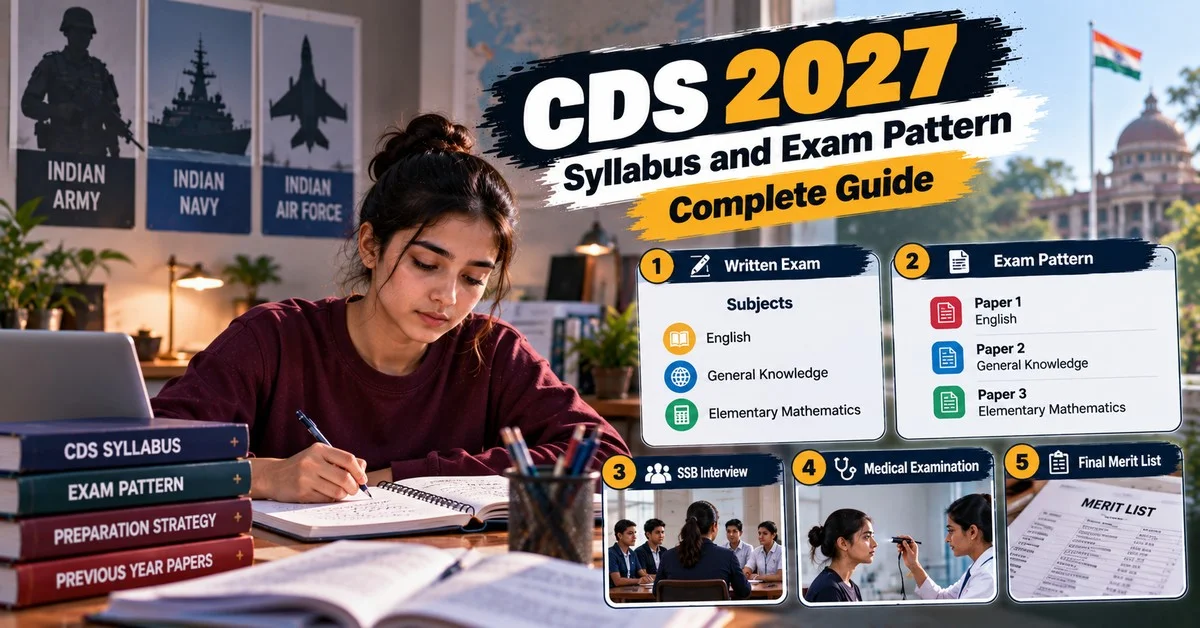
Selection Process After the Written Exam
The selection process continues after the written test:
- Written exam: 300 marks for IMA, INA and AFA; 200 marks for OTA
- SSB interview: A five-day, two-stage process of intelligence, psychology, group and interview tests
- Computerised Pilot Selection System (CPSS): For AFA candidates, conducted at the Air Force Selection Board
- Medical examination: For candidates recommended by the SSB
- Final merit list: Based on written and SSB marks, subject to medical fitness and vacancies
UPSC fixes minimum qualifying marks for the written papers at its discretion. Only candidates who qualify are called for the SSB.
How to Prepare the CDS 2027 Syllabus
Here are practical tips to cover the CDS 2027 Syllabus well:
- Start with NCERT books. Class 6 to 10 NCERT books give a strong base for the CDS Maths syllabus and for History, Geography and Science.
- Read a newspaper daily. It helps with English and current affairs at the same time.
- Practise Maths every day. Focus on arithmetic, algebra and geometry, and work on speed without a calculator.
- Build vocabulary steadily. Learn a few new words, idioms and phrases each day.
- Revise current affairs. Cover at least the last 6 to 12 months before the exam for the CDS GK syllabus.
- Solve previous year papers. They show the type and level of questions asked.
- Take timed mock tests. Practise all papers in the real 2-hour timing and fill OMR sheets.
- Mind the negative marking. Attempt questions you are confident about and skip wild guesses.
CDS Exam Pattern: Common Mistakes to Avoid
- Ignoring English, even though it counts for every academy
- Preparing the CDS Maths syllabus at a very high level instead of focusing on speed at Class 10 level
- Leaving current affairs for the last month
- Guessing too many answers and losing marks to negative marking
- For OTA aspirants, assuming the paper is easy because it has no Maths
FAQs
What is the CDS 2027 Syllabus?
It covers English, General Knowledge and Elementary Mathematics for IMA, INA and AFA. OTA candidates take only English and General Knowledge.
How many questions are there in the CDS exam?
As per the CDS exam pattern, English and GK have 120 questions each, and Elementary Mathematics has 100 questions.
What is the CDS marking scheme?
Each paper carries 100 marks. One-third of the marks for a question are deducted for each wrong answer, and no marks are deducted for questions left blank.
Is Maths included in the OTA exam pattern?
No. OTA candidates appear only for English and General Knowledge, with 200 written marks in total.
What is the level of the CDS Maths syllabus?
Elementary Mathematics is of Class 10 (matriculation) level, while English and GK are of graduate level.
How many marks is the SSB interview in CDS?
The SSB interview carries 300 marks for IMA, INA and AFA, and 200 marks for OTA.
Is the CDS exam available in Hindi?
Yes. The GK and Maths papers are in both Hindi and English. The English paper is only in English.