Agniveer Vayu Phase 2: PFT, Adaptability Tests and Medical Explained
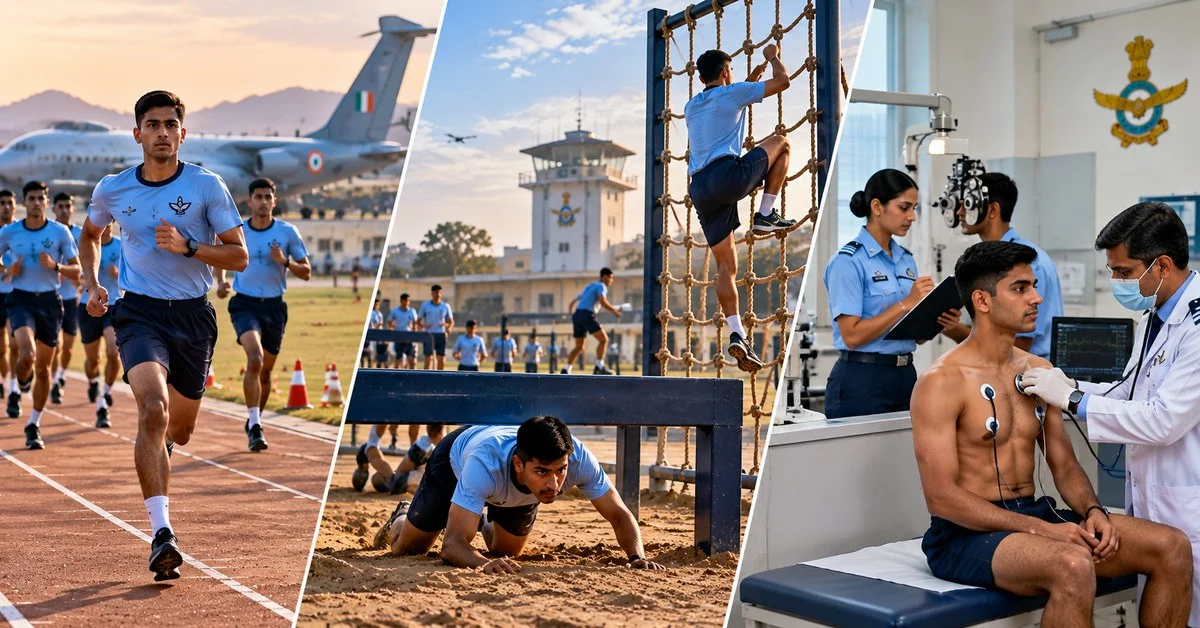
Cleared the online test? Here is your full guide to Agniveer Vayu Phase 2: the documents to carry, PFT standards for male and female candidates, what the adaptability test checks, and the medical standards that decide your selection.
Clearing the online test is a big step, but it does not get you into the Air Force on its own. Candidates can still lose their place if they are not ready for the run, miss a document or are unprepared for the medical checks.
This guide explains Agniveer Vayu Phase 2 step by step: what to carry, the PFT standards, the adaptability test and the Phase 3 medical. All standards are taken from recent official notifications, so match them with the notification for your own intake.
What Is Agniveer Vayu Phase 2?
After the online test, the IAF applies a cut-off to the Phase I marks and shortlists candidates for the next stage. These marks are normalised to balance out differences in paper difficulty, and you must qualify in each paper separately, not just on your total.
Shortlisted candidates get a new admit card through their login on the official portal (agnipathvayu.cdac.in). Agniveer Vayu Phase 2 is held at the Airmen Selection Centre (ASC) given on that admit card. It has three parts:
-
Document verification: Your certificates are checked against your application.
-
Physical Fitness Test (PFT): A timed run followed by strength exercises.
-
Adaptability Test-II: A check of whether you are suited to Air Force life.
Only candidates who clear Phase 2 move on to the medical examination in Phase 3.
Documents to Carry for Agniveer Vayu Phase 2
Missing a document is an easy way to lose your chance. As per the official notification, carry:
-
Admit cards: A colour printout of your phase 2 admit card, plus your original Phase I admit card with the Air Force seal and the invigilator’s signature.
-
Application form: A colour printout of your filled online application.
-
Photographs: Eight unattested passport-size photographs.
-
Certificates: The original and four self-attested photocopies of your Class 10 certificate, and your Class 12 (or diploma or vocational course) certificate and marks sheets.
-
Extra certificates: NCC ‘A’, ‘B’ or ‘C’ certificates and any other additional skill certificates, if you have them.
-
Stationery: HB pencil, eraser, sharpener, glue stick, stapler and a black or blue ball pen.
Keep in mind that internet copies of marks sheets are not accepted. Your original certificates are returned after verification. If you have a permanent tattoo, carry two postcard-size photographs of it as well.
PFT Standards: Run and Exercises
The agniveer vayu PFT is done in two parts. You must pass the run (PFT-I) before you are allowed to attempt the exercises (PFT-II).
PFT-I: 1.6 km run
PFT-II: Exercises (after 10 minutes of rest)
There is a 2-minute break between each exercise. Before the PFT, you must sign a consent form, and candidates under 18 also need a parent or guardian’s signature. The form comes attached to the admit card. Wear sports shoes and shorts or track pants.
How to prepare for the PFT:
-
Train for the run first: The run comes first, and if you fail it you cannot attempt the rest. Build up to running 1.6 km comfortably under your target time, not just on it.
-
Practise in order: Do the run, rest 10 minutes, then do push-ups, sit-ups and squats with short breaks. This copies the real test.
-
Check your form: Reps done with poor form may not be counted. Practise full push-ups and full squats.
Adaptability Test-II: What It Checks
Candidates who pass the PFT take the adaptability test. The official notification describes it simply: it is done “as per policy in vogue” to select candidates who can adapt to the Air Force environment and military way of life.
The IAF does not publish a fixed format, marks or pass criteria for this test. Candidates who have attended describe a short written section and a group discussion, but the exact format can change from one intake to the next. Older notifications also mentioned an Adaptability Test-I, while recent ones refer only to the second test.
You cannot “cram” for this stage. What helps is:
-
Be genuine: Answer honestly about yourself instead of giving rehearsed lines.
-
Speak clearly in a group: If there is a discussion, make your point simply, listen to others and don’t try to dominate.
-
Know why you want to join: Be clear about why you want to serve in the IAF and what you know about life as an Agniveer.
Phase 3: Agniveer Vayu Medical Test
Candidates who clear the adaptability test get a medical appointment letter. The agniveer vayu medical test is conducted by an Air Force medical team at the ASCs. The notification advises candidates to be prepared to stay for four to five days at their own cost.
The medical includes basic investigations such as blood and urine tests, biochemistry, a chest X-ray, an ECG, an ultrasound for female candidates, and any other test the medical officer feels is needed.
Key standards from the 02/2025 notification:
-
Height: Minimum 152.5 cm for men and 152 cm for women. Women from the North East or the hilly areas of Uttarakhand need 147 cm, and women from Lakshadweep need 150 cm.
-
Weight: Must be in proportion to your height and age.
-
Chest: Men need a minimum chest of 77 cm, and both men and women need a minimum expansion of 5 cm.
-
Hearing: You must be able to hear a forced whisper from 6 metres with each ear separately.
-
Dental: Healthy gums and a minimum of 14 dental points.
-
Eyesight: 6/12 in each eye, correctable to 6/6. Colour vision must be CP-II. Candidates who have had PRK or LASIK eye surgery are not accepted.
Tattoos are allowed only on the inner forearm (from the inside of the elbow to the wrist) and on the back of the hand. Offensive or obscene tattoos are not allowed anywhere. Tribal tattoos linked to tribal customs may be considered.
What If You Are Declared Medically Unfit?
You can ask for an appeal medical board. You need to deposit ₹40 through e-MRO or MRO and submit your application, the original receipt and a photocopy of your unfitness certificate to the ASC within three working days of your medical.
The appeal board’s decision is final, with no further review, so if you know of a small fixable issue, such as earwax or a dental problem, get it checked by a doctor well before your medical date.
Final Merit and Enrolment
Candidates who clear all three phases are placed in a merit-wise provisional select list, which is displayed at the ASCs and on the official portal. Being on this list does not guarantee enrolment.
Final enrolment happens strictly in order of merit, depending on vacancies, medical fitness and eligibility. Selected candidates receive an e-call letter by email. This is why your Phase I score keeps mattering until the very end.
FAQs
What is the running time for the Agniveer Vayu PFT?
Male candidates must complete the 1.6 km run within 7 minutes, and female candidates within 8 minutes. You must pass the run before attempting the push-ups, sit-ups and squats.
What happens in the Agniveer Vayu adaptability test?
It checks whether you are suited to Air Force life and the military way of life. The IAF does not publish a fixed format, so be honest, clear and genuine rather than giving rehearsed answers.
Where is the Agniveer Vayu medical held?
It is held at the ASCs by an Air Force medical team. Be ready to stay for four to five days at your own cost.
Can I appeal if I am declared medically unfit?
Yes. You can apply for an appeal medical by depositing ₹40 and submitting the required papers within three working days. The appeal board’s decision is final.